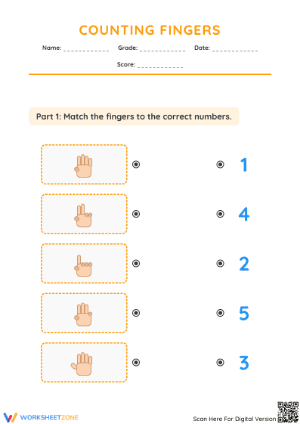
These numbers 0-10 worksheets give kindergarten and preschool teachers a ready-made set of targeted practice activities that move students from rote recitation toward genuine number sense. Each worksheet isolates a specific skill — tracing, counting sets of objects, sequencing, matching numerals to quantities — so teachers can assign them precisely rather than handing over a general packet and hoping for coverage.
What Each Worksheet Builds
The set addresses the skills that actually trip up young learners, not just the ones that look good in a scope and sequence. Number formation comes first: students trace each numeral 0 through 10 using directional prompts that teach correct stroke order. This matters more than it sounds — children who skip formation practice often develop habits that interfere with speed and legibility in later grades, and 6/9 reversals are far more common in students who learned numerals purely by imitation rather than guided tracing.
Counting worksheets ask students to mark each object as they go, building one-to-one correspondence rather than letting them sweep-count visually and guess. Separate activities cover cardinality — students count a group of objects and circle the numeral that names the total, reinforcing that the last number spoken represents the whole set, not just the final object touched. Sequencing worksheets present a number line with missing values and ask students to fill in the gaps, which builds the ordinal understanding prerequisite to addition. Matching worksheets pair a numeral with a pictured quantity; students draw a connecting line, then verify by counting the images again.
Standard Alignment
These worksheets align with Common Core State Standards K.CC.A.3, which requires students to write numbers from 0 to 20 and represent a number of objects with a written numeral 0-20. The tracing and formation worksheets directly address the writing portion of this standard. K.CC.B.4 — understanding the relationship between numbers and quantities, including the cardinality principle — is covered through the counting and matching worksheets. K.CC.B.5, which asks students to count to answer "how many?" questions about arranged or scattered objects up to 20, is addressed by the varied counting layouts across the set. For pre-K programs using state-level early learning standards rather than Common Core, the counting, formation, and correspondence skills in this set map cleanly to the numeracy benchmarks in most state frameworks for children ages 3-5.
Why This Format Works for This Age Group
Early childhood math instruction sits at an awkward intersection: children at this stage need physical, manipulative-based learning, but they also need repeated exposure to abstract symbols so those symbols become automatic. Worksheets occupy a middle position in that progression. They are not manipulatives, but a well-designed tracing or counting worksheet asks students to do something physical — press a pencil, draw a line, mark each object — that keeps engagement higher than passive observation.
Cognitive load is the real constraint at this level. When a kindergartner is still working to remember what the numeral 7 looks like, asking them simultaneously to count objects, write the answer, and compare it to another set overloads working memory and produces errors that don't reflect understanding. The worksheets in this set keep each activity focused on one skill at a time, which is a deliberate design choice rooted in how young learners consolidate new information.
Fitting These Worksheets Into Your Week
The most reliable use pattern is morning work during the first two to three weeks of a new number unit. Students arrive at different times, settle unpredictably, and need something they can start without instructions — a tracing or simple counting worksheet handles that window well. Because the content is familiar by design, hesitant students get a confidence-building win before the whole-group lesson even begins.
During math centers, pair one worksheet with a small bin of counters. A student tracing the numeral 8 on the worksheet then places eight cubes on the desk and points to each — the paper anchors the abstract symbol while the physical objects carry the quantity. This combination consistently produces better retention than either activity alone. For small-group pull-out instruction, the sequencing and matching worksheets work well as a shared task: two students work through the same worksheet together, which generates the kind of low-stakes verbal math talk ("no, that goes between 6 and 8") that benefits both partners. Friday review blocks are a natural fit for the comparison activities and number line fill-ins, which compress several skills into a single short worksheet that doubles as an informal formative check.
Frequent Student Errors Worth Watching For
The most consistent error pattern in number formation is directionality on 5 and 2. Students who can identify both numerals reliably will still begin the stroke at the bottom rather than the top, producing mirror images that are technically legible but indicate the student is drawing from memory rather than following internalized stroke sequence. Watch for this on the first tracing worksheet for each number — not just the last one, where repetition may mask the problem.
On counting worksheets, the sweep-count habit surfaces quickly: students visually scan a group of five objects, recognize it looks like five, and circle the numeral without actually pointing to each item. The worksheets prompt sequential marking, but some students skip that step. A quick classroom norm — "touch every picture before you circle your answer" — catches this before it calculates a child as fluent when they are actually pattern-matching.
Zero causes its own confusion. Students who have counted zero objects before will still hesitate when asked to write 0 next to an empty box, because the idea of writing a number to represent nothing feels contradictory. Expect to address this explicitly rather than assuming the worksheet alone will resolve it.
Adjusting the Worksheets Across Ability Levels
For students who are still building pencil control, the tracing worksheets with larger numerals and heavier dotted paths are the right starting point. Reduce the range to 0-5 until formation is consistent — asking a student who cannot yet reliably write 3 to practice the full 0-10 range in a single session spreads practice too thin to produce retention. Slide the worksheets into a dry-erase pocket so the student can wipe and repeat the same worksheet multiple times without burning through paper; this also lowers the stakes, which helps students who tense up around mistakes made in pencil.
For students who arrive already writing numbers correctly, the tracing activities hold little value. Move them directly to the sequencing, cardinality, and comparison worksheets. You can extend any counting worksheet by asking the student to write the number that comes before and after the answer, or to draw one more or one fewer object than the pictured group. Students ready for a larger challenge can write the number word alongside the numeral — "seven" next to 7 — which builds early literacy skills without needing a separate worksheet set.
Frequently Asked Questions
These say kindergarten — can they be used in preschool or first grade?
Yes. The formation and basic counting worksheets work well for preschoolers in the second half of the year when they are beginning formal number exposure. First-grade teachers use them at the start of the year for students who need to solidify foundational skills before the class moves into addition and subtraction — they are low-pressure review that doesn't feel remedial to a six-year-old.
Do these worksheets require any prep beyond printing?
No prep is required. For repeated use, slide them into dry-erase pockets and keep a small bin of dry-erase markers at the station; students complete the worksheet, show the teacher, and wipe it clean. This works especially well for the tracing worksheets, where repetition on the same numeral is the whole point.
How many worksheets should I assign per number before moving on?
That depends on the student, but a useful rule of thumb is to watch for automaticity rather than counting completions. If a student pauses to think about stroke direction on 4 or hesitates before writing 7, they need more formation practice regardless of how many worksheets they have finished. If they form the numeral fluidly without reference to the model, they are ready to move on to the counting and cardinality activities for that number.
















 Interactive Worksheet Maker
 Quiz Maker
 Word Search Maker
 Crossword Puzzle Maker
 Word Scramble Generator
 Sentence Scramble Generator
 Handwriting Worksheet Generator
 Name Tracing Generator
 Fill In The Blank Generator