What Real Number System Worksheets Cover in Grade 8
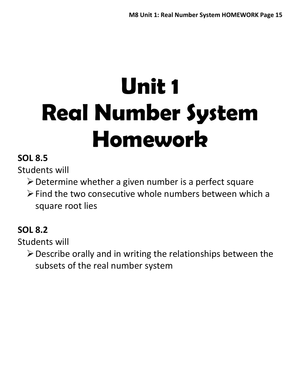
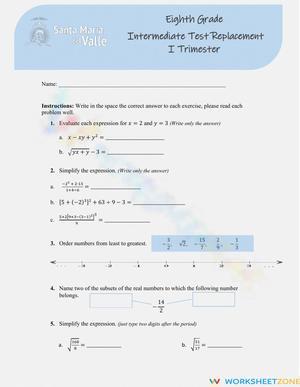
Real number system worksheets give grade 8 students structured practice with two connected skills: sorting numbers into the nested subsets of the real numbers, and comparing or locating rational and irrational values on a number line. Most sets move from quick classification tasks toward more demanding estimation problems, so you can match a sheet to where a class or small group actually is. In a pre-algebra sequence this unit usually lands before students work with radicals and irrational constants, so clean practice here pays off in high school algebra.
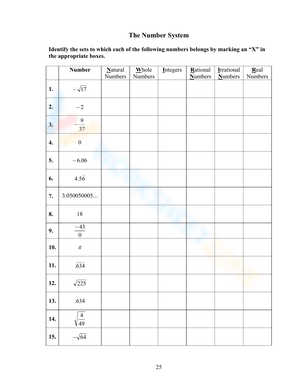
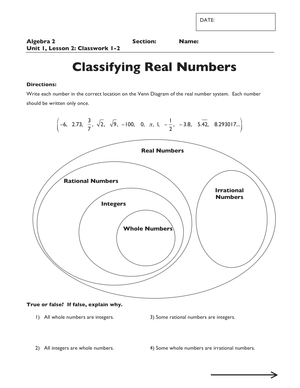
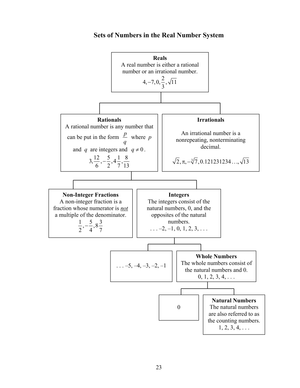
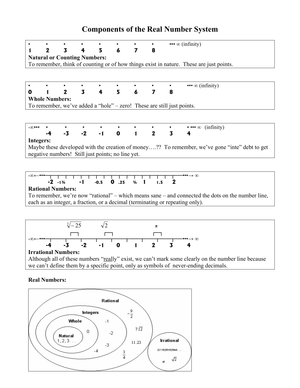
The system is built as nested subsets. Natural numbers sit inside whole numbers, which sit inside integers, which sit inside rational numbers. Irrational numbers form a separate, non-overlapping group, and together the rationals and irrationals make up the real numbers. A worksheet that keeps this hierarchy visible, rather than listing five flat categories, helps students reason about why 7 counts as natural, whole, integer, and rational all at once, while the square root of 2 belongs only to the irrationals.
Because the topic sits at the boundary between arithmetic and algebra, the best worksheet sets do more than ask for labels. They mix number formats on purpose: fractions, decimals, square roots, and familiar constants all appear side by side, so students cannot rely on surface cues like a fraction bar or a radical sign to guess a category. That variety is what turns a sorting task into genuine reasoning about the structure of the real numbers.
How to Sequence a Real Number System Unit
A dependable order keeps the unit from turning into a memory test. Start with classification, where students name the subsets a number belongs to, and only then move to placement and estimation on a number line. When students can already justify why a value is rational, the jump to approximating an irrational number feels like an extension rather than a brand-new topic.
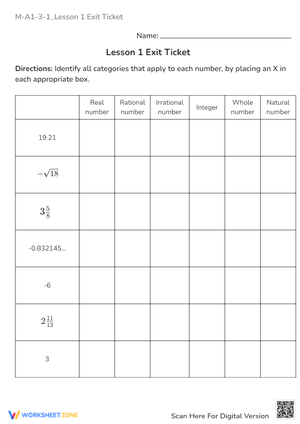
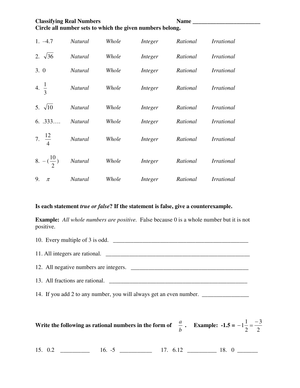
- Open with sorting: give a mixed set of numbers and have students label each as natural, whole, integer, rational, or irrational.
- Add decimal expansion work so students see that rational numbers terminate or repeat, while irrationals do neither.
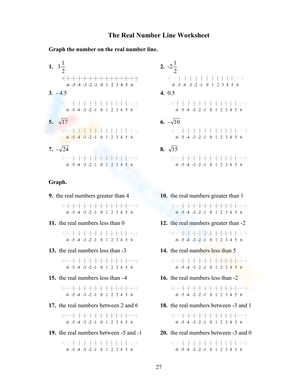
- Introduce the number line, first with rationals, then with irrational values that need estimation.
- Close with mixed problems that combine classification and placement in a single task.
What the Standards Ask Students to Do
According to the Common Core State Standards Initiative, standard 8.NS.A.1 asks students to know that numbers which are not rational are called irrational and to understand that every number has a decimal expansion, with rational numbers producing repeating decimals; 8.NS.A.2 then has them use rational approximations to locate irrational numbers on a number line and estimate their size.
Khan Academy's grade 8 number system materials and lesson breakdowns on BetterLesson map to the same two expectations, so you can pull practice items that reinforce classification and estimation without drifting off standard.
Placing Irrational Numbers on a Number Line
The number line is where the real number system stops being a vocabulary list and starts being math students can reason about. The core move is successive approximation: bound an irrational value between two whole numbers, then tighten that range one decimal place at a time.
Take the square root of 2 as the anchor example. Students first show it falls between 1 and 2, because 1 squared is 1 and 2 squared is 4. Then they test tenths and find it sits between 1.4 and 1.5, since 1.4 squared is 1.96 and 1.5 squared is 2.25. One more round narrows it between 1.41 and 1.42. That repeated squaring is the exact reasoning 8.NS.A.2 expects, and it doubles as a preview of how calculators approximate radicals to many decimal places.
Worksheets that ask for this bounding process, rather than a single rounded answer, give you a clear window into student thinking and an easy place to spot who is guessing.
Common Misconceptions to Watch For
A few predictable errors show up every year. Building worksheet items that target them directly saves reteaching time later.
- Assuming every square root is irrational. The square root of 9 is 3, a rational number, so include perfect squares on purpose.
- Believing negative numbers cannot be rational. Values like negative 4 and negative three-fifths are rational, and worksheets should mix in negatives.
- Treating any decimal as irrational. A repeating or terminating decimal is rational; only non-repeating, non-terminating decimals are irrational.
- Forgetting that a single number lives in several subsets at once, such as 0 being whole, integer, and rational.
- Thinking irrational numbers are not real numbers. Irrational values like pi are still part of the real number system, just outside the rational subset.
Classroom Implementation
The same worksheet library can drive very different lessons depending on grouping. For whole-class instruction, project a sorting sheet and work the first few numbers together, thinking aloud about each subset before releasing students to finish independently. The shared vocabulary you build in those first minutes carries through the rest of the unit.
For small-group intervention, hand out scaffolded sheets that isolate one skill at a time. A group still shaky on decimal expansion works only on terminating versus repeating decimals, with no estimation added yet. Students ready for more get enrichment tasks that combine classification and number-line placement in the same problem, or that push into estimating expressions like pi squared.
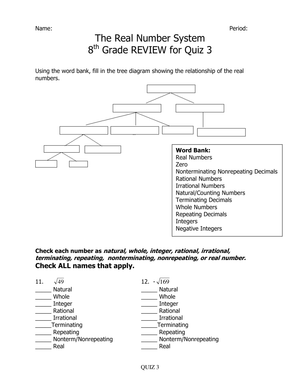
Pair the print practice with two visuals. A hierarchy chart or Venn diagram makes the nested subsets concrete for visual learners, and a shared number line, on paper or a wall strip, gives students a spot to physically place rational and irrational values as they estimate.
Keep two kinds of checks in rotation. Quick classification exit tickets, where students sort five or six numbers into subsets, tell you fast whether the vocabulary has landed. Deeper tasks, where students approximate an irrational number and defend its spot on a number line, show whether the reasoning behind 8.NS.A.2 is solid. Both checks take only a few minutes, so you can run them without giving up instructional time.
Connecting Worksheets to Later Math Standards
The work students do here is a foundation, not a stand-alone topic. The classification vocabulary and the estimation habits from a grade 8 real number system unit carry directly into high school algebra, where students operate with radicals, rational exponents, and irrational constants. A student who can already bound the square root of 2 between 1.4 and 1.5 is better prepared to simplify radical expressions and reason about whether a result is rational or irrational.
Keeping that arc in view changes how you grade. When a student mislabels a repeating decimal as irrational, it is worth a quick conference now, because the same misunderstanding will resurface the first time they meet a rational exponent. Worksheets that force clear justification, not just an answer, make those conversations easy to start.
Frequently Asked Questions
1. What grade level covers the real number system?
The real number system is a grade 8 pre-algebra topic tied to the 8.NS standards. Students classify numbers into subsets and estimate irrational values before high school work with radicals and irrational constants.
2. What is the difference between rational and irrational numbers?
A rational number can be written as a fraction of two integers, and its decimal either terminates or repeats. An irrational number, like the square root of 2, has a decimal that never terminates and never repeats.
3. How can teachers use these worksheets for small-group intervention?
Use scaffolded sheets that isolate one skill for groups who need support, such as decimal expansion alone, and reserve combined classification-and-estimation tasks as enrichment for students who are ready to stretch.
4. What visuals pair well with real number system worksheets?
Hierarchy charts and Venn diagrams make the nested subsets visible, while a classroom number line gives students a place to estimate and position rational and irrational numbers as they work.