




























0
Views
0
Downloads

0.0
0
Save
0 Likes
Share
Odd and Even Numbers: Identifying Math Basics
0 Views
0 Downloads

Paste this activity's link or code into your existing LMS (Google Classroom, Canvas, Teams, Schoology, Moodle, etc.).
Students can open and work on the activity right away, with no student login required.
You'll still be able to track student progress and results from your teacher account.
Information
Description
What It Is:
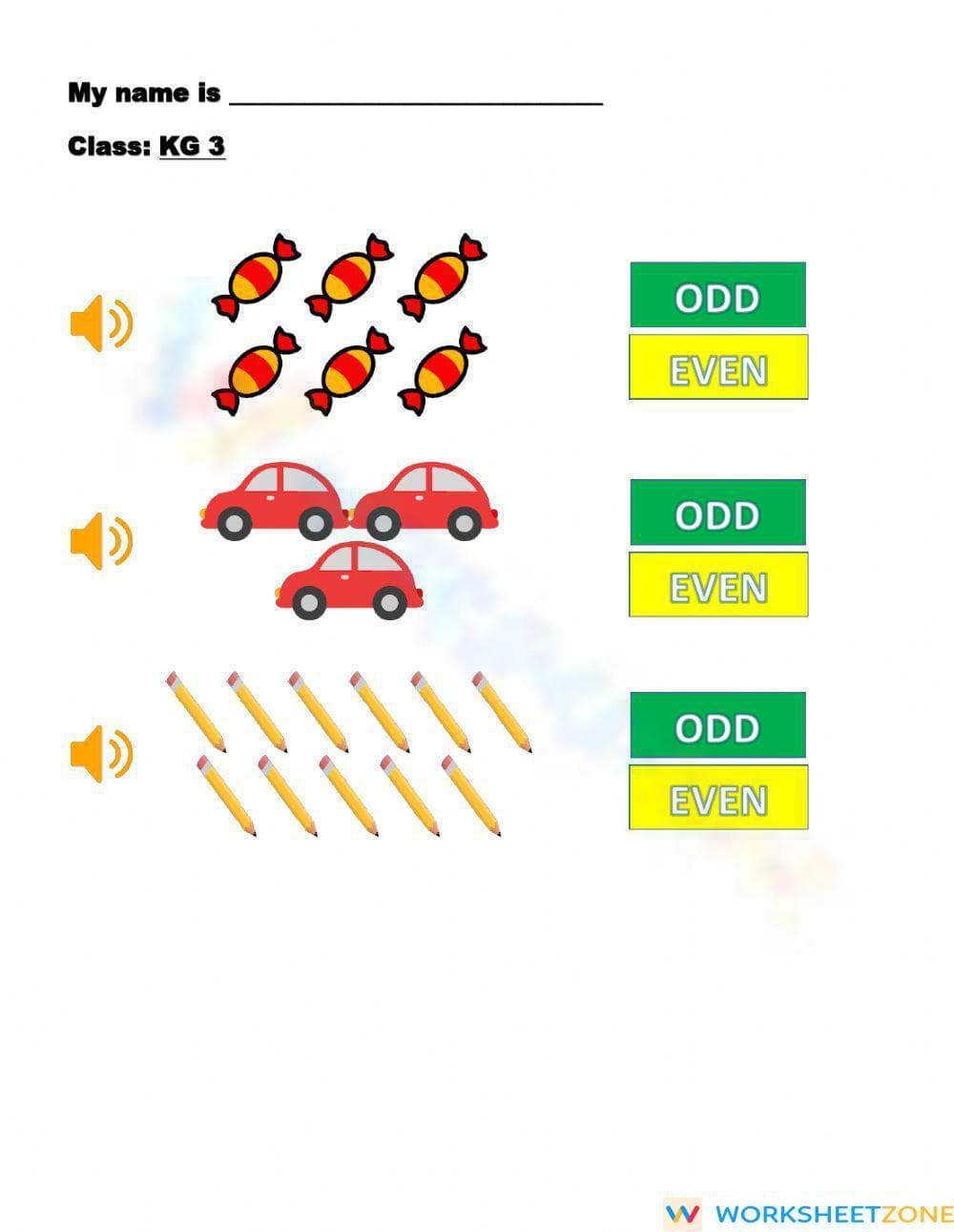
This is a math worksheet designed to help young children practice identifying odd and even numbers. The worksheet features three sections, each displaying a different set of objects: candies, cars, and pencils. Each set of objects is paired with a selection box containing 'ODD' and 'EVEN' options for the child to choose from. The worksheet also includes a space at the top for the student's name and class (KG 3).
Grade Level Suitability:
This worksheet is most suitable for Kindergarten (KG) and possibly early first grade. The concepts of odd and even numbers are introduced at this level, and the use of visual aids like candies, cars, and pencils makes it accessible for young learners. The simple layout and clear instructions also contribute to its suitability for this age group.
Why Use It:
This worksheet helps children develop their understanding of odd and even numbers through visual representation. By counting the objects and determining whether the quantity is odd or even, students reinforce their counting skills and build a foundation for more advanced math concepts. It also improves their visual discrimination skills.
How to Use It:
The student should first count the number of objects in each set (candies, cars, and pencils). Then, based on whether the total number is odd or even, they should select or mark the corresponding 'ODD' or 'EVEN' option next to each set. For example, if there are 7 candies, they should mark 'ODD.'
Target Users:
The target users for this worksheet are kindergarten students (KG 3 as indicated) and early first-grade students who are learning about odd and even numbers. Teachers can use it as a classroom activity or homework assignment. Parents can also use it as a supplemental learning tool at home.
This is a math worksheet designed to help young children practice identifying odd and even numbers. The worksheet features three sections, each displaying a different set of objects: candies, cars, and pencils. Each set of objects is paired with a selection box containing 'ODD' and 'EVEN' options for the child to choose from. The worksheet also includes a space at the top for the student's name and class (KG 3).
Grade Level Suitability:
This worksheet is most suitable for Kindergarten (KG) and possibly early first grade. The concepts of odd and even numbers are introduced at this level, and the use of visual aids like candies, cars, and pencils makes it accessible for young learners. The simple layout and clear instructions also contribute to its suitability for this age group.
Why Use It:
This worksheet helps children develop their understanding of odd and even numbers through visual representation. By counting the objects and determining whether the quantity is odd or even, students reinforce their counting skills and build a foundation for more advanced math concepts. It also improves their visual discrimination skills.
How to Use It:
The student should first count the number of objects in each set (candies, cars, and pencils). Then, based on whether the total number is odd or even, they should select or mark the corresponding 'ODD' or 'EVEN' option next to each set. For example, if there are 7 candies, they should mark 'ODD.'
Target Users:
The target users for this worksheet are kindergarten students (KG 3 as indicated) and early first-grade students who are learning about odd and even numbers. Teachers can use it as a classroom activity or homework assignment. Parents can also use it as a supplemental learning tool at home.


