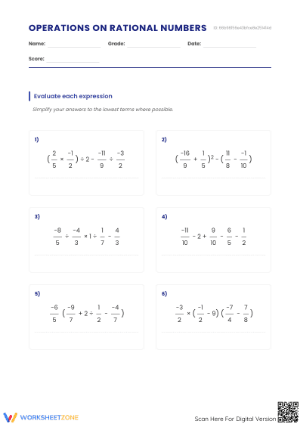
These integers and rational numbers worksheets give grades 6 and 7 teachers a targeted set of printable practice materials covering every major skill in the number system unit — classification, number line work, all four operations, and word problems grounded in real contexts. The set is organized so teachers can pull individual worksheets for a single skill or combine several for a review block without doing any assembly work.
The Specific Skills Targeted
Each worksheet addresses a distinct slice of the number system standards. Classification and sorting worksheets present a mixed list of whole numbers, negative integers, fractions, and terminating or repeating decimals and ask students to categorize each one. The Venn diagram format used in several of these worksheets makes the subset relationship visible — integers nested inside the larger set of rational numbers — which is exactly the representation students need before they can reason about it abstractly.
Number line worksheets range from straightforward integer placement to exercises that put negative fractions and decimals on the same line and ask students to compare them. Operations worksheets are separated by skill: addition, subtraction, multiplication, and division each get their own worksheet, which lets teachers target a specific gap rather than assigning a general review. Word problem worksheets use temperature change, elevation, and account balance scenarios — contexts where negative rational numbers appear naturally and students can reason about whether an answer is sensible.
Mixed review worksheets fold classification, number line, and operations tasks together on one worksheet. These work well in the two or three weeks before a unit assessment, when the goal is keeping earlier skills activated rather than introducing new material.
Standard Alignment
The classification and number line worksheets address 6.NS.C, which covers understanding of rational numbers, absolute value, and coordinate plane plotting. This standard cluster asks students to recognize integers as a subset of rational numbers and use that understanding to order and compare values — exactly what the sorting and number line exercises practice. The operations worksheets address 7.NS.A, the Grade 7 cluster that extends number system knowledge to addition, subtraction, multiplication, and division of rational numbers, including negative fractions and decimals. Because the two clusters build directly on each other, teachers working with mixed-readiness classrooms will find that the Grade 6 worksheets serve as review and scaffolding for students who need it, while the Grade 7 operations sheets push students who are ready to move forward.
Frequent Student Errors Worth Watching For
The error that surfaces most reliably in 6th grade is treating "rational number" as a synonym for "fraction with a visible numerator and denominator." Students who hold this definition will correctly identify 3/4 and −7/2 as rational but hesitate on 0.75, mark −5 as not rational, and leave 0 in a separate mental category entirely. A student who has just graphed −2 on a number line without difficulty will sometimes exclude it from a rational numbers sorting task because it "doesn't look like a fraction." That gap — between procedural comfort and conceptual understanding — is exactly what the classification worksheets are built to expose.
A second pattern appears specifically with negative fractions: students treat −3/4 as though the negative sign only applies to the numerator, leading them to compare it incorrectly on a number line. The correction is usually fast once a teacher marks a worked example, but it has to be caught. Watch the ordering problems on the number line worksheets for this error; it shows up in roughly a third of papers the first time students see negative fractions plotted alongside positive ones.
Operations practice surfaces a different set of errors. Subtraction of a negative integer — for example, 4 − (−3) — causes persistent confusion even for students who handle addition of negatives correctly. Students who have memorized "two negatives make a positive" without understanding why will apply it inconsistently, sometimes turning the subtraction into multiplication in their heads. The scaffolded operations worksheets walk through each step explicitly before moving to independent practice, which reduces but does not eliminate this error; plan to revisit it during the mixed review phase.
How to Build These Worksheets Into Your Lesson Plans
The classification worksheets work best as opening activities at the start of a unit, before any formal instruction on operations. Giving students a sorting task on day one surfaces what they already know — or think they know — about integers and rational numbers, and the whole-class discussion that follows the sort does more diagnostic work than a pre-test could in the same amount of time.
Operations worksheets follow the pattern of gradual release well. Work through two or three problems from an addition or subtraction worksheet together, annotating a projected copy for the class, then hand students the same worksheet to finish independently or in pairs. The structure is already there; the teacher-led portion just primes the thinking before students work alone.
Station rotations using four different worksheet types — classification, number line, operations, word problems — run cleanly in a 45-minute period with groups rotating every 10 to 12 minutes. The variety across stations keeps engagement higher than a single worksheet format sustains across the full period, and teachers can observe each station briefly during the rotation to catch procedural errors before they calcify.
Mixed review worksheets are useful in a specific 8-minute window: the end of class, after instruction is done and before the period transitions. Pulling three or four problems from a mixed review worksheet as a daily exit check gives a running picture of which students have internalized classification and which are still shaky on operations — without requiring separate quiz time.
Frequently Asked Questions
What is the difference between integers and rational numbers?
Integers are the counting numbers, their negatives, and zero: …−2, −1, 0, 1, 2… Rational numbers are any values expressible as a ratio p/q where p and q are integers and q ≠ 0. That definition covers integers (since any integer n equals n/1), all fractions, and any decimal that terminates or repeats. The two sets are related by containment: every integer is a rational number, but rational numbers also include values like 1/2 and 0.333… that are not integers.
Are these worksheets appropriate for both 6th and 7th grade?
Yes. The classification and number line worksheets align to Grade 6 Number System standards and work as core practice in a 6th grade unit or as review at the start of 7th grade. The operations worksheets — particularly those covering multiplication and division of rational numbers — align to Grade 7 Number System standards. The mixed review worksheets span both grade levels, making them useful at the boundary between years or for 7th graders who need to revisit Grade 6 concepts.
How do I sequence these worksheets across a unit?
Start with classification. Students need to know what integers and rational numbers are before they operate with them. Move to number line worksheets next, since ordering and comparing values builds the spatial intuition that makes operations more meaningful. Introduce operations worksheets one skill at a time — addition before subtraction, since adding negative integers is slightly more intuitive — and save the word problem worksheets for after students have basic procedural fluency. Mixed review worksheets belong at the end of the unit and during any spiral review built into later weeks.
Do the worksheets include answer keys?
Each worksheet in this set comes with a corresponding answer key. For operations worksheets, the key shows intermediate steps rather than just final answers, which makes it easier to identify where a student's work diverged from the correct process.
















 Interactive Worksheet Maker
 Quiz Maker
 Word Search Maker
 Crossword Puzzle Maker
 Word Scramble Generator
 Sentence Scramble Generator
 Handwriting Worksheet Generator
 Name Tracing Generator
 Fill In The Blank Generator