


























Views
Downloads

Printable Even or Odd Christmas Tree Worksheet | Grade 2
Paste this activity's link or code into your existing LMS (Google Classroom, Canvas, Teams, Schoology, Moodle, etc.).
Students can open and work on the activity right away, with no student login required.
You'll still be able to track student progress and results from your teacher account.
Mastering even and odd numbers becomes a festive celebration with this Christmas tree math worksheet. Students practice identifying parity by coloring ornaments, sorting numerical values, and creating their own examples. This activity ensures learners understand the rule of ending digits while enjoying a holiday-themed instructional experience that builds foundational number sense.
At a Glance
- Grade: 2 · Subject: Math
- Standard:
CCSS.MATH.CONTENT.2.OA.C.3— Determine whether a group of objects has an odd or even number of members- Skill Focus: Even and Odd Number Identification
- Format: 2 pages · 30 problems · Answer key included · PDF
- Best For: Holiday-themed independent practice or morning work
- Time: 15–20 minutes
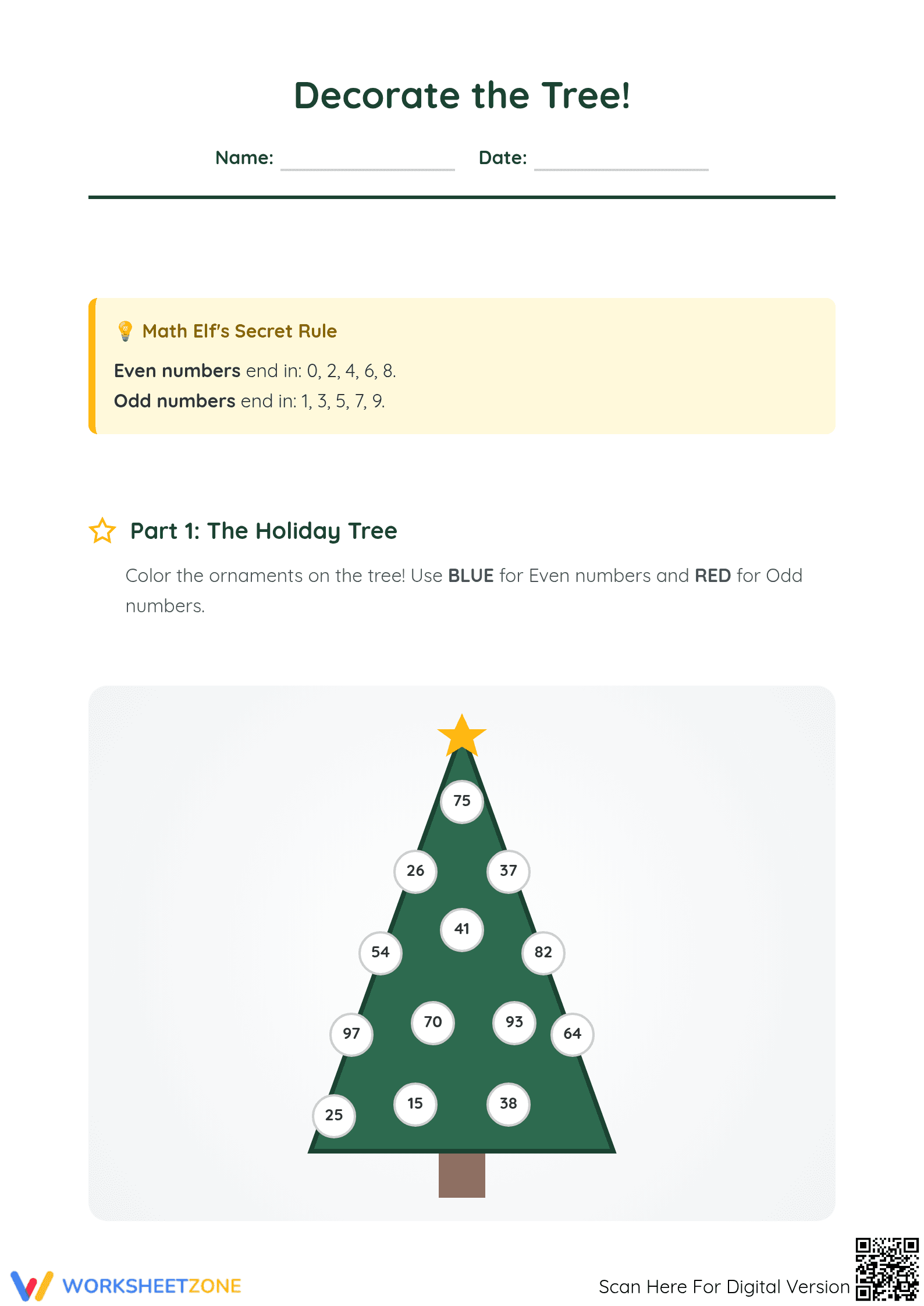
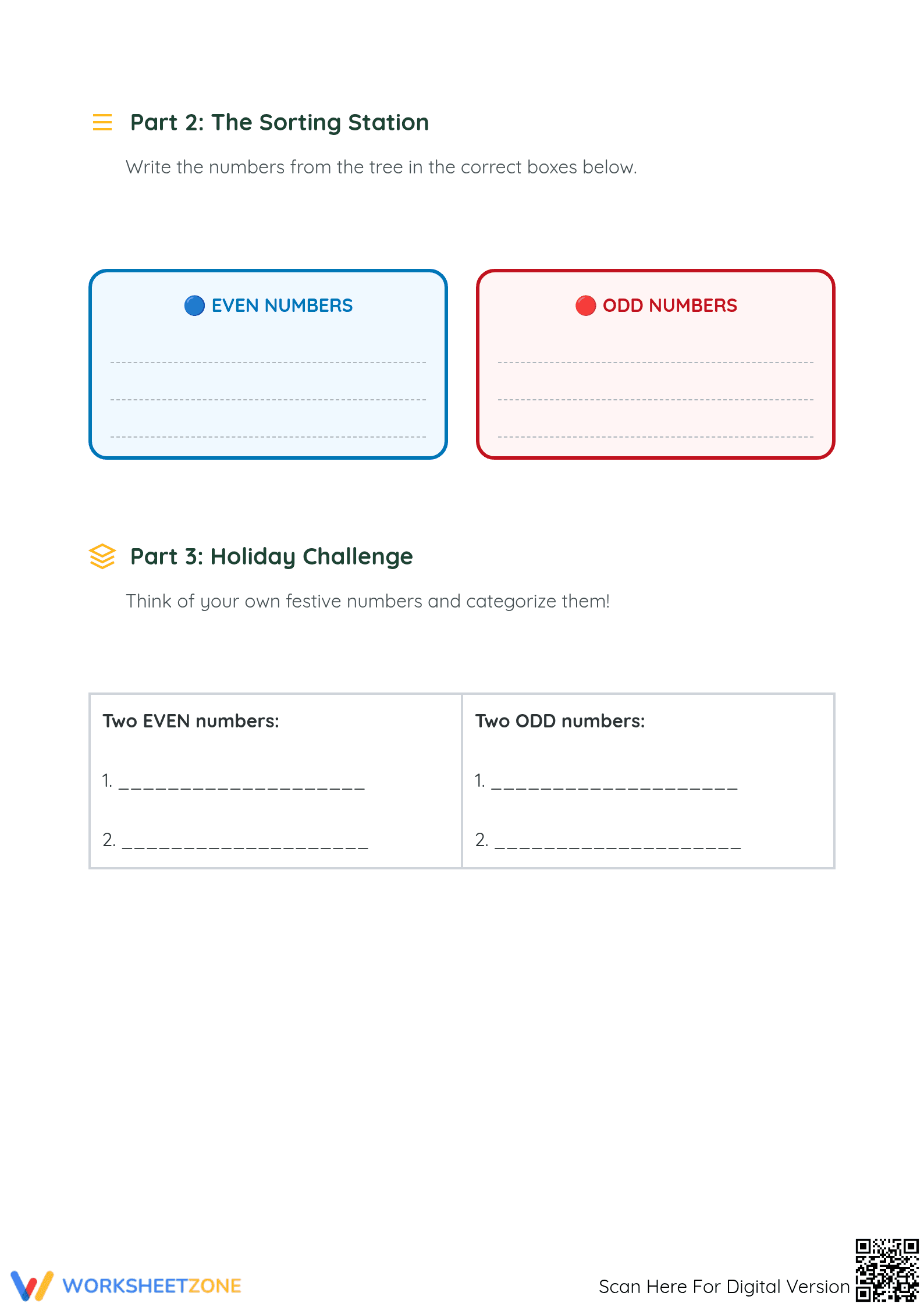
The package contains two comprehensive pages designed for immediate classroom application. Page one features a large Christmas tree with 13 numbered ornaments ranging from 15 to 97 for coloring based on parity rules. The second page includes a Sorting Station for organizational practice and a Holiday Challenge where students generate original even and odd numbers. A full answer key is provided.
Zero-Prep Workflow
Implementing this resource takes less than two minutes of teacher preparation. First, print the two-page PDF (30 seconds). Second, distribute the sheets along with red and blue crayons to your students (60 seconds). Finally, review the completed Math Elf's Secret Rule as a whole-group check or using the included key. Its self-explanatory nature makes it an ideal candidate for emergency sub plans or quiet transitions.
Standards Alignment
This resource aligns directly with `CCSS.MATH.CONTENT.2.OA.C.3`, which requires students to determine if a number is even or odd by looking at its digits or pairing objects. It specifically supports the development of algebraic thinking by reinforcing patterns in the base-ten system. This standard code can be copied directly into lesson plans, IEP goals, or district curriculum mapping tools.
How to Use It
Use this worksheet during the independent practice phase of a lesson on parity. It serves as an excellent formative assessment tool; observe if students correctly apply the ending-digit rule (0, 2, 4, 6, 8 for even) during the coloring phase. Expect completion in 15 to 20 minutes, making it perfect for a math center or a festive morning activity.
Who It's For
The activity is tailored for Grade 2 students but provides valuable reinforcement for Grade 3 learners struggling with number patterns. It includes visual scaffolds, such as the Secret Rule box, to support English Language Learners and students with IEP accommodations. Pair this with a holiday-themed number line or an interactive 100-chart for a comprehensive learning experience.
According to the RAND AIRS 2024 report on instructional materials, thematic integration in early elementary math significantly increases student engagement and retention of abstract concepts like parity. This Grade 2 worksheet specifically addresses CCSS.MATH.CONTENT.2.OA.C.3 by requiring students to classify numbers based on the even-or-odd digit rule. Moving from visual coloring to abstract sorting and finally to independent number generation, the resource follows the gradual release of responsibility model. Research indicates that students who master these foundational number patterns early show higher proficiency in later multiplication and division units. This activity provides the structured repetition necessary for long-term mastery while maintaining high interest through seasonal themes. The inclusion of an explicit rule box serves as a permanent visual anchor, reducing cognitive load for diverse learners as they move through the 30 discrete tasks provided across the two-page spread.


