


























Views
Downloads

Printable Odd or Even Numbers Worksheet | Grade 3-5 Math
Paste this activity's link or code into your existing LMS (Google Classroom, Canvas, Teams, Schoology, Moodle, etc.).
Students can open and work on the activity right away, with no student login required.
You'll still be able to track student progress and results from your teacher account.
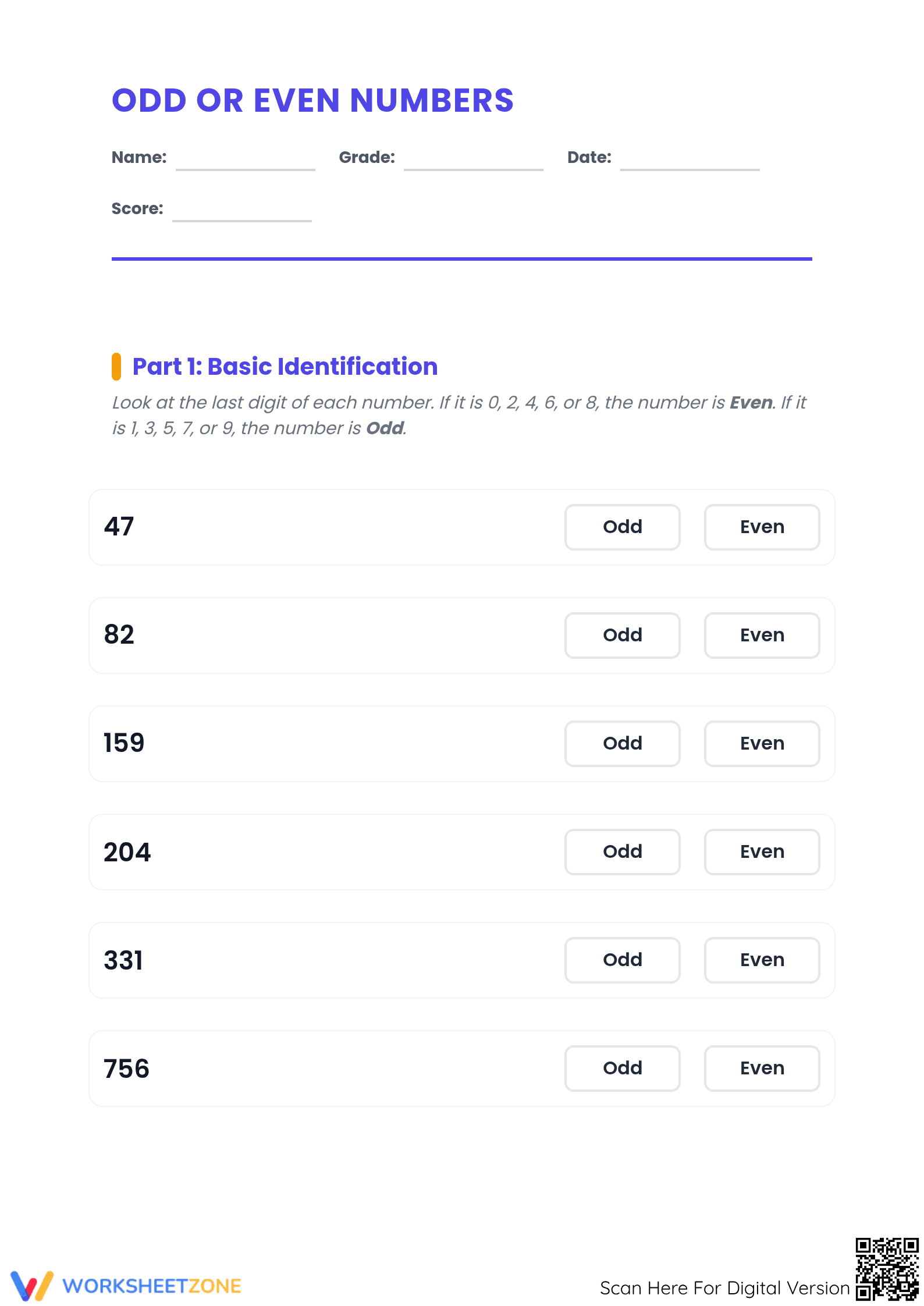
This comprehensive 5-page worksheet provides a robust framework for students to master the concept of odd and even numbers. By progressing from basic identification to complex operational patterns and logical word problems, learners develop a deep conceptual understanding of number parity that serves as a foundation for advanced algebraic thinking and pattern recognition.
At a Glance
- Grade: 3–5 · Subject: Math
- Standard:
3.OA.D.9— Identify arithmetic patterns and explain them using properties of operations- Skill Focus: Number Parity & Operational Patterns
- Format: 5 pages · 33 problems · Answer key included · PDF
- Best For: Core instruction, math centers, or independent review
- Time: 30–45 minutes
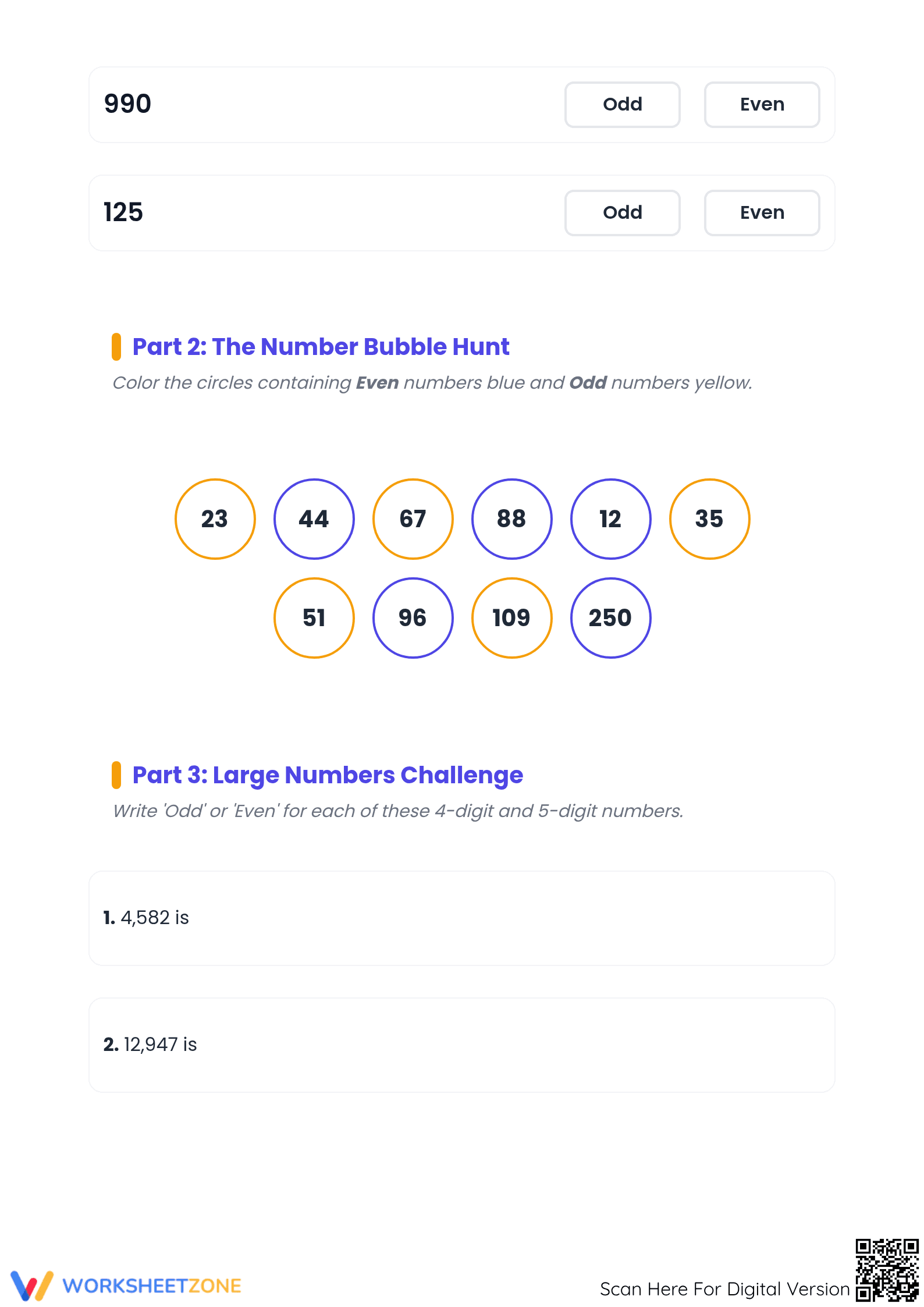
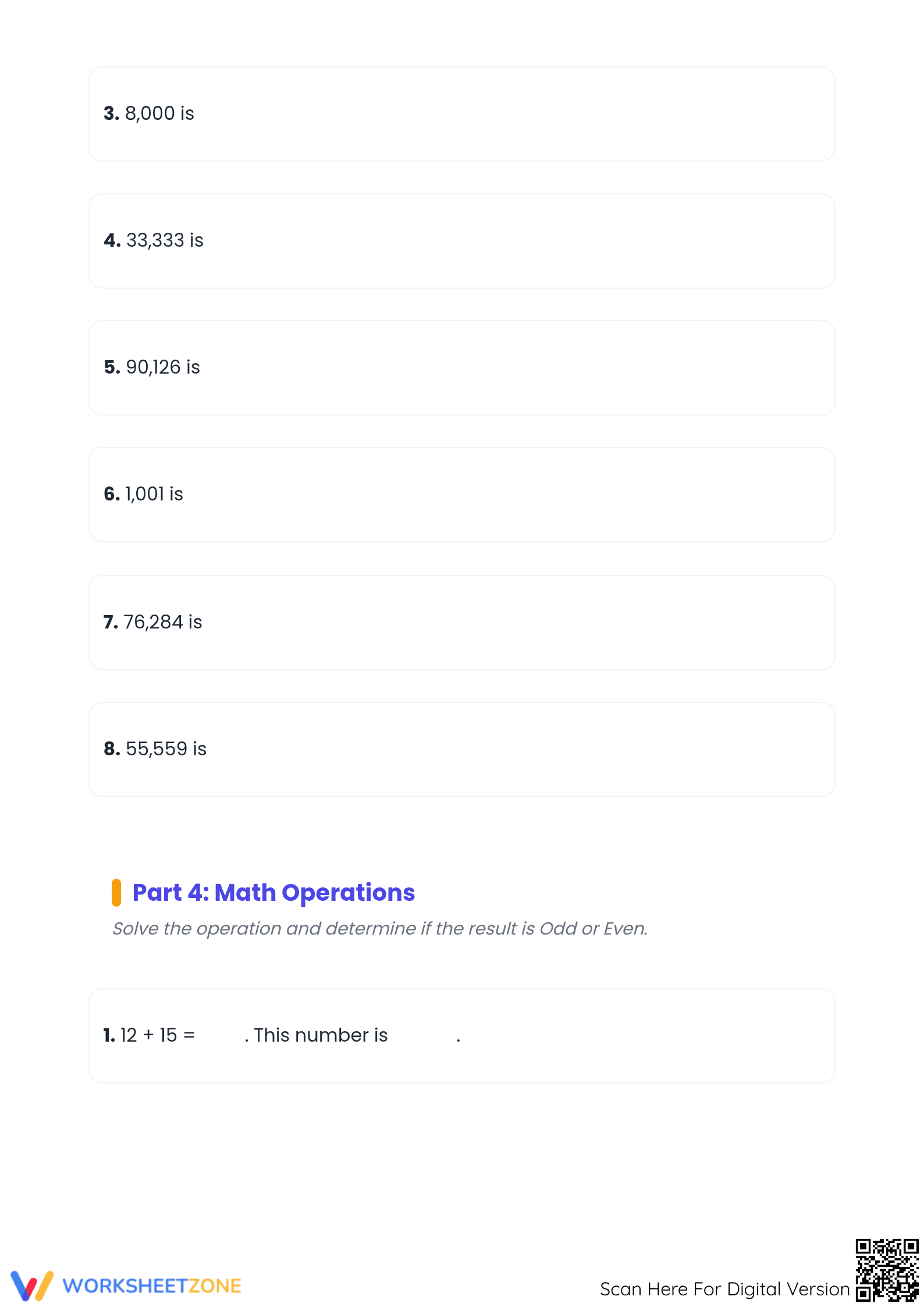
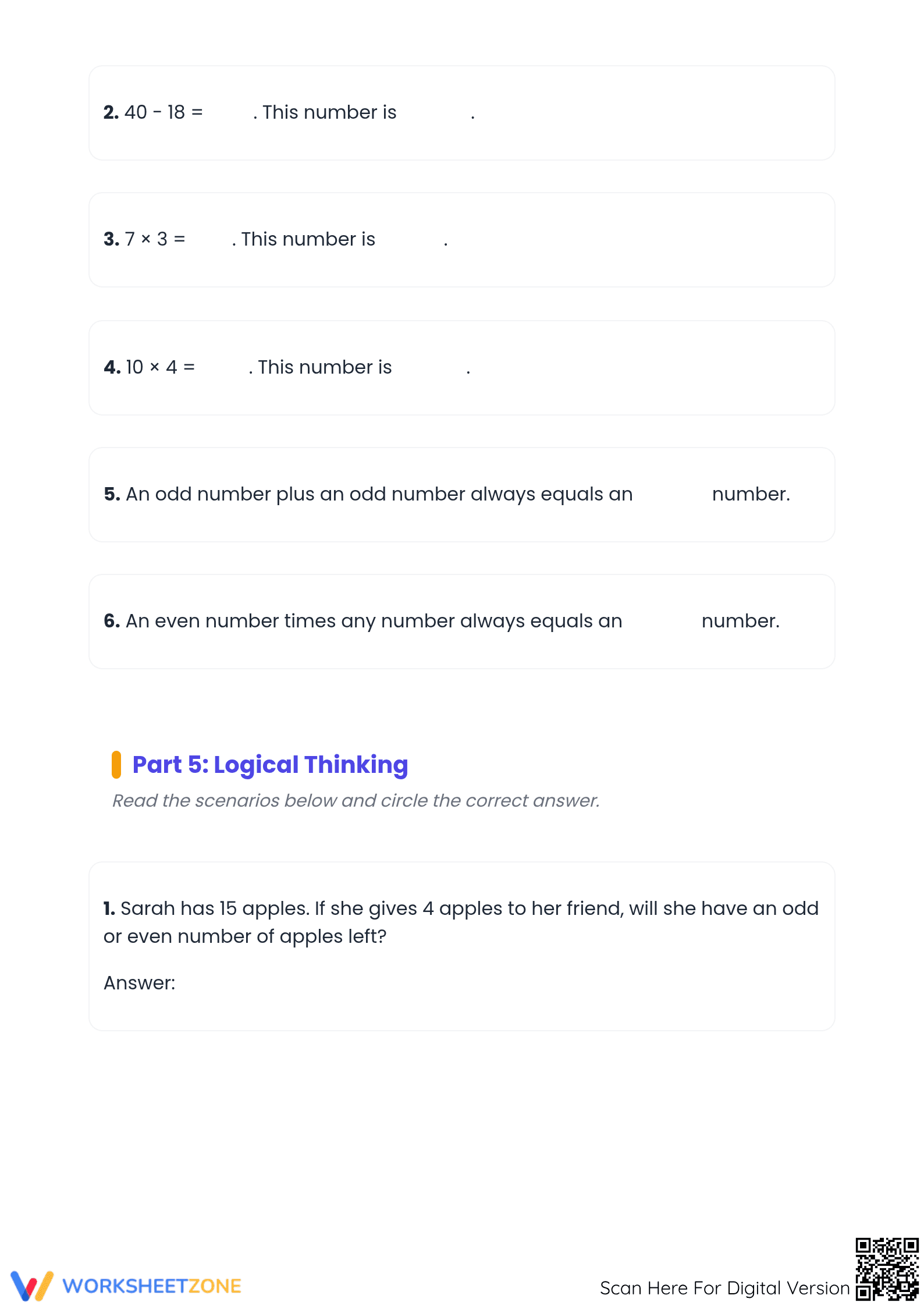
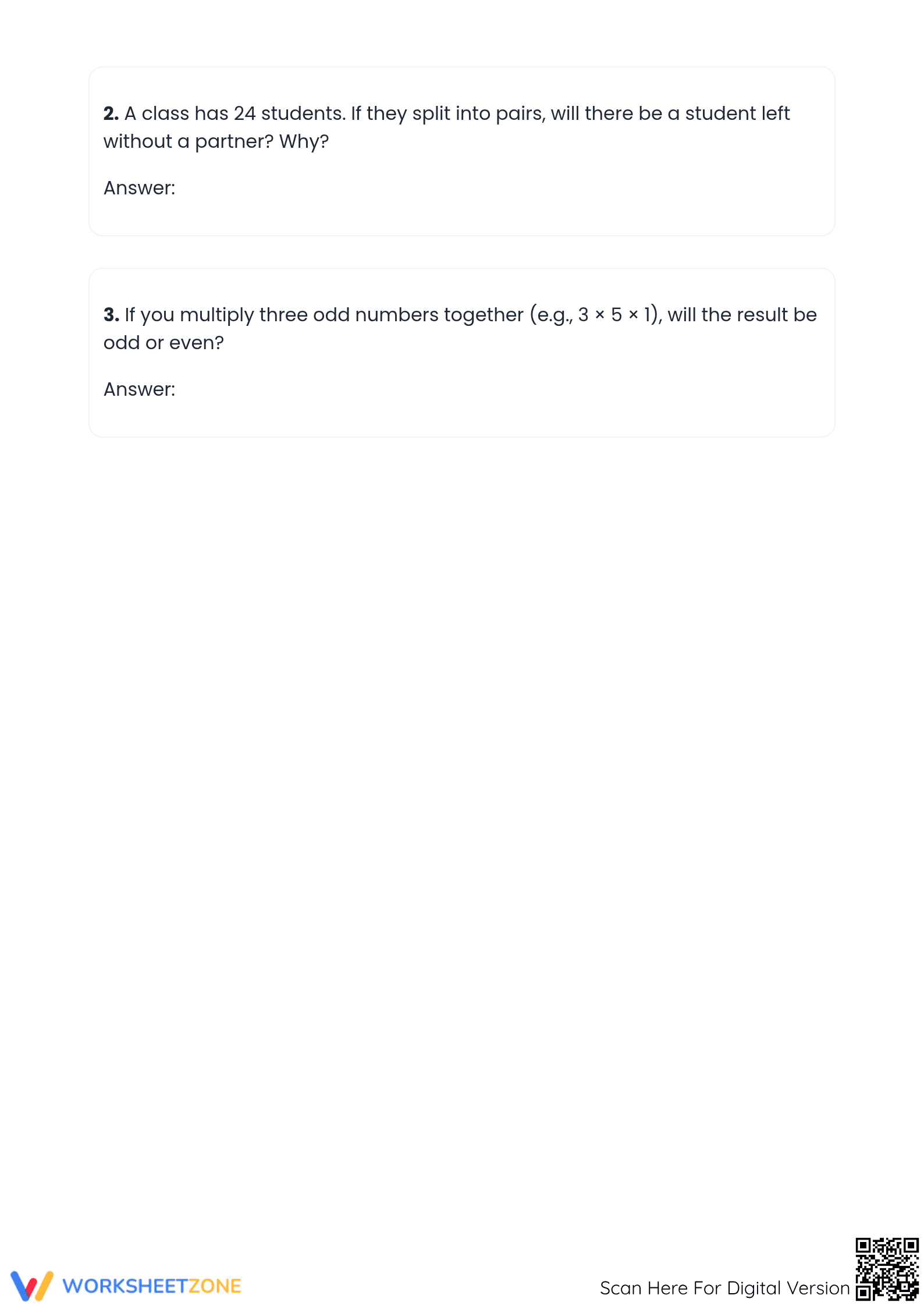
This packet includes five distinct parts: basic digit-based identification, a visual coloring hunt, large number challenges up to 5 digits, operational parity rules for addition and multiplication, and logical thinking scenarios. The 33 structured problems come with a full answer key, providing immediate feedback for independent study or guided classroom sessions.
Skill Progression
- Guided Practice: Students start with Part 1, using last-digit rules to classify 6 foundational numbers with explicit scaffolding and rule definitions.
- Supported Practice: Part 2 and 3 transition to 18 problems involving visual sorting and multi-digit numbers to build fluency and recognition speed.
- Independent Practice: Parts 4 and 5 challenge students with 9 higher-order tasks involving operations and logic to prove conceptual mastery.
This structured sequence follows the gradual-release model, ensuring students build confidence before tackling abstract mathematical patterns and rules.
Standards Alignment
Aligned to CCSS.MATH.CONTENT.3.OA.D.9: "Identify arithmetic patterns (including patterns in the addition table or multiplication table), and explain them using properties of operations." Students explore how operations affect parity, such as realizing that an even number times any number always results in an even number. This standard code can be copied directly into lesson plans, IEP goals, or district curriculum mapping tools.
How to Use It
Use this resource during a core lesson on number patterns or as a comprehensive review packet before unit assessments. Educators should observe students during Part 4 to see if they can explain the underlying logic behind operational parity rather than just memorizing rules. Expected completion time is 30 to 45 minutes, depending on grade level. One formative assessment tip is to check the word problem responses for evidence of clear mathematical reasoning.
Who It's For
Designed for Grade 3-5 students, this resource supports inclusive classrooms, remedial math groups, and enrichment for younger learners. It pairs naturally with an interactive number line or hundreds chart to help students visualize the alternating nature of parity during direct instruction or peer-to-peer tutoring sessions.
The 3.OA.D.9 standard requires students to look beyond simple identification and recognize deeper mathematical patterns. Research from RAND AIRS 2024 highlights that early mastery of parity properties significantly improves a student's ability to predict outcomes in multiplication and division. By engaging with the 33 tasks in this worksheet, learners transition from procedural knowledge—looking at the final digit—to conceptual understanding of how evenness is maintained through addition and multiplication operations. The inclusion of logical word problems ensures that the skill is not practiced in a vacuum but is applied to real-world scenarios. This multi-modal approach, combining visual coloring with rigorous calculation, aligns with best practices for cognitive load management in elementary mathematics. Teachers can use the included answer key to quickly identify misconceptions in student logic during the formative assessment phase of the lesson.


