


























Views
Downloads
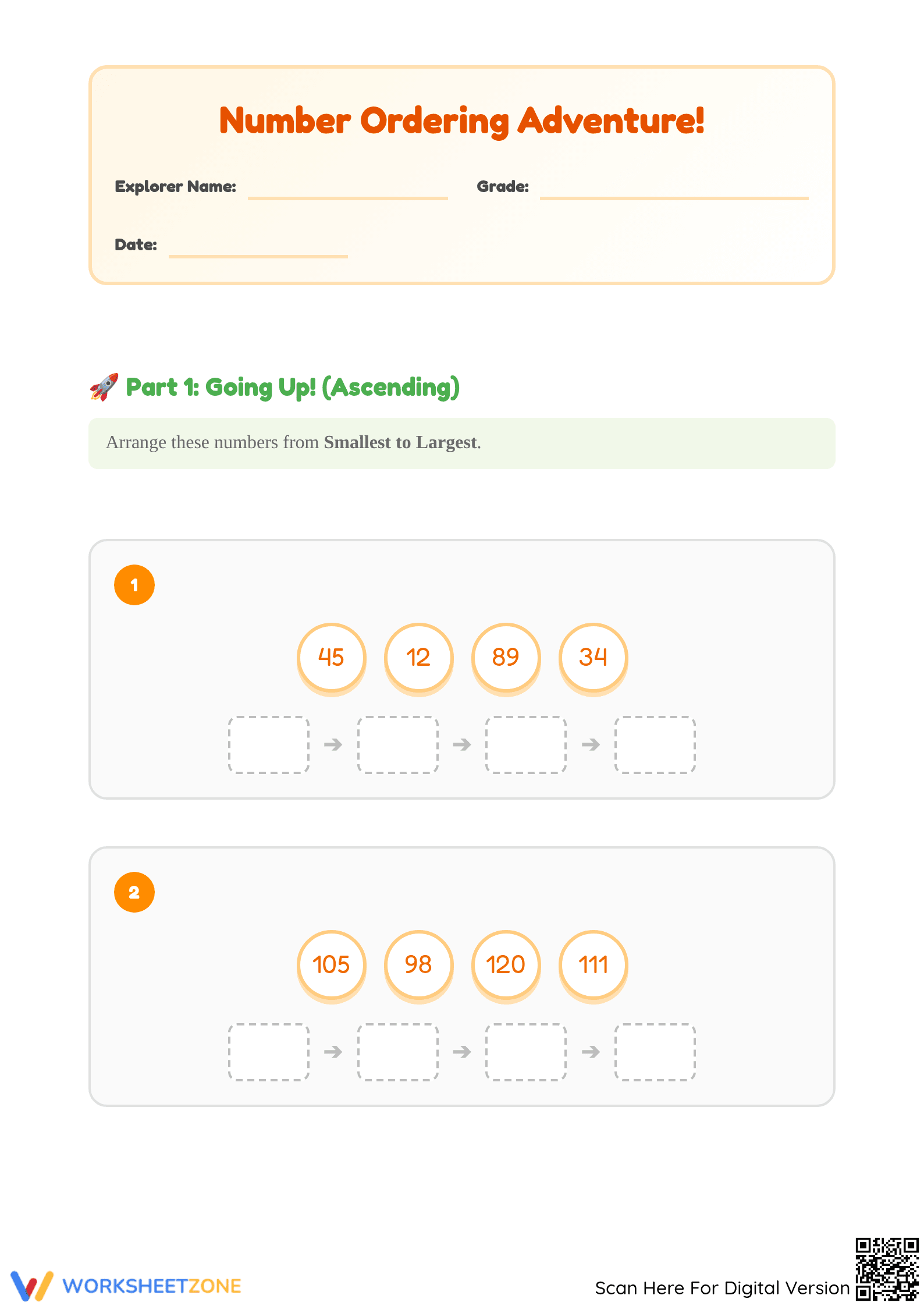


Ascending and Descending Order to 200 | Essential Math
Paste this activity's link or code into your existing LMS (Google Classroom, Canvas, Teams, Schoology, Moodle, etc.).
Students can open and work on the activity right away, with no student login required.
You'll still be able to track student progress and results from your teacher account.
This Grade 2 math worksheet provides comprehensive practice for students to master number sequencing. By arranging sets of numbers up to 200, learners develop a concrete understanding of place value and numerical relationships. The structured format ensures students can confidently identify relative magnitudes in both increasing and decreasing patterns.
At a Glance
- Grade: 2 · Subject: Math
- Standard:
CCSS.MATH.CONTENT.2.NBT.A.4— Compare three-digit numbers based on meanings of hundreds, tens, and ones digits- Skill Focus: Ascending and descending order to 200
- Format: 5 pages · 14 problems · Answer key included · PDF
- Best For: Independent practice and formative assessment
- Time: 20–30 minutes
The resource contains five high-quality pages featuring 14 distinct number-ordering tasks. Part 1 focuses on ascending order (smallest to largest), Part 2 targets descending order (largest to smallest), and Part 3 offers a mixed challenge to test cognitive flexibility. Each problem presents four numbers in circular frames with dashed response boxes and directional arrows to guide the student's workflow. A full five-page answer key is provided for rapid grading and immediate feedback.
Zero-Prep Workflow:
- Print: Select the specific pages needed for your lesson and print enough copies for your class in less than 60 seconds.
- Distribute: Hand out the worksheets as a warm-up or independent center activity with zero additional teacher setup required.
- Review: Use the included answer key to grade the 14 tasks in under 2 minutes or allow students to self-correct their work.
This streamlined process makes the worksheet an ideal candidate for emergency sub plans or last-minute morning work.
This resource is directly aligned with CCSS.MATH.CONTENT.2.NBT.A.4, which requires students to compare two three-digit numbers based on meanings of the hundreds, tens, and ones digits. By ordering four numbers simultaneously, students must apply these comparison skills repeatedly and systematically. This practice also supports advanced first graders working toward higher-level number sense. Both standard codes can be copied directly into lesson plans, IEP goals, or district curriculum mapping tools.
Assign this worksheet during the independent practice phase of a gradual release lesson on place value. It serves as an excellent bridge between simple two-number comparisons and complex data ordering. For a formative assessment tip, observe if students consistently struggle with numbers containing the digit zero, such as 105 versus 150, as this indicates a specific misconception in place value understanding. Completion typically takes 20 to 30 minutes.
This resource is designed for Grade 2 students working toward mastery of the Number and Operations in Base Ten domain. It is also suitable for Grade 1 enrichment or Grade 3 intervention. Pair this worksheet with a physical number line or base-ten blocks to provide concrete support for kinesthetic learners who need to visualize the distance between values before writing them.
According to Fisher & Frey (2014), the gradual release of responsibility model is most effective when students are provided with structured independent practice that mirrors the complexity of the instructional standard. This worksheet facilitates that transition by requiring students to apply CCSS.MATH.CONTENT.2.NBT.A.4 across 14 varied tasks. By sequencing numbers up to 200 in both ascending and descending order, learners move beyond rote counting to a deeper conceptual understanding of numerical magnitude. Research indicates that frequent, low-stakes practice with place value comparison significantly improves long-term retention of mathematical fluency. This resource provides the necessary repetition to solidify these foundational skills before students progress to multi-digit addition and subtraction. The inclusion of a mixed-order challenge further promotes cognitive endurance and ensures that students are reading instructions carefully rather than relying on repetitive patterns.


