


























Views
Downloads





Essential Ascending & Descending Math Worksheet | Grade 1-2
Paste this activity's link or code into your existing LMS (Google Classroom, Canvas, Teams, Schoology, Moodle, etc.).
Students can open and work on the activity right away, with no student login required.
You'll still be able to track student progress and results from your teacher account.
This comprehensive math packet masters the concept of ordering whole numbers through a structured progression of ascending and descending sequences. Students develop critical number sense by arranging values from smallest to biggest and biggest to smallest, transitioning from direct numerical lists to applied word problem puzzles that ensure deep conceptual understanding and mathematical fluency.
At a Glance
- Grade: 1-2 · Subject: Math
- Standard:
CCSS.MATH.CONTENT.1.NBT.B.3— Compare two two-digit numbers based on meanings of tens and ones digits- Skill Focus: Ascending and Descending Order
- Format: 5 pages · 15 problems · Answer key included · PDF
- Best For: Independent practice and number sense reinforcement
- Time: 25–35 minutes
What's Inside
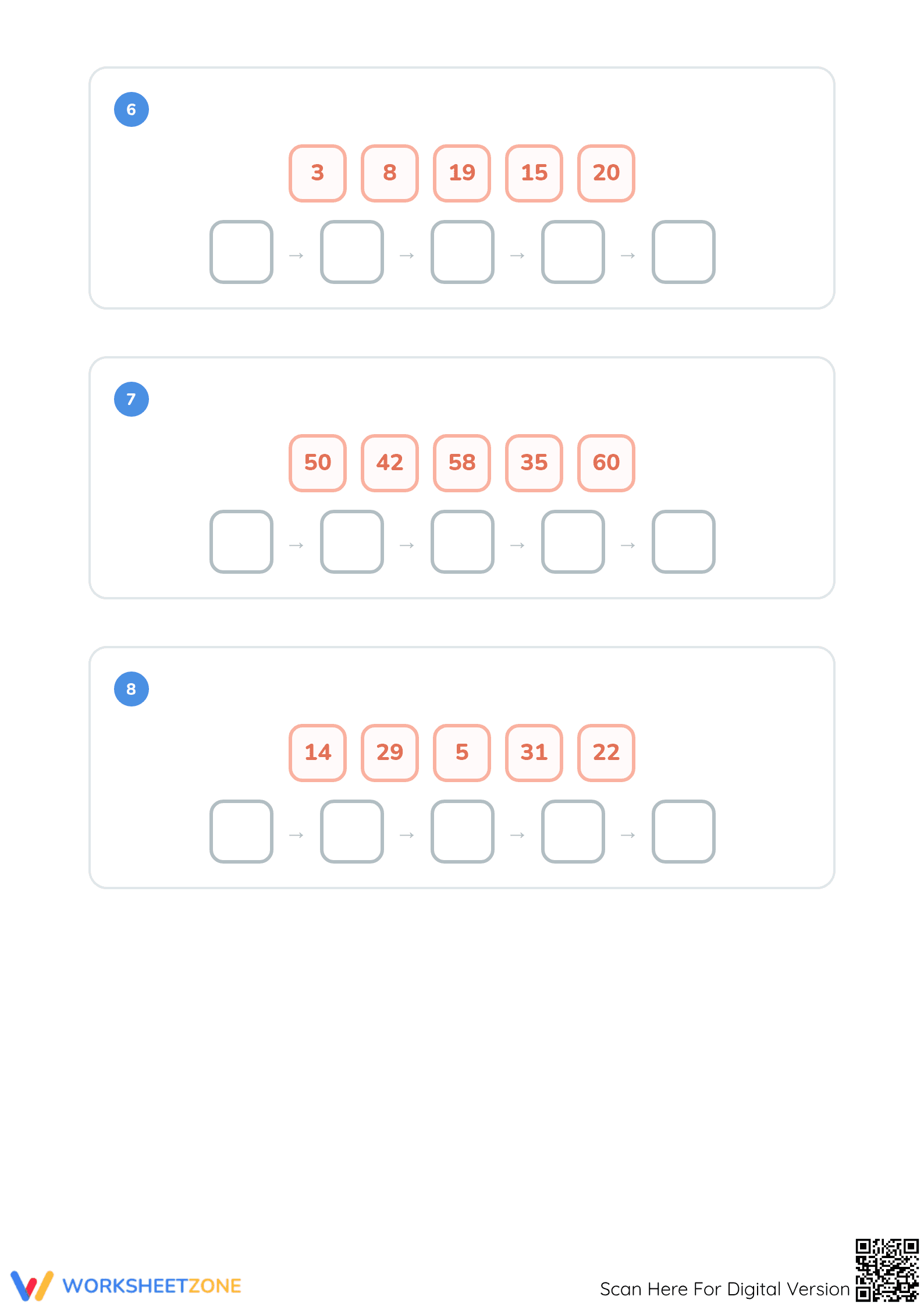
This 5-page printable packet includes 15 distinct tasks divided into four logical parts. Part 1 focuses on "Climbing Up" with ascending order practice, while Part 2 moves to "Sliding Down" with descending sequences. Part 3 introduces "Mini Challenges" for speed and fluency, and Part 4 concludes with "Star Challenges" featuring word problems and temperature-based ordering puzzles. A complete answer key is provided for immediate grading.
Zero-Prep Workflow
- Print (30 seconds): Select the pages needed or print the entire 5-page packet for a week of bell-ringers or centers.
- Distribute (1 minute): Hand out to students for individual seatwork or use as a robust sub plan resource.
- Review (1 minute): Utilize the included answer key to check for accuracy or allow students to self-correct during centers.
Total teacher preparation time is under two minutes, making this an ideal "grab-and-go" resource for busy classrooms.
Standards Alignment
The primary alignment is `CCSS.MATH.CONTENT.1.NBT.B.3`, which requires students to "Compare two two-digit numbers based on meanings of the tens and ones digits, recording the results of comparisons with the symbols >, =, and <." While the worksheet focuses on ordering sets, it applies the underlying logic of place value comparison required by this standard. This code can be copied directly into lesson plans, IEP goals, or district curriculum mapping tools.
How to Use It
Use this resource during the independent practice phase of a place value unit to solidify the distinction between ascending and descending directions. For a formative assessment observation, watch how students handle the Star Challenge puzzles on page 5, as these require translating verbal cues into numerical order. The expected completion time for the full packet is approximately 30 minutes, allowing for deep engagement with the material.
Who It's For
This resource is designed for Grade 1 and Grade 2 students working on number sense and place value mastery. It serves as an excellent reinforcement tool for students needing extra practice with sequencing. Pair this worksheet with a 1-100 number line or a hundreds chart to provide visual support for learners who are still developing their mental number line and place value conceptualization.
Aligned to CCSS.MATH.CONTENT.1.NBT.B.3, this resource ensures students master numerical sequencing, a foundational step in developing place value proficiency and mental mathematical models. According to EdReports 2024, high-quality materials for early elementary mathematics must provide varied opportunities for students to engage with number comparison beyond simple isolated pairs. This worksheet fulfills that requirement by presenting 15 tasks that range from direct list-sorting to contextualized temperature and sticker puzzles. By practicing both ascending and descending orders, students internalize the relative magnitude of two-digit numbers, which is essential for later success with multi-digit addition and subtraction. Research highlighted in the NAEP framework suggests that student fluency with ordering numbers is a strong predictor of overall algebraic readiness in later grades. The structured progression from "Climbing Up" to "Star Challenges" aligns with gradual-release models, ensuring students move from rote sorting to applied problem-solving.


