


























Views
Downloads



Ascending Order Mastery Worksheet | Essential Math Practice
Paste this activity's link or code into your existing LMS (Google Classroom, Canvas, Teams, Schoology, Moodle, etc.).
Students can open and work on the activity right away, with no student login required.
You'll still be able to track student progress and results from your teacher account.
This comprehensive math worksheet helps students master the concept of ascending order by sequencing various types of rational numbers. Students will practice arranging sets from least to greatest, moving from simple whole numbers to complex decimals and negative integers. This resource ensures students develop a strong sense of number magnitude and place value across multiple mathematical contexts.
At a Glance
- Grade: 3-10 · Subject: Math
- Standard:
CCSS.MATH.CONTENT.6.NS.C.7— Understand ordering and absolute value of rational numbers- Skill Focus: Ascending order sequencing
- Format: 5 pages · 20 problems · Answer key included · PDF
- Best For: Independent practice and skill reinforcement
- Time: 25–40 minutes
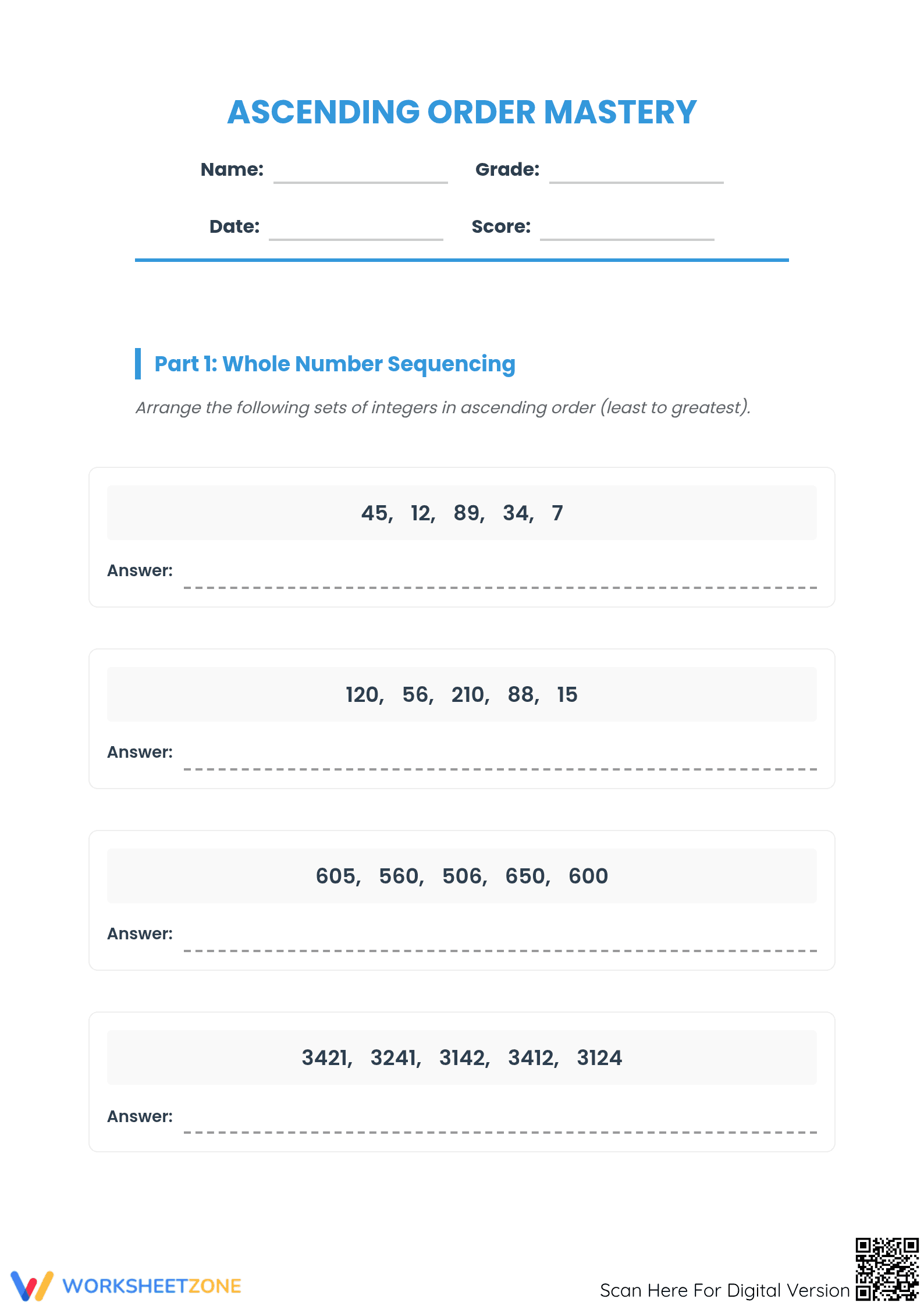
The packet contains five distinct pages, each focusing on a specific numerical category. It includes 20 multi-number sets requiring students to write the correct sequence on provided answer lines. The layout is clean and distraction-free, featuring whole numbers, multi-digit integers, decimals to the thousandths place, negative values, and mixed sets including fractions. A full answer key is provided for rapid grading.
- Guided practice: The first page uses familiar whole numbers and three-digit integers to establish the basic "least to greatest" logic with 4 clear examples.
- Supported practice: Pages two and three introduce decimals and negative integers, requiring students to apply place value knowledge and sign awareness to 8 intermediate problems.
- Independent practice: The final pages present challenge sets with mixed formats, including fractions and decimals, across 8 complex tasks.
This gradual-release structure follows the instructional model to build student confidence through increasing complexity.
The primary focus is CCSS.MATH.CONTENT.6.NS.C.7, which requires students to understand the ordering of rational numbers. It also supports CCSS.MATH.CONTENT.4.NBT.A.2 by reinforcing multi-digit number comparisons. Both standard codes can be copied directly into lesson plans, IEP goals, or district curriculum mapping tools.
Assign this worksheet as a mid-unit formative assessment after teaching number lines and place value. During the activity, observe if students struggle specifically when zero or negative signs are introduced. This resource typically takes 30 minutes to complete and works well as a quiet independent desk activity or a structured homework assignment.
This resource is designed for middle school students but is highly effective for upper elementary enrichment or high school remediation. It is particularly useful for students who need extra practice with the abstract concept of negative number magnitude. Pair this with a physical number line or a place value anchor chart for maximum impact.
According to the RAND AIRS 2024 report, structured practice in sequencing rational numbers is a foundational requirement for algebraic readiness. This worksheet addresses the core requirements of CCSS.MATH.CONTENT.6.NS.C.7 by forcing students to evaluate the relative position of numbers on a conceptual number line. By moving from concrete whole numbers to abstract negative integers and decimals, the resource aligns with the Fisher & Frey (2014) model of scaffolded instruction. Research from EdReports 2024 suggests that high-quality math materials must provide varied representations of numbers to ensure deep conceptual understanding. This 20-task set provides the necessary repetition for students to internalize the rules of ascending order across different number systems. Teachers can use the results to identify specific misconceptions regarding decimal place value or the counter-intuitive nature of negative integer magnitude, which are common hurdles in middle school mathematics.


