


























Views
Downloads
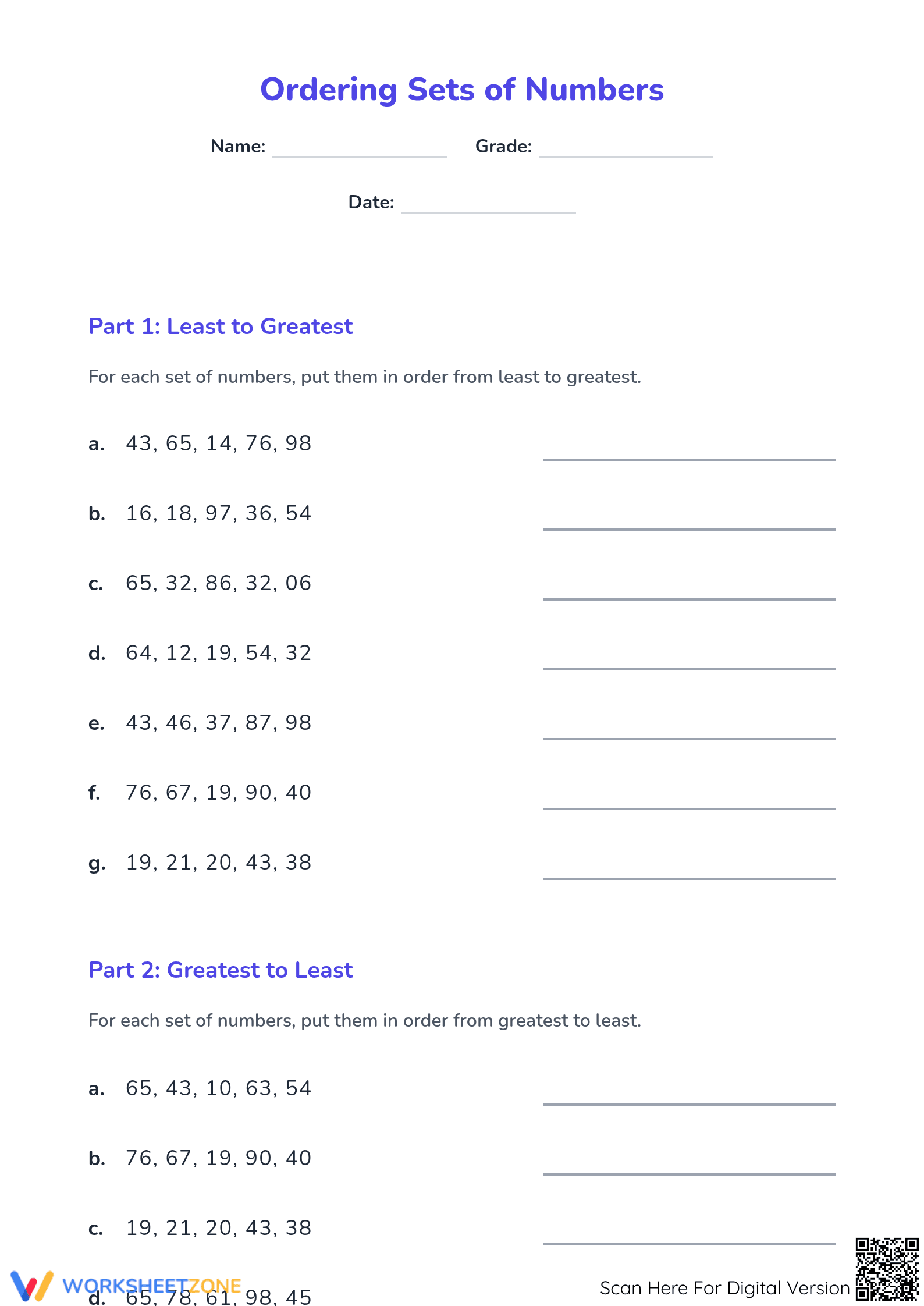


Printable Ordering Sets of Numbers Worksheet | Grade 2 Math
Paste this activity's link or code into your existing LMS (Google Classroom, Canvas, Teams, Schoology, Moodle, etc.).
Students can open and work on the activity right away, with no student login required.
You'll still be able to track student progress and results from your teacher account.
This comprehensive math worksheet helps Grade 2 students master ordering sets of numbers up to 100. By organizing multiple values from least to greatest and greatest to least, learners build essential number sense. Students manage complex numerical sequences, ensuring they are prepared for more advanced place value concepts.
At a Glance
- Grade: 2 · Subject: Math
- Standard:
CCSS.MATH.CONTENT.2.NBT.A.4— Order sets of numbers from least to greatest and greatest to least- Skill Focus: Ordering Sets of Numbers
- Format: 2 pages · 14 problems · Answer key included · PDF
- Best For: Independent practice or small group review
- Time: 15–25 minutes
What's Inside
This two-page resource contains 14 complex ordering tasks. Part 1 challenges students to sequence seven sets of five numbers from least to greatest. Part 2 requires students to reverse the logic, ordering sets from greatest to least. The clean layout provides ample writing space for young learners and includes a scanable QR code for immediate digital access and answer verification.
Skill Progression
- Guided Exploration: Students begin by identifying the smallest value in a set of five distinct two-digit numbers, establishing a baseline for comparison.
- Systematic Sequencing: Intermediate tasks require students to compare tens and ones digits simultaneously to place numbers in a logical, ascending order.
- Reverse Cognitive Loading: The final section forces students to invert their logic, strengthening mental flexibility by ordering numbers in descending order.
Standards Alignment
The primary focus is CCSS.MATH.CONTENT.2.NBT.A.4, comparing numbers based on the meanings of the digits. While the standard explicitly mentions using symbols for two numbers, this worksheet extends that logic to ordering full sets. This is a critical prerequisite for Grade 3 operations. Both standard codes can be copied directly into lesson plans, IEP goals, or district curriculum mapping tools.
How to Use It
Use this worksheet during the "You Do" phase of a lesson. After modeling place value, assign Part 1 as a formative assessment. It also serves as an excellent bell-ringer or fast-finisher activity to reinforce mental number lines. Teachers should observe if students check the tens place before the ones place to identify those needing additional scaffolding during instruction.
Who It's For
This resource is designed for Grade 2 students but is effective for Grade 1 learners ready for an enrichment challenge. It also provides remediation for Grade 3 students. The clear formatting makes it an ideal resource for English Language Learners (ELL) and students with IEPs who benefit from structured task designs paired with instruction.
According to an EdReports 2024 analysis of foundational math curricula, consistent practice with non-linear numerical ordering is a key indicator of long-term success in algebraic thinking. This worksheet directly addresses the cognitive demand required by CCSS.MATH.CONTENT.2.NBT.A.4 by forcing students to evaluate multiple place-value relationships simultaneously. Rather than relying on simple rote memorization, the exercise demands active comparison of the tens and ones digits across a set of five variables. Fisher & Frey (2014) emphasize that this type of structured practice bridges the gap between initial conceptual understanding and procedural fluency. By requiring both ascending and descending sequences, the resource ensures that students develop a robust, flexible mental number line. This dual-directional approach prevents the common "autopilot" error where students only learn to count upwards, preparing them for more complex subtraction and estimation tasks in higher elementary grades.


