


























Views
Downloads
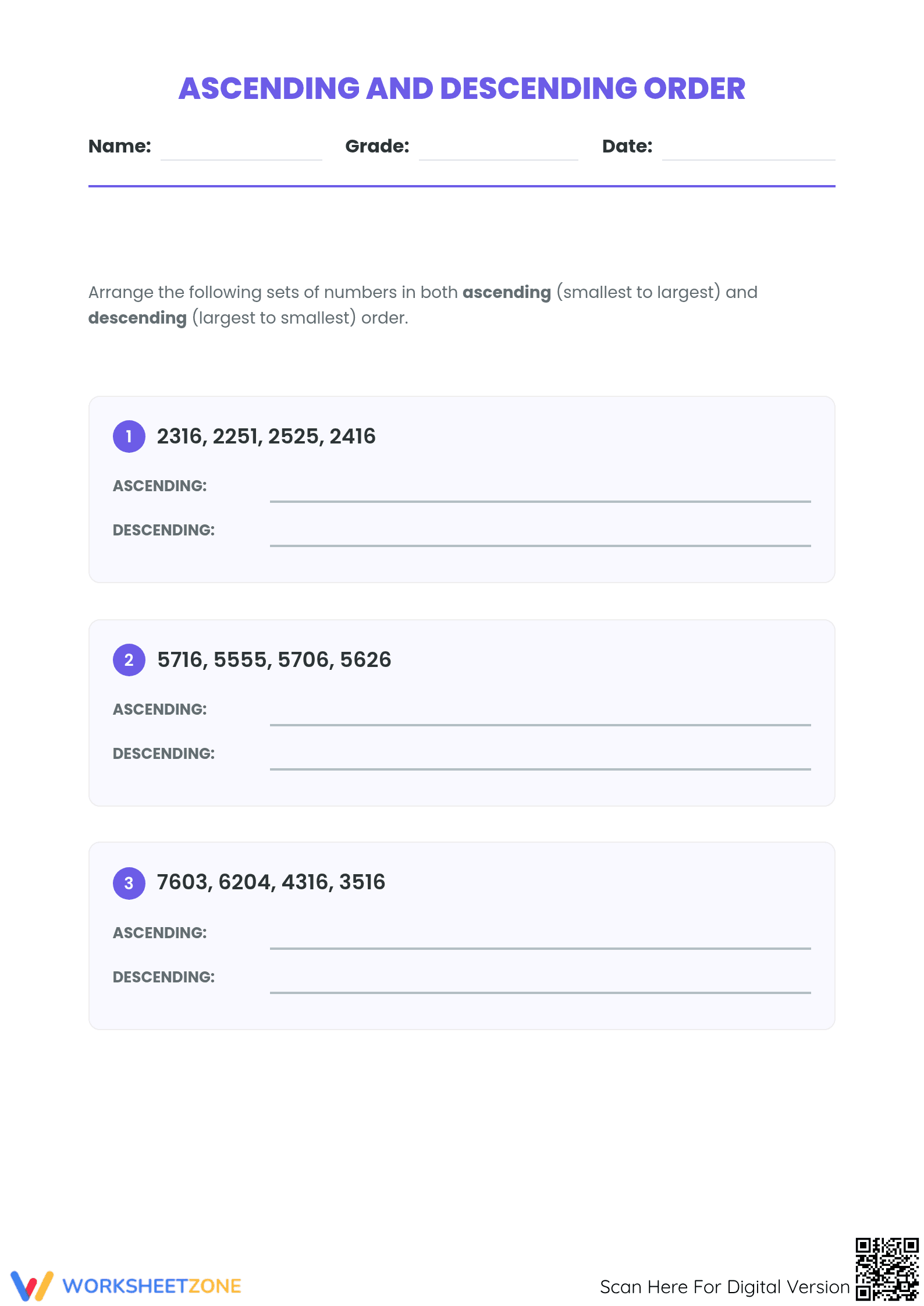



Ascending and Descending Order Worksheet | Grade 4 Essential
Paste this activity's link or code into your existing LMS (Google Classroom, Canvas, Teams, Schoology, Moodle, etc.).
Students can open and work on the activity right away, with no student login required.
You'll still be able to track student progress and results from your teacher account.
Strengthen place value mastery and numerical fluency with this comprehensive multi-page practice set. Students practice the critical skill of comparing and sequencing multi-digit whole numbers by arranging sets in both ascending and descending order. This dual-directional approach ensures students truly understand the relative magnitude of numbers rather than just following a rote procedure.
At a Glance
- Grade: 4 · Subject: Math
- Standard:
CCSS.MATH.CONTENT.4.NBT.A.2— Compare multi-digit numbers based on meanings of the digits in each place- Skill Focus: Numerical sequencing and place value comparison
- Format: 4 pages · 15 problems · Answer key included · PDF
- Best For: Independent practice and formative assessment
- Time: 20–30 minutes
What's Inside: This 4-page PDF contains 15 structured tasks designed to build confidence with large numbers. The first 10 problems focus on four-digit numbers, providing a solid foundation in comparing thousands and hundreds. The final 5 problems transition into advanced ordering with five-digit numbers, challenging students to maintain accuracy across ten-thousands and thousands places. A full answer key is provided for rapid grading or student self-correction.
Skill Progression
- Guided Practice: The initial 5 problems use distinct four-digit numbers, allowing students to focus on the primary digit in the thousands place to determine order.
- Supported Practice: Problems 6 through 10 introduce numbers with similar leading digits, requiring students to look deeper into the hundreds and tens places to differentiate values.
- Independent Mastery: The "Advanced Ordering" section moves to five-digit numbers (up to 55,555), where students must navigate complex place value shifts and repetitive digits to succeed.
This structure follows a gradual-release model, moving from basic comparison to high-complexity sequencing within a single session.
Standards Alignment: This resource is specifically designed to meet `CCSS.MATH.CONTENT.4.NBT.A.2`. Students must read and write multi-digit whole numbers using base-ten numerals and compare two multi-digit numbers based on meanings of the digits in each place, using the results of the comparison to order the sets. Both standard codes can be copied directly into lesson plans, IEP goals, or district curriculum mapping tools.
How to Use It: This worksheet is ideal for the "You Do" phase of a lesson on place value. Assign the first page as a quick check for understanding during direct instruction. If students demonstrate proficiency, assign the advanced pages for independent work. For a formative assessment tip, observe if students are underlining the highest place value digit first or if they struggle when the first two digits are identical. Completion typically takes 20 to 30 minutes depending on student fluency.
Who It's For: While designed for Grade 4 learners, this resource is an excellent intervention tool for Grade 5 students who need to reinforce their number sense before moving into decimals. It also serves as a high-level challenge for Grade 3 students ready for multi-digit work. Pair this worksheet with a place value anchor chart or a physical number line to support visual learners.
According to research by Fisher & Frey (2014), the ability to sequence numbers accurately is a foundational component of mathematical literacy that directly impacts a student's success with rounding and estimation. This worksheet addresses the common misconception that longer numbers are always larger by including five-digit numbers with varying internal values. By requiring both ascending and descending arrangements for every problem set, the resource forces students to engage in metacognitive checking, reducing careless errors. Data from the NAEP suggests that students who master multi-digit comparison early show significantly higher proficiency in middle-school algebraic reasoning. This 15-task set provides the exact volume of practice needed to move from procedural knowledge to conceptual mastery of `CCSS.MATH.CONTENT.4.NBT.A.2` standards.


