


























Views
Downloads

Printable Cursive Letter A Worksheet | Grade K
Paste this activity's link or code into your existing LMS (Google Classroom, Canvas, Teams, Schoology, Moodle, etc.).
Students can open and work on the activity right away, with no student login required.
You'll still be able to track student progress and results from your teacher account.
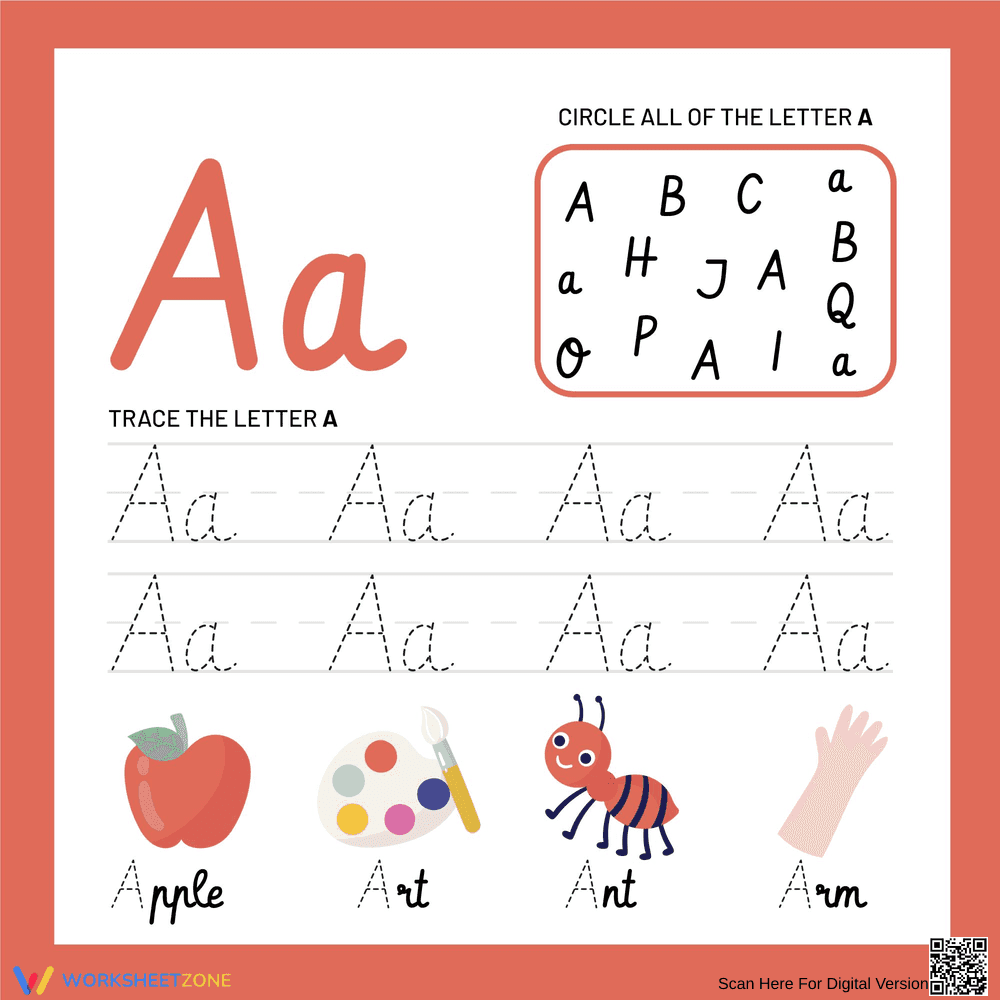
This foundational handwriting worksheet helps early learners master the cursive letter A through targeted visual recognition and guided tracing. Students build fine motor control and letter familiarity by identifying the target letter among distractors, practicing proper stroke order, and tracing simple vocabulary words.
At a Glance
- Grade: K · Subject: Handwriting
- Standard:
CCSS.ELA-LITERACY.L.K.1.A— Print upper- and lowercase letters- Skill Focus: Cursive letter A tracing and recognition
- Format: 1 page · 3 tasks · No answer key needed · PDF
- Best For: Morning work or literacy centers
- Time: 10–15 minutes
This single-page resource features three distinct task sections designed to reinforce letter knowledge. The top section challenges students to circle all uppercase and lowercase A's within a mixed letter bank. The middle section provides two lined rows with dashed guides for tracing uppercase and lowercase cursive A pairs. The bottom section introduces four illustrated vocabulary words (Apple, Art, Ant, Arm) with dashed cursive text for extended tracing practice.
Zero-Prep Workflow
This worksheet is designed for immediate classroom implementation with minimal teacher preparation:
- Print (1 minute): Simply download the PDF and print a class set. The clear, high-contrast design ensures excellent reproduction on standard school copiers.
- Distribute (1 minute): Hand out the sheets during morning routines or transition periods. The intuitive layout requires almost no verbal instruction.
- Review (1 minute): Quickly scan student work to verify correct stroke direction and letter identification. Total teacher prep time is under two minutes, making this an ideal addition to any emergency sub plan.
Standards Alignment
This resource aligns with CCSS.ELA-LITERACY.L.K.1.A: Print many upper- and lowercase letters. While the standard focuses on print, this worksheet adapts the foundational skill for early cursive exposure, supporting fine motor development and letter-sound correspondence. Both standard codes can be copied directly into lesson plans, IEP goals, or district curriculum mapping tools.
How to Use It
Deploy this worksheet during morning work to establish a calm, focused start to the school day. It also functions perfectly as an independent station during literacy centers. While students work, teachers can conduct quick formative assessments by observing pencil grip and stroke direction. Ensure students start their cursive letters at the correct baseline or midline point. Expected completion time ranges from 10 to 15 minutes depending on the student's fine motor proficiency.
Who It's For
This material is primarily designed for Kindergarten students beginning their handwriting journey, as well as Preschoolers demonstrating early readiness for letter formation. It serves as an excellent intervention tool for first graders needing extra fine motor support. Pair this worksheet with a tactile sand tray activity or a direct instruction lesson on the short "a" vowel sound to create a comprehensive literacy experience.
Aligning early handwriting practice with CCSS.ELA-LITERACY.L.K.1.A to print upper- and lowercase letters provides a critical foundation for future literacy success. According to Fisher & Frey (2014), explicit instruction in letter formation combined with guided practice significantly improves both reading fluency and written expression in early elementary students. This worksheet supports that research by integrating visual discrimination tasks with physical tracing exercises, reinforcing the cognitive link between a letter's shape and its phonetic value. By engaging multiple modalities—seeing the letter, finding it among distractors, and physically tracing its path—young learners develop stronger neural pathways for literacy. Consistent, structured practice with resources like this ensures students build the automaticity required to transition from focusing on letter mechanics to focusing on content generation in later grades.


