




























Views
Downloads
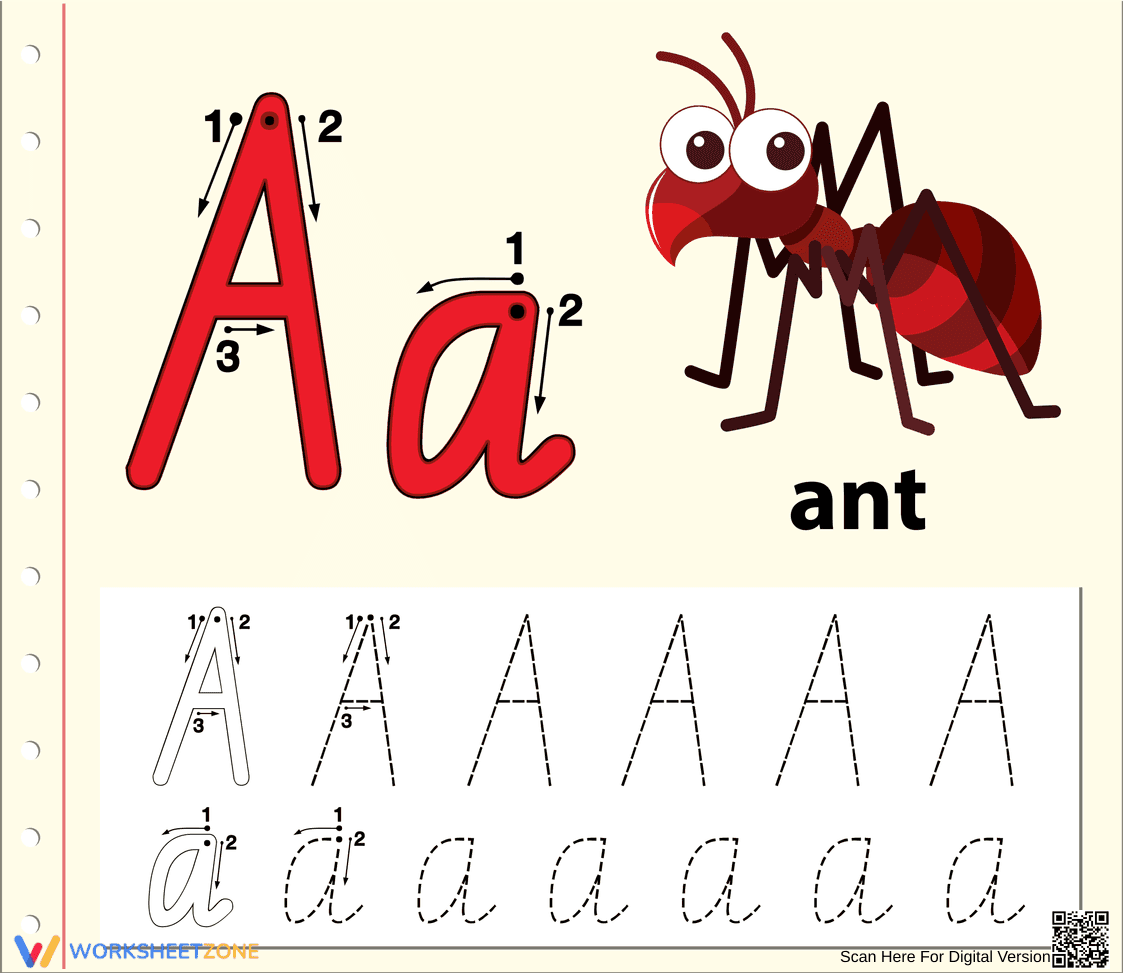

Tracing the Letter A | Essential Kindergarten Worksheet

Paste this activity's link or code into your existing LMS (Google Classroom, Canvas, Teams, Schoology, Moodle, etc.).
Students can open and work on the activity right away, with no student login required.
You'll still be able to track student progress and results from your teacher account.
This Preschool and Kindergarten handwriting worksheet helps early learners master the formation of the letter A through guided tracing. Students practice both uppercase and lowercase versions while connecting the letter sound to the word 'ant.' By providing clear directional arrows, this resource ensures students develop correct muscle memory for foundational writing success.
At a Glance
- Grade: Preschool & Kindergarten · Subject: English Handwriting
- Standard:
CCSS.ELA-LITERACY.L.K.1.A— Print many upper- and lowercase letters- Skill Focus: Letter A formation
- Format: 1 page · 14 problems · PDF
- Best For: Morning work and literacy centers
- Time: 10–15 minutes
The worksheet features a large visual anchor with the letter A and a friendly ant illustration to reinforce phonics. Below the anchor, students find two rows of tracing tasks: six uppercase 'A's and eight lowercase 'a's. Each row begins with a numbered guide showing the exact stroke sequence, followed by dashed-line letters that gradually reduce support to encourage independent control.
This resource is designed for a two-minute teacher setup. First, print the single-page PDF for your entire class or small group. Second, distribute the sheets during your literacy block or as a quiet morning arrival activity. Finally, review the completed work to check for proper pencil grip and stroke direction. This zero-prep design makes it an ideal choice for emergency sub plans or daily handwriting practice.
This resource aligns with `CCSS.ELA-LITERACY.L.K.1.A`, which focuses on the ability to print many upper- and lowercase letters. By isolating the letter A, students can concentrate on the specific diagonal and curved strokes required for this character. Both standard codes can be copied directly into lesson plans, IEP goals, or district curriculum mapping tools.
Assign this worksheet during the independent practice phase of a handwriting lesson after demonstrating the strokes on a whiteboard. It also functions well as a formative assessment tool; observe students as they trace to identify those struggling with fine motor coordination or top-to-bottom stroke order. Expect most students to complete the 14 tasks within 10 to 15 minutes.
This worksheet is tailored for preschool and kindergarten students who are just beginning their writing journey. It is also highly effective for English Language Learners (ELL) who need visual anchors for vocabulary. Pair this with a letter A alphabet song or a physical sand tray for a multi-sensory learning experience.
The CCSS.ELA-LITERACY.L.K.1.A standard requires students to print many upper- and lowercase letters, a foundational skill for early literacy development. This worksheet facilitates this by providing 14 specific tracing opportunities that emphasize correct stroke order and directional flow. According to Fisher & Frey (2014), the gradual release of responsibility model is most effective when students move from guided tracing to independent production. By using visual cues like directional arrows and the 'A is for ant' mnemonic, this resource supports phonemic awareness alongside fine motor development. Research indicates that tactile engagement with letter shapes significantly improves long-term orthographic mapping in preschool and kindergarten learners. This printable resource serves as a high-quality tool for teachers seeking to bridge the gap between letter recognition and handwriting mastery. It provides a structured environment for students to practice the specific motor patterns required for the letter A, ensuring they meet early language standards with confidence and precision.


