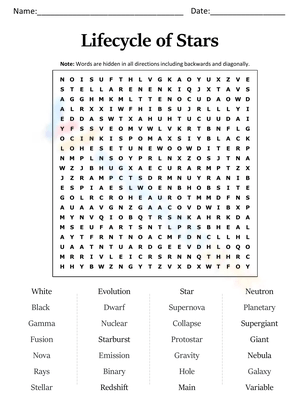
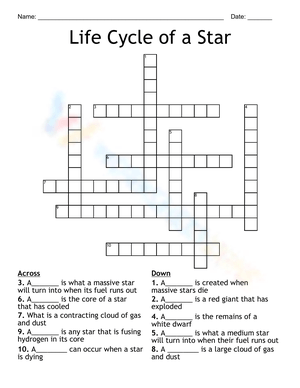
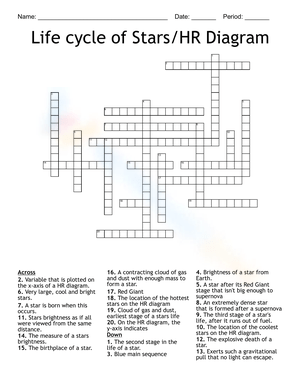
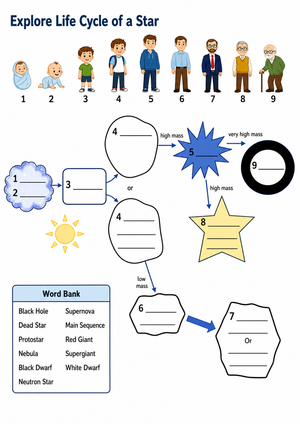
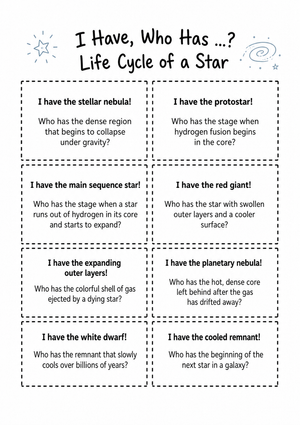
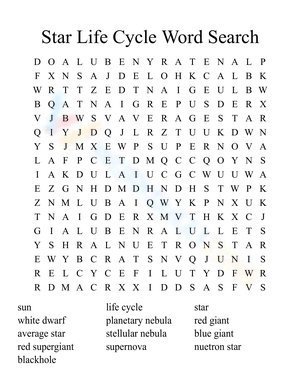
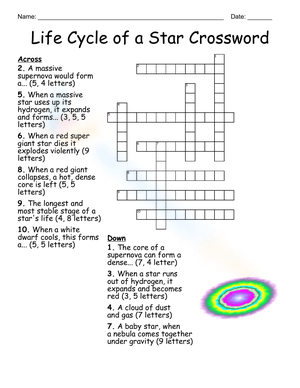
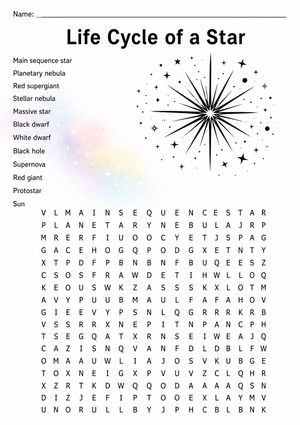
These life cycle of a star worksheets for 8th grade give teachers a direct entry point into one of middle school astronomy's most demanding topics — a sequence that branches based on stellar mass and requires students to connect vocabulary, causation, and comparison simultaneously. Each worksheet isolates a specific skill: labeling a formation diagram, ordering stages from nebula through end states, or explaining in writing why two stars with different masses arrive at entirely different endings. The set fits into first instruction, unit review, and small-group reteaching.
The Stages Students Need to Know — and the Branch That Separates Them
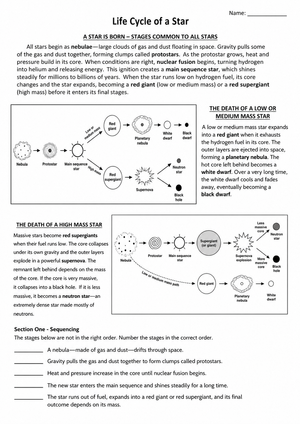
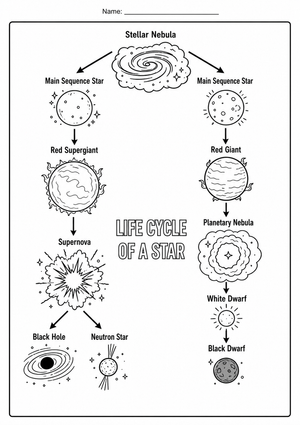
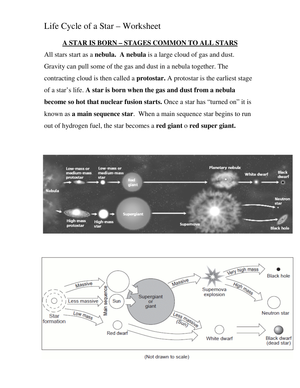
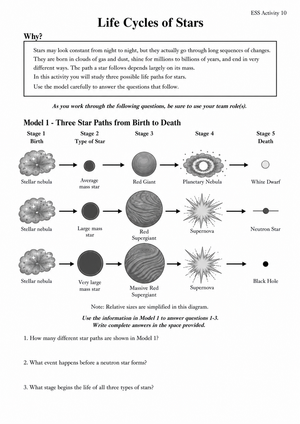
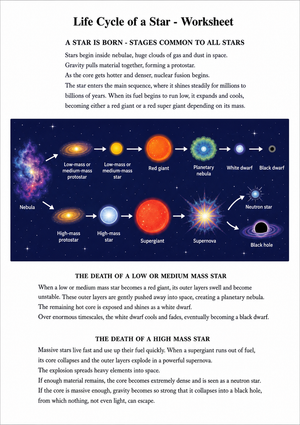
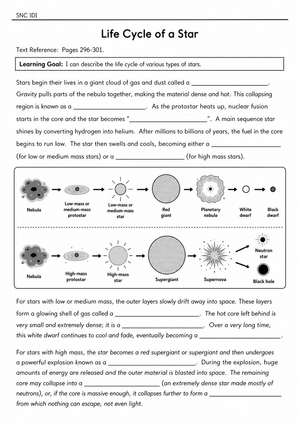
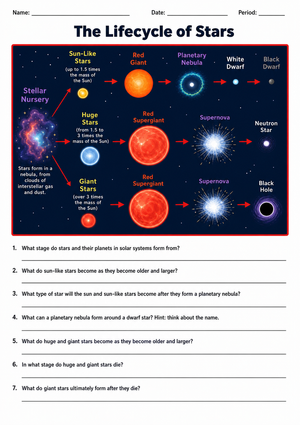
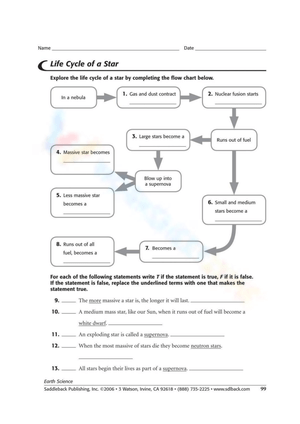
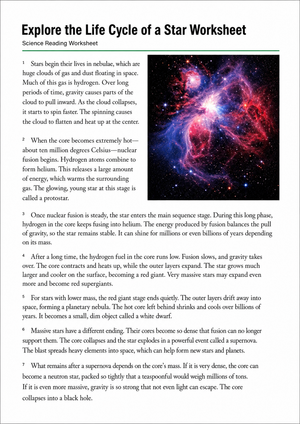
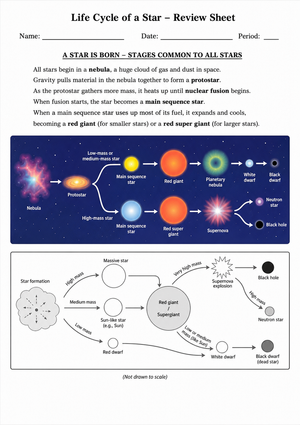
The shared early sequence is manageable for most 8th graders. Nebula, protostar, and main-sequence star are terms students pick up without too much difficulty. The real teaching challenge arrives when the diagram splits: average-mass stars expand into red giants and eventually cool into white dwarfs, while high-mass stars move through the supergiant phase, detonate in a supernova, and leave behind either a neutron star or a black hole. Getting students to correctly route each star type through its end stages — rather than simply name the stages from a list — is where the instructional work actually happens.
The most effective move in this unit is marking mass as the explicit decision point on the diagram, not a side note buried in the margin. When students label the branching fork and write the cause of the split at that location, they are forced to connect cause to outcome. That annotation shows up later in short-answer responses more reliably than any amount of verbal explanation. Each worksheet treats the branching structure as a primary task, not an afterthought.
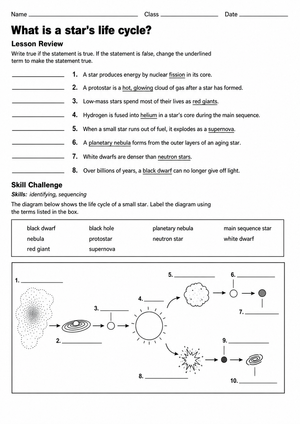
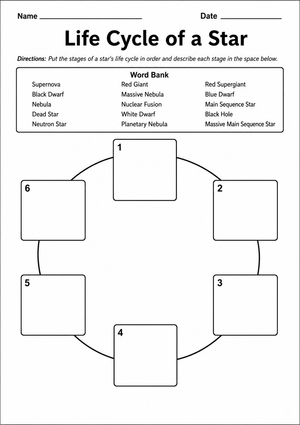
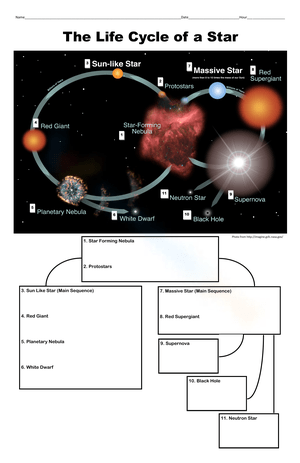
- Formation-stage labeling — students match nebula and protostar to their positions in the sequence before fusion begins
- Main-sequence annotation — students describe what nuclear fusion is doing during this long stable period, not just what the stage is called
- Branching sequence tasks — students place red giant, white dwarf, supergiant, supernova, neutron star, and black hole on the correct path
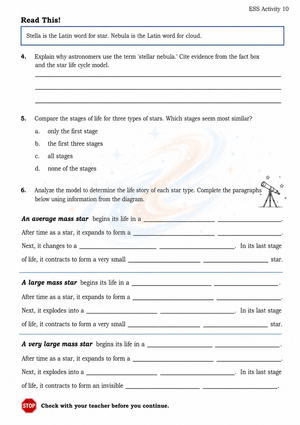
- Compare-and-contrast writing prompts — short responses that ask students to explain the role of mass without simply listing stage names in order
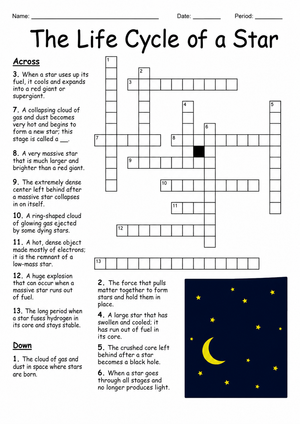
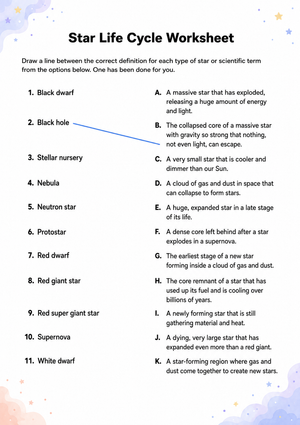
- Vocabulary matching — structured repetition for students still building science reading fluency before they attempt independent writing
Student Errors These Worksheets Bring to the Surface
The most persistent mistake is the assumption that every star ends as a black hole. Students latch onto the most dramatic outcome and apply it universally. A worksheet that requires students to correctly route average stars toward white dwarfs reveals that error immediately. If a student writes "black hole" at the end of the average-star path, or places "white dwarf" on both branches, the diagram makes that confusion visible before the unit ends — in time to address it directly.
Students also routinely misread the main-sequence stage as a brief transition. In sequencing tasks, they move through it as quickly as they move through "protostar," with no sense that a star like our sun remains in this stage for roughly ten billion years. A short-response question asking what is happening inside the star during the main sequence — not just what it is called — reveals whether students understand that fusion is actively powering the star throughout. Students who cannot answer that are not ready for the end-stage material.
A third error is positional rather than vocabulary-based: students place supernova on the average-star path, after the red giant stage. These students often know what a supernova is. The problem is that they have not connected supernova specifically to the high-mass branch. Fill-in branching diagrams catch this reliably, because students must commit to a location on the diagram rather than select a term from a recognition-based list.
Fitting These Worksheets Into Your Astronomy Unit
Life cycle of a star worksheets for 8th grade fit naturally into nearly every phase of a lesson cycle. On day one of the unit, project a partially completed branching diagram as a bell ringer — give students three minutes to fill in what they already believe to be true, collect it before any instruction begins, and you have pre-assessment data with no preparation time. During direct instruction, the same worksheet becomes guided notes: students write terms and brief explanations as each stage is introduced, which reduces the passive drift that happens when listening is the only task.
For intervention later in the unit, split the work. Do not ask students who are still uncertain about protostar and main sequence to simultaneously sort neutron stars and supernovas. Secure the shared path first, then introduce the branch as a second step. That approach also translates well to center rotations — one station handles formation stages, another handles the two end-stage paths. Sub plans benefit from this structure too; the labeling and sequencing tasks are self-contained enough that a substitute does not need astronomy content knowledge to run them effectively.
Adapting the Set for a Range of Student Readiness
For students who need more support, remove the branching structure from the first attempt entirely. Ask them to complete only the shared path — nebula, protostar, main-sequence star — before the two end-stage paths are introduced. Vocabulary matching on this shorter sequence gives repeated exposure to terms without the added cognitive load of simultaneous comparison. Once that foundation is stable, add the mass-based split as a second, separate task.
Students who move through labeling and sequencing quickly need a different kind of challenge. Instead of asking "what comes after the main sequence for a massive star?", ask "why does a massive star not end as a white dwarf?" That shift requires causal reasoning rather than recall. Extending further, students can annotate each stage with what is changing about the star's energy output — a connection that links directly to the physical science content many 8th graders are covering in parallel. Each worksheet supports that kind of extension without requiring additional materials.
Standard Alignment
Stellar evolution is formally addressed in high school NGSS under HS-ESS1-1, which asks students to develop a model illustrating the sun's life span and the role of nuclear fusion in releasing energy, and under HS-ESS1-3, which asks students to communicate scientific ideas about the way stars produce elements across their life cycle. Many 8th grade Earth and space science courses introduce this content ahead of those standards to build the vocabulary and conceptual model students will need. These life cycle of a star worksheets for 8th grade address the core sequence and mass-dependent branching that both standards assume students can describe. They do not cover the detailed fusion physics of HS-ESS1-1 in full — that depth belongs in high school — but they build the foundational understanding that makes later instruction on stellar evolution productive rather than remedial.
Frequently Asked Questions
Which stages should 8th graders know for the star life cycle?
At minimum: nebula, protostar, and main-sequence star as the shared path. From there, the average-star path requires red giant and white dwarf; the massive-star path requires supergiant, supernova, neutron star, and black hole. Most 8th grade unit assessments ask students to place these correctly on a branching diagram and explain why the two paths diverge after the main sequence.
What distinguishes the average-star path from the massive-star path?
Both begin identically: nebula, protostar, main sequence. After the main sequence, stellar mass determines the outcome. Average stars expand into red giants and slowly shed their outer layers, leaving a cooling white dwarf. Massive stars burn through available fuel faster, expand into supergiants, and explode in supernovas — leaving behind either a neutron star or, for the most massive, a black hole.
Why does a star eventually leave the main-sequence stage?
At the 8th grade level, students need to connect fuel availability to structural change: when the star can no longer sustain fusion at the rate that kept it stable, the outer layers expand while the core contracts. Students do not need the full nuclear physics to explain this. They do need to understand that fusion is what held the star in the main sequence, and that a change in the rate of fusion drives the transition into the next stage — because that causal link is what distinguishes understanding from pure memorization.
Can these worksheets function as assessment tools, not just practice?
Life cycle of a star worksheets for 8th grade work as formative assessment when collected mid-unit — scanning completed diagrams takes roughly five minutes and immediately shows which students are misrouting stages or placing end states on the wrong branch. The compare-and-contrast writing prompts also hold up as informal summative checks when students must explain the mass-based split without a word bank. Whether a worksheet acts as practice or assessment depends on when and how it is used, not on the resource itself.












 Interactive Worksheet Maker
 Quiz Maker
 Word Search Maker
 Crossword Puzzle Maker
 Word Scramble Generator
 Sentence Scramble Generator
 Handwriting Worksheet Generator
 Name Tracing Generator
 Fill In The Blank Generator