


























Views
Downloads

Classifying Matter Worksheet — Essential Grade 8 Science
Paste this activity's link or code into your existing LMS (Google Classroom, Canvas, Teams, Schoology, Moodle, etc.).
Students can open and work on the activity right away, with no student login required.
You'll still be able to track student progress and results from your teacher account.
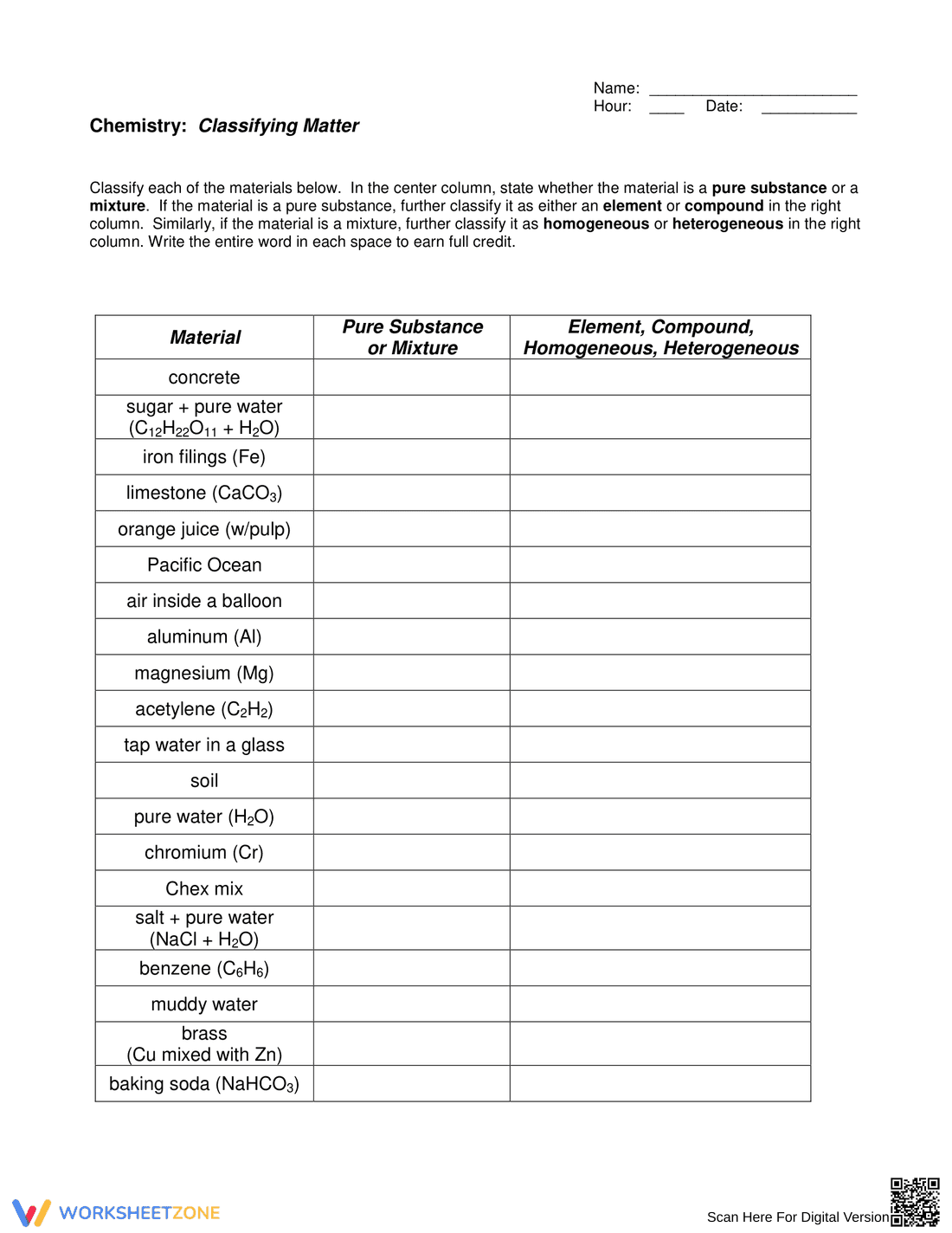
This Grade 8 chemistry worksheet provides a structured framework for students to master the classification of matter. By analyzing 20 different substances, learners develop the critical ability to distinguish between pure substances and mixtures while identifying specific sub-categories like elements and compounds. It ensures students grasp fundamental chemical properties through practical application.
At a Glance
- Grade: 8 · Subject: Science
- Standard:
MS-PS1-1— Develop models to describe the atomic composition of simple molecules and extended structures- Skill Focus: Classifying pure substances and mixtures
- Format: 1 page · 20 problems · Answer key included · PDF
- Best For: Independent practice or quick formative assessment
- Time: 15–20 minutes
The resource features a comprehensive 20-row classification table. Each row presents a material—ranging from common household items like orange juice and Chex mix to chemical compounds like benzene and limestone. Students must complete a two-step classification process: first identifying the broad category (pure substance vs. mixture) and then the specific type (element, compound, homogeneous, or heterogeneous).
Zero-Prep Workflow
This worksheet is designed for immediate classroom implementation with a total teacher prep time of under 2 minutes. First, print the single-page PDF for your class. Second, distribute the sheets as a bell-ringer or exit ticket. Third, review the results using the included answer key for instant feedback. Its self-explanatory layout makes it an ideal emergency sub plan.
Standards Alignment
Primary alignment is to `MS-PS1-1`, which requires students to understand the composition of matter. By distinguishing between elements, compounds, and mixtures, students build the conceptual foundation necessary for modeling atomic structures. Both standard codes can be copied directly into lesson plans, IEP goals, or district curriculum mapping tools.
How to Use It
Use this worksheet during the elaborate phase of a lesson cycle to reinforce vocabulary. It works best after a direct instruction session on the properties of matter. As a formative assessment tip, observe if students struggle with "tap water" versus "pure water," as this reveals their understanding of dissolved minerals. Completion typically takes 15 to 20 minutes.
Who It's For
This resource is tailored for middle school physical science students and introductory high school chemistry learners. It provides excellent support for English Language Learners by using familiar materials to illustrate abstract concepts. Pair this with a physical sorting lab or a digital interactive on molecular structures for a complete unit.
According to the RAND AIRS 2024 report, structured classification tasks are vital for developing scientific literacy and categorical reasoning in middle school learners. This worksheet aligns with MS-PS1-1 by requiring students to differentiate between pure substances and mixtures, a core competency in the NGSS framework. By engaging with 20 distinct examples, students move beyond rote memorization toward a functional understanding of chemical composition. Research from Fisher & Frey (2014) emphasizes that such scaffolded independent practice is essential for the gradual release of responsibility, ensuring students can apply classification rules to novel substances. This resource provides the necessary repetition to achieve mastery in identifying elements, compounds, and various mixture types. It serves as a reliable tool for both general education and specialized instruction, providing clear evidence of student progress toward state science standards.


