


























1 / 2
0
Views
0
Downloads

Save
0 Likes
Share
Classification of Matter Worksheet
0 Views
0 Downloads
Paste this activity's link or code into your existing LMS (Google Classroom, Canvas, Teams, Schoology, Moodle, etc.).
Students can open and work on the activity right away, with no student login required.
You'll still be able to track student progress and results from your teacher account.
Information
Description
What It Is:
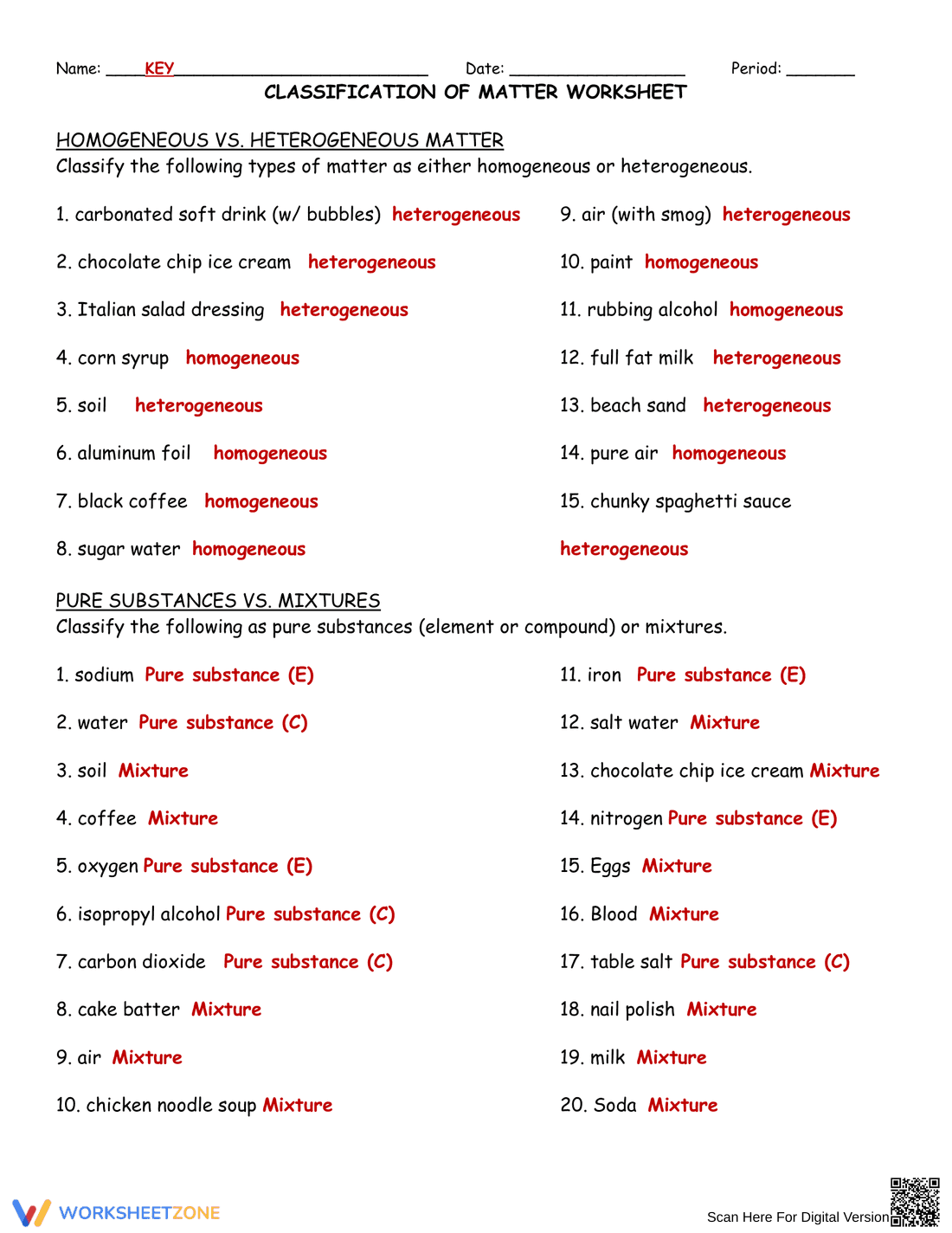
This is a science worksheet titled 'Classification of Matter Worksheet.' It contains two sections. The first section asks students to classify matter as either homogeneous or heterogeneous, using examples like carbonated soft drink, chocolate chip ice cream, and air with smog. The second section requires students to classify matter as either a pure substance (element or compound) or a mixture, using examples like sodium, water, soil, and coffee. The answers are already filled in, indicating this is a key.
Grade Level Suitability:
This worksheet is suitable for middle school (grades 6-8) and early high school (grade 9). It reinforces fundamental concepts in chemistry and physical science related to the states and composition of matter. The examples are relatable and the classification tasks are appropriate for these grade levels.
Why Use It:
This worksheet helps students understand the differences between homogeneous and heterogeneous matter, as well as pure substances and mixtures. It provides practical examples that allow students to apply their knowledge and reinforce key concepts in classifying matter based on its composition and uniformity.
How to Use It:
This worksheet can be used as a practice activity, review assignment, or as a key to check student work. Students should read each example and determine whether it fits the category of homogeneous or heterogeneous matter, or whether it is a pure substance (element or compound) or a mixture. The worksheet can be completed individually or in groups.
Target Users:
This worksheet is designed for science teachers, homeschool educators, and students studying chemistry or physical science. It is particularly useful for students who are learning about the classification of matter and need practice identifying different types of substances.
This is a science worksheet titled 'Classification of Matter Worksheet.' It contains two sections. The first section asks students to classify matter as either homogeneous or heterogeneous, using examples like carbonated soft drink, chocolate chip ice cream, and air with smog. The second section requires students to classify matter as either a pure substance (element or compound) or a mixture, using examples like sodium, water, soil, and coffee. The answers are already filled in, indicating this is a key.
Grade Level Suitability:
This worksheet is suitable for middle school (grades 6-8) and early high school (grade 9). It reinforces fundamental concepts in chemistry and physical science related to the states and composition of matter. The examples are relatable and the classification tasks are appropriate for these grade levels.
Why Use It:
This worksheet helps students understand the differences between homogeneous and heterogeneous matter, as well as pure substances and mixtures. It provides practical examples that allow students to apply their knowledge and reinforce key concepts in classifying matter based on its composition and uniformity.
How to Use It:
This worksheet can be used as a practice activity, review assignment, or as a key to check student work. Students should read each example and determine whether it fits the category of homogeneous or heterogeneous matter, or whether it is a pure substance (element or compound) or a mixture. The worksheet can be completed individually or in groups.
Target Users:
This worksheet is designed for science teachers, homeschool educators, and students studying chemistry or physical science. It is particularly useful for students who are learning about the classification of matter and need practice identifying different types of substances.


