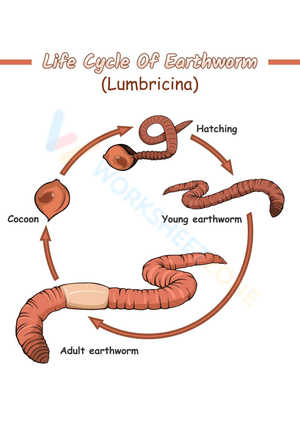
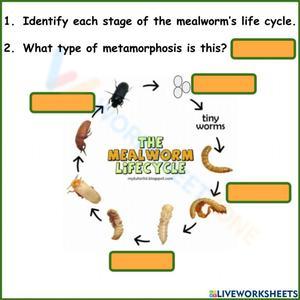
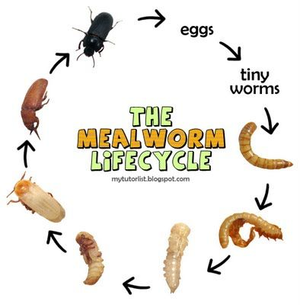
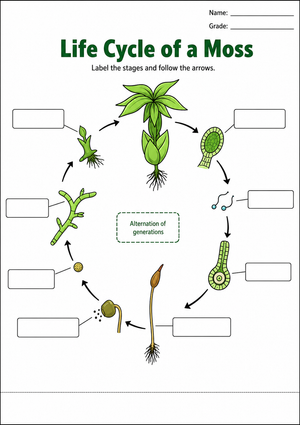
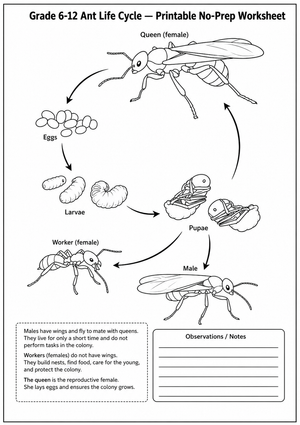
Life cycle printable worksheets for 7th grade earn their place in a unit when they go beyond sequencing diagrams and start asking students to explain why each stage matters — not just what comes next. This set gives teachers a range of focused tasks: labeling, comparative analysis, cause-and-effect prompts, and short constructed responses built around organisms that show meaningful differences in development.
The Analytical Work Inside Each Worksheet
Each worksheet targets a specific scientific idea rather than covering all of life science at once. That focused design keeps cognitive load manageable while still pushing 7th graders toward the kind of thinking middle school life science actually demands.
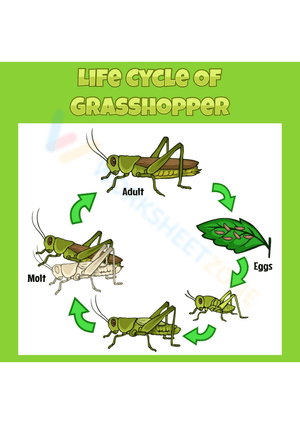
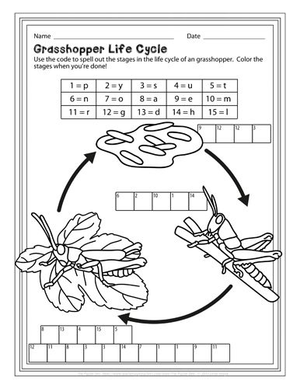
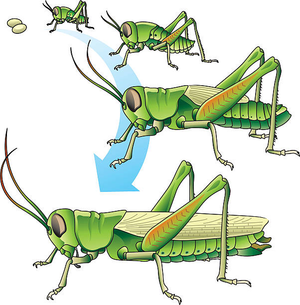
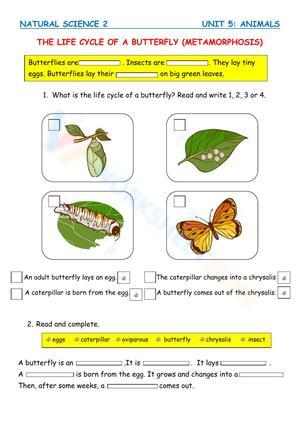
- Comparative organism tasks: Students examine butterflies and grasshoppers side by side to distinguish complete from incomplete metamorphosis, then explain what each developmental pattern means for survival and reproduction.
- Vocabulary in context: Terms like germination, metamorphosis, pollination, and larva appear embedded in diagrams and prompts — not isolated on a separate matching list.
- Environmental cause-and-effect: Prompts ask what happens to a population when a specific life stage is disrupted by habitat loss, drought, or temperature shift.
- Short written responses: Each worksheet reserves space for students to justify a claim using evidence from a diagram or informational passage.
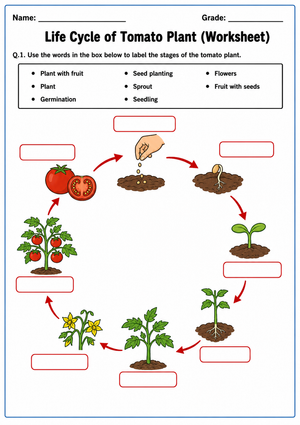
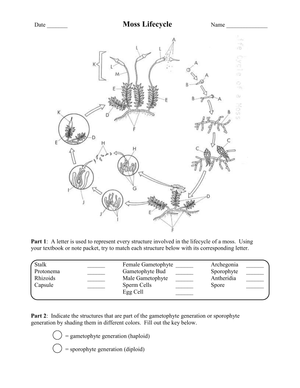
- Plant life cycles: Flowering plant examples cover pollination, fertilization, seed dispersal, and germination, connecting directly to unit work on reproduction and ecosystems.
The consistent thread across the set is one orienting question: how does this stage help the organism survive long enough to reproduce? Students who internalize that question start to read life cycle diagrams as functional systems rather than sequences to memorize.
Fitting These Worksheets Into Your Weekly Lesson Plan
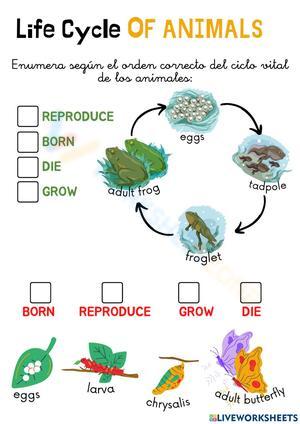
Finding resources that work at multiple points in the instructional week without additional prep is one of the small, practical wins of 7th grade planning. Life cycle printable worksheets for 7th grade address that directly — the same set works as a warm-up, a station task, a homework assignment, or a sub-plan review without adjusting the materials. A half-page diagram question at the start of class takes about 5 minutes and pulls students back into the organism from the previous day — a more reliable re-entry than a verbal recap, especially after a weekend. At stations, different worksheets run simultaneously: one group labels a frog development diagram while another completes a butterfly-to-grasshopper comparison chart, and a third group reads a short passage on plant reproduction and answers text-dependent questions. All three tasks involve the same core concepts; none requires teacher intervention to launch.
For homework, reading-response worksheets work best because they do not depend on classroom materials or lab access. Students read a short informational passage and answer three to five questions about adaptation, environmental pressure, and reproduction. The format is clear enough that parents can see what the assignment asks, which cuts down on the "I didn't understand the directions" problem that frequently surfaces with open-ended science homework.
Mistakes Students Make That These Worksheets Help You Catch
The most predictable error at this level is conflating sequence knowledge with conceptual understanding. A student can correctly label egg, nymph, and adult on a grasshopper diagram and still write — when asked — that "the nymph stage is just a smaller version of the adult." They have memorized the stages without registering that each stage occupies a distinct ecological role: different food sources, different predators, different habitat use. These worksheets surface that gap because the questions move past identification. When a student can label but cannot explain why the nymph lacks wings, the teacher has a specific, actionable gap to address rather than a vague sense that the student "didn't get it."
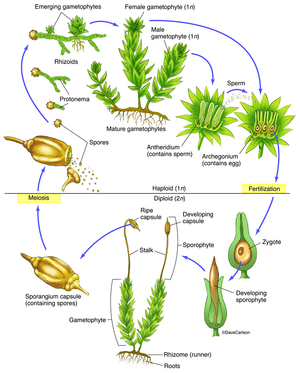
Plant life cycles produce a different kind of confusion. Students commonly treat pollination and fertilization as the same event, which makes the rest of the seed formation sequence hard to follow. Worksheets that separate those two events in a diagram — and ask students to mark exactly where fertilization occurs — make the distinction visible in a way that class discussion alone rarely accomplishes.
A third pattern shows up in environmental scenario questions. Students tend to predict that any disruption to any stage causes extinction. The more accurate reasoning — that disruptions to early stages affect population size while disruptions to reproductive stages affect population persistence — requires repeated practice connecting life cycle logic to population thinking. That is precisely what the scenario prompts in this set build toward.
Standard Alignment
These worksheets align most directly to NGSS MS-LS1-4, which asks students to use argument based on empirical evidence to support explanations for how characteristic animal behaviors and specialized plant structures affect the probability of successful reproduction. The comparison tasks and cause-and-effect prompts in each worksheet build toward that standard by connecting organism structure and behavior — at specific life stages — to reproductive success. Secondary alignment reaches MS-LS2-2, which focuses on how resource availability affects organism populations, making the environmental scenario questions directly relevant. For teachers working with state standards rather than NGSS, the comparison and written-response tasks map onto most state middle school life science expectations around reproduction, heredity, and ecosystem interactions.
Adapting These Worksheets for Different Student Levels
The honest limitation of compare-and-contrast formats is that they require a student to hold two organisms in working memory at once. For students who find that difficult, the same comparison task can be restructured: answer all questions for organism A first, then answer the same questions for organism B, then compare. That sequence reduces the simultaneous cognitive demand without lowering the scientific expectation. When selecting life cycle printable worksheets for 7th grade for a mixed-readiness class, look for sets that vary the amount of reading and the depth of written explanation required while keeping the science content consistent across all levels.
- Students needing additional support: Provide word banks, pre-labeled diagrams where students annotate function rather than name parts, and sentence starters for written responses — "This stage helps the organism survive by..."
- On-level learners: Assign the worksheets as designed — diagram tasks paired with short explanatory prompts and at least one comparison across two organisms.
- Students ready for extension: Add a three-organism comparison, require a written claim supported by two pieces of diagram evidence, or introduce a scenario where one stage is eliminated and students predict population-level effects across two generations.
For English language learners, diagram-heavy worksheets are a reliable entry point. Visual tasks give students access to the science content before they have to produce extended written English, and vocabulary embedded in diagrams serves as language support without requiring a separate handout.
Frequently Asked Questions
How are these worksheets different from elementary life cycle activities?
Elementary life cycle work focuses on identifying and ordering stages. These worksheets ask students to explain why stages exist — how each one serves the organism's survival and reproduction — and to compare patterns across multiple organisms. The shift from identification to analysis is the defining difference at the middle school level.
Which organisms appear across the set?
The set includes butterflies, grasshoppers, frogs, and flowering plants. Those four were chosen because they cover complete metamorphosis, incomplete metamorphosis, amphibian development with habitat shifts, and plant reproduction — enough variety that students encounter meaningfully different developmental patterns rather than slight variations on the same sequence.
Can these worksheets serve as assessment tools rather than just practice?
Yes. The reading-response and written-claim formats translate directly into assessment use. A sequence that moves from diagram labeling to comparative analysis to a constructed response — spread across three or four worksheets over a unit — shows whether students can transfer life cycle knowledge across organisms, which is the actual standard at this level. Life cycle printable worksheets for 7th grade that include written justification give teachers something more informative than a fill-in score: they reveal the reasoning gap, not just the wrong answer.
How much class time does each worksheet take?
Labeling and sequencing worksheets typically take 8 to 12 minutes. Comparison charts and reading-response worksheets run closer to 15 to 20 minutes, depending on reading level and the number of written prompts. Most teachers find the shorter formats work well as warm-up or closing tasks, while the longer formats are better suited to independent work blocks or station rotations.
Are the plant life cycle worksheets strong enough for a stand-alone plant unit?
The plant worksheets cover pollination, fertilization, seed dispersal, and germination with enough depth to carry a focused mini-unit. They work best when paired with brief direct instruction on the difference between pollination and fertilization — a distinction that trips up nearly every 7th grader encountering it for the first time, and one that the worksheets alone will not fully resolve without some front-loading.












 Interactive Worksheet Maker
 Quiz Maker
 Word Search Maker
 Crossword Puzzle Maker
 Word Scramble Generator
 Sentence Scramble Generator
 Handwriting Worksheet Generator
 Name Tracing Generator
 Fill In The Blank Generator