7th Grade Moss Worksheets for Life Cycle and Plant Study
7th grade moss worksheets give life science teachers a direct way to address one of the most misunderstood plant groups in the middle school curriculum. Moss sits at the intersection of classification, reproduction, and habitat — three threads that run through the 7th grade life science sequence — and a well-designed worksheet makes those connections concrete before students move on to ferns or seed plants. This set focuses on nonvascular plant structure, the moss life cycle, and the relationship between water and spore reproduction.
What Each Worksheet Addresses
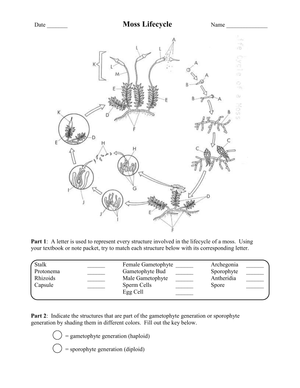
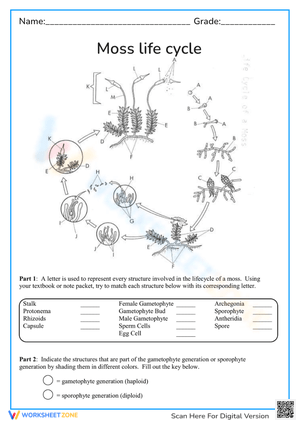
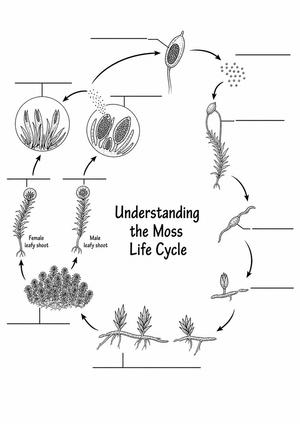
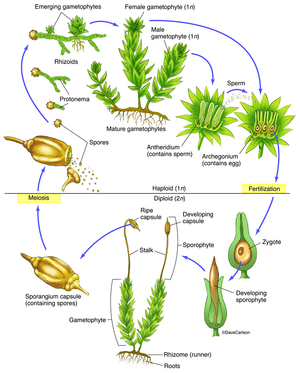
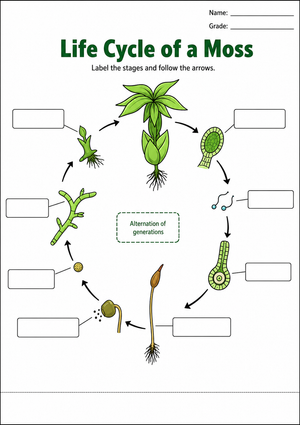
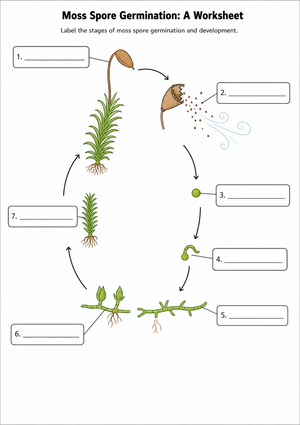
Across 7th grade moss worksheets in this set, each resource targets a distinct aspect of moss biology rather than cramming everything into one sprawling task. The life cycle labeling worksheet has students identify the spore, protonema, gametophyte, and sporophyte stages on a diagram — with prompts that ask them to state the function of each structure, not just its name. A sequencing task places life cycle events out of order and asks students to reconstruct the correct progression, which shifts the cognitive demand from recognition to active recall.
The comparison chart asks students to mark which structures — true roots, vascular tissue, seeds, flowers — are present in moss, a fern, and a flowering plant. This is where plant diversity becomes visible rather than abstract. A short reading passage accompanies the comparison chart, focused on moist habitats and spore reproduction, with annotation tasks that direct students to underline causal relationships rather than simply highlight facts. Review tasks use short-answer prompts, matching, and diagram questions — the format that works equally well as an exit ticket or a homework assignment without modification.
Mistakes Students Make That These Worksheets Help You Catch
The error that shows up most consistently in student work is the gametophyte-sporophyte inversion. Students regularly label the green mat as the sporophyte and the brown stalk as the gametophyte. The reasoning is almost always the same: sporo- sounds like it should name the dominant, visible structure, and the stalk clearly holds spores, so students conclude it must be the sporophyte. The labeling worksheet addresses this by requiring students to identify which stage is haploid and which produces gametes — not just which carries which name — forcing the conceptual connection rather than letting students match terms to a picture and move on.
A second pattern is treating moss as an early or immature form of grass. Students who hold this idea sometimes write in their annotations that moss will "grow into" a larger plant given enough time. The comparison chart disrupts that assumption more effectively than a correction on the board: when students mark that moss lacks vascular tissue and seeds while a flowering plant has both, it becomes clear that these are not two developmental stages of the same organism.
The water-fertilization connection also generates errors worth anticipating. Students frequently write that moss grows in wet places because "it likes moisture" — a circularity that sidesteps the actual mechanism. Short-answer prompts that ask students to explain why water is required for fertilization surface that gap directly. When the answer has to include sperm motility, students can no longer stop at habitat description.
Building These Worksheets Into Your Lesson Sequence
The life cycle labeling worksheet works best as a first-day task, after a brief observation opener. A photograph of moss on a shaded rock face or the base of a tree gives students two minutes to write what they notice about size, texture, and location before any vocabulary appears. That builds a concrete visual the diagram can anchor to. Model the first two labels, then let students complete the rest with a partner. Keeping the image visible during that partner work reduces confusion without making the task easier.
On the following day, the short reading and comparison chart pair well in a 20-minute independent block. Ask students to underline every sentence explaining why moss lives in moist environments, then circle every reference to reproduction before they touch the chart. Those annotations become the evidence base when students fill in the chart's cells — they apply text information rather than guess at answers.
Stations work particularly well for this topic. One station anchors vocabulary with the labeling task, a second runs the sequencing exercise, and a third uses the comparison chart. 7th grade moss worksheets in this set are built as standalone resources, so rotating students through three stations in one class period requires no modification to the materials. End the unit with a five-item check — ask students to name one nonvascular trait, place two life cycle stages in correct order, or explain water's role in fertilization — and the results tell you exactly where to spend the next morning's opening ten minutes.
Standard Alignment
These worksheets align with NGSS MS-LS1-4, which asks students to construct evidence-based arguments explaining how organism traits relate to survival and reproduction. Moss is a clean case study for that standard: the absence of vascular tissue, the requirement for external water during fertilization, and reliance on spore dispersal each connect a structural trait directly to habitat constraints. Teachers who frame the lesson around "what does this structure tell us about where moss can live?" find the worksheet prompts fit MS-LS1-4 language naturally. The life cycle and comparison tasks also support MS-LS3-2, which addresses how reproduction varies across organisms — the set gives students a concrete comparative model before they encounter flowering plant reproduction later in the unit.
Differentiating These Worksheets Across Ability Levels
7th grade moss worksheets in this set include word banks on the life cycle labeling diagrams. Students who are still building scientific vocabulary use the word bank as a reference without changing the thinking demand of the task itself. Students who move through the labeling quickly can extend by writing one sentence explaining the function of each labeled structure — a shift from identification to application that requires no additional materials.
The comparison chart offers the widest range of adjustment. At a basic level, students mark which structures are present or absent with a checkmark. A step further, they write brief explanations for each absence — "Moss does not have seeds because ___" — connecting structure to function rather than just recording a fact. For students who need additional language support, sentence frames alongside the chart keep the thinking moving without reducing the conceptual demand of the task.
Short-answer prompts on the review worksheets are easy to adjust by question type before printing. "Name two nonvascular traits of moss" asks for recall. "Explain how the absence of vascular tissue limits where moss can grow" applies the same content at a higher level. The same students, the same worksheet, a different cognitive demand — the adjustment takes about 30 seconds per question.
Frequently Asked Questions
What background knowledge do students need before using these worksheets?
Students need basic familiarity with what a plant is — something green that produces food through photosynthesis. No prior study of plant cells, cell walls, or chloroplasts is required. The worksheets work at the organism level, so 7th graders who haven't yet covered cell biology in depth work through every task without a knowledge gap.
How long does each worksheet take to complete?
The labeling and sequencing worksheets typically take 12 to 15 minutes for an on-grade-level student. The comparison chart runs longer — closer to 20 to 25 minutes — because students generate explanations rather than identify terms. Review tasks used as exit tickets take about 10 minutes. Plan accordingly if you're pairing more than one worksheet in a single class period.
Can the life cycle labeling worksheet be used without the reading passage?
Yes. The labeling worksheet is self-contained and holds up as a first-exposure task during direct instruction, a review tool later in the unit, or a reteach resource for students who struggled the first time. The reading passage adds context and causal evidence but is not a prerequisite for completing the diagram.
Do these worksheets work as substitute lesson materials?
The labeling and sequencing worksheets work well with a substitute because the directions are written for students and the tasks don't require live instruction to begin. The comparison chart works better when a teacher models the first row before students continue independently — that brief setup prevents the most common confusion about what "present" and "absent" mean in a chart comparing plant structures across three organism types.
Clear All