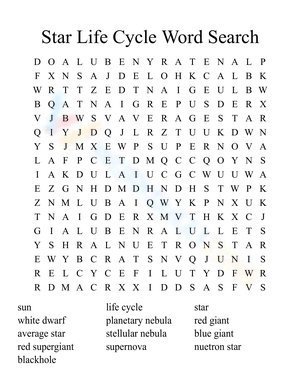
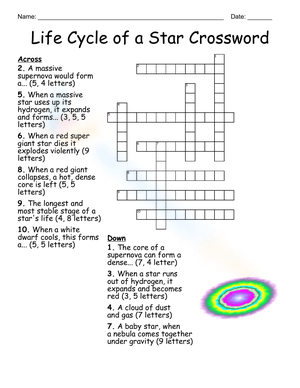
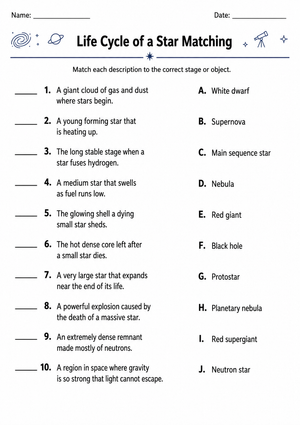
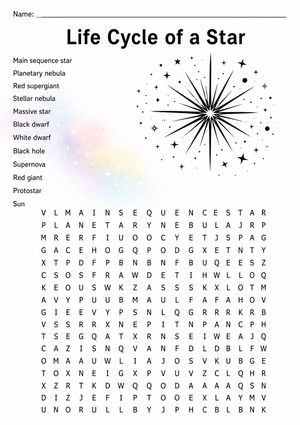
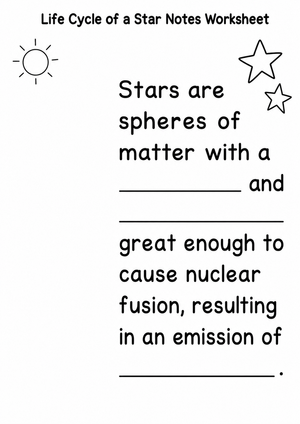
Life cycle of a star printable worksheets for 7th grade give teachers a concrete path through one of middle school astronomy's most process-heavy topics. Students at this age can handle the full sequence — nebula through the branching endpoints of white dwarf or black hole — but they need multiple passes at the content before the logic of mass-dependent endings really sticks. These worksheets deliver that repetition through formats that move between recognition and explanation.
The Core Sequence Students Need to Own
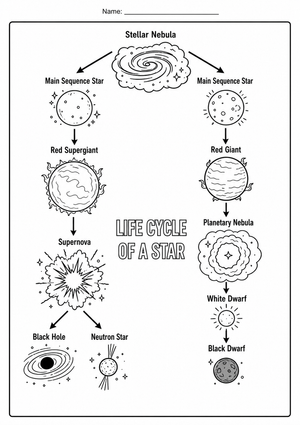
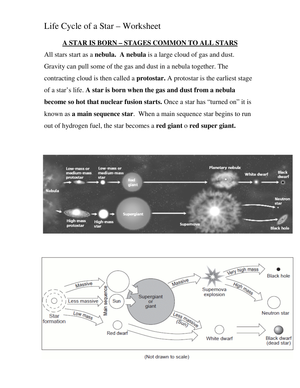
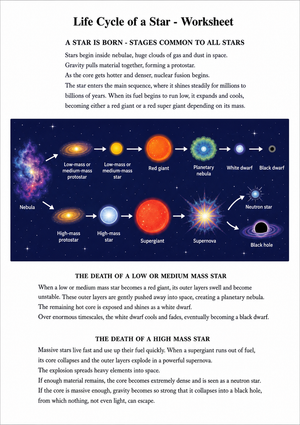
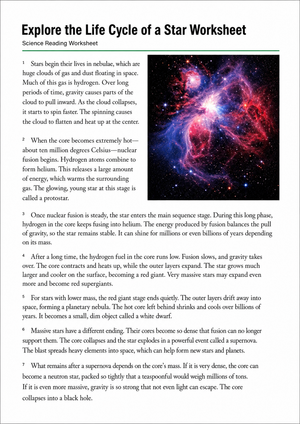
Seventh grade astronomy introduces students to two parallel story lines that share the same opening chapters. Every star begins as a nebula — a cloud of gas and dust pulled together by gravity — passes through the protostar stage, and then settles into the main sequence, where it spends the vast majority of its existence burning hydrogen through nuclear fusion. What happens after that depends entirely on mass.
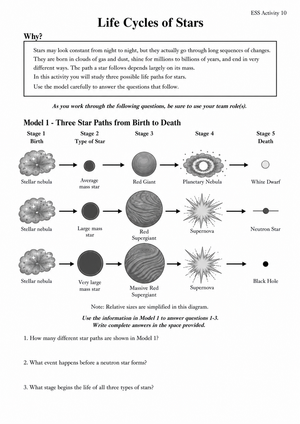
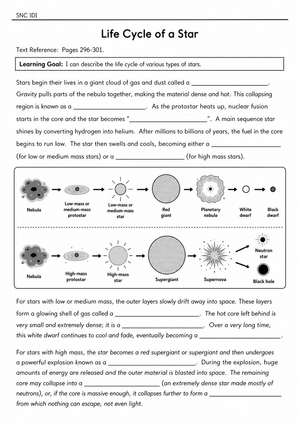
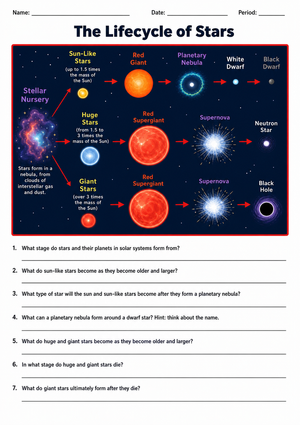
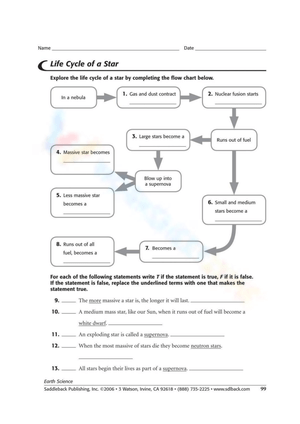
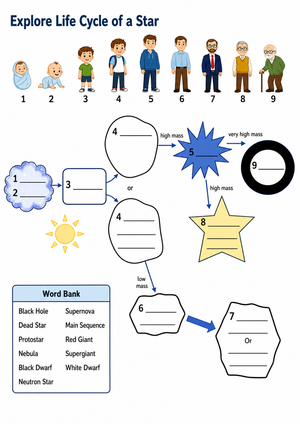
An average-mass star (similar to our sun) swells into a red giant, sheds its outer layers as a planetary nebula, and collapses into a white dwarf. A massive star takes a more dramatic route: red supergiant, supernova explosion, then either neutron star or black hole depending on how much mass remained. Each worksheet in the set asks students to work with this branching structure in a different format — labeling, sequencing, comparing, explaining — so the logic becomes familiar across multiple encounters rather than memorized once and forgotten before the test.
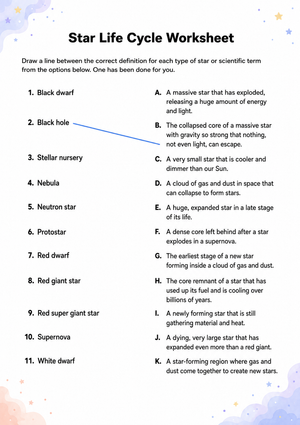
Students work with the following vocabulary across the set:
- Nebula — the gas and dust cloud where star formation begins
- Protostar — the collapsing cloud stage before sustained nuclear fusion begins
- Main sequence — the stable, fusion-powered period that defines most of a star's life
- Red giant — the expansion stage for average-mass stars
- Red supergiant — the expansion stage for massive stars
- Planetary nebula — the expelled outer layers of an average-mass star
- White dwarf — the dense remnant left by an average-mass star
- Supernova — the explosive death of a massive star
- Neutron star — one possible dense remnant after a supernova
- Black hole — the other possible remnant when a massive star's core collapses completely
Where Students Consistently Lose the Thread
The single most predictable error in student work on this topic: students assume every star ends as a black hole. The word "supernova" carries cultural weight from movies and games, and students apply it to all stars regardless of mass. Worksheets that ask students to label both pathways side by side do the most to disrupt this assumption — when students trace two separate routes on a diagram, the conditional logic (if massive, then supernova; if average, then red giant) becomes visible rather than abstract.
A second error worth watching: students frequently confuse the protostar stage with the main sequence. The protostar is a collapsing cloud that has not yet started sustained nuclear fusion; the main sequence begins when fusion stabilizes and the star reaches equilibrium. Students who rush through vocabulary matching treat these as interchangeable because both feel like "a star forming." Worksheets that pair definitions with process descriptions — not just terms with labels — surface this confusion faster than multiple-choice alone.
A quieter but consistent third problem: students place the planetary nebula on the massive-star pathway because "nebula" appears at both ends of the star life cycle. If a diagram doesn't clearly anchor planetary nebula to average-mass stars only, this error turns up in nearly every class set. Branching visuals with explicit labels on each branch prevent that misreading before it forms.
Fitting These Worksheets Into a Two-Day Astronomy Sequence
The branching structure of this topic suits a two-day sequence well, and life cycle of a star printable worksheets for 7th grade fit cleanly into both days without extra prep work. On day one, teach the shared beginning: nebula, protostar, main sequence. A labeling worksheet with a word bank works here because students are building vocabulary for the first time, and holding new terms alongside a new sequence in working memory is already a full cognitive load for a standard 45-minute period.
Day two can introduce the branching endpoints. A compare-and-contrast worksheet that places the average-star path and the massive-star path in parallel columns gives students a visual anchor for a concept they otherwise tangle. After students complete that worksheet independently, the teacher-led debrief can focus on why mass is the deciding variable — which is the conceptual move students most often skip when left to summarize on their own.
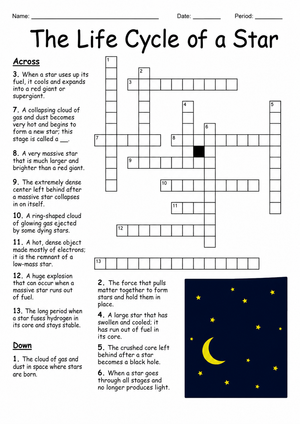
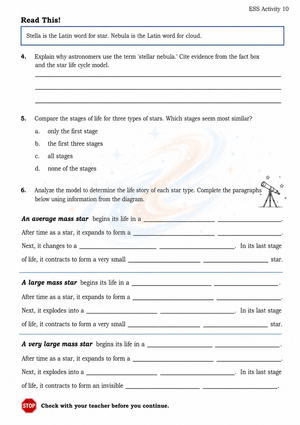
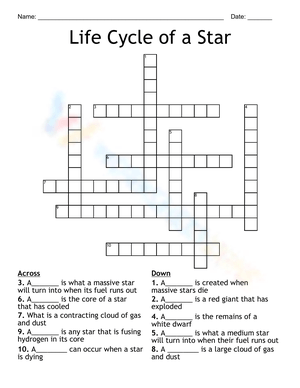
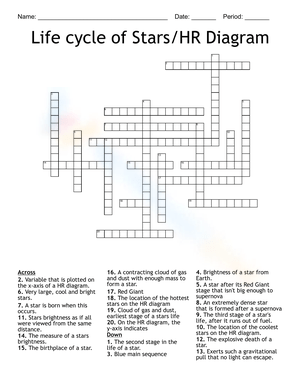
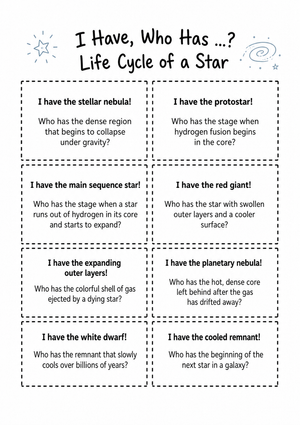
The set also breaks cleanly into stations. A vocabulary matching station, a cut-and-sort sequencing station, a short reading station with comprehension questions, and a constructed-response station (write two sentences explaining why a massive star doesn't end as a white dwarf) cover the same content four different ways in one period without feeling repetitive. Students who finish early at any station can attempt a challenge prompt without stalling the rotation.
For a Friday review block or the day before a quiz, a mixed worksheet — labeling combined with a written comparison — surfaces remaining misconceptions quickly. A teacher can scan those responses in under ten minutes and know exactly which gaps still need attention before the assessment.
Tiering the Worksheets for a Range of Learner Readiness
Working life cycle of a star printable worksheets for 7th grade into a differentiated lesson is straightforward because the adjustments sit mostly in the support structure, not in the science content itself. For students who struggle with the volume of new terms, a word bank arranged in rough sequence order — rather than alphabetically — removes a hidden sorting task and lets them focus on the astronomy. Sentence frames such as After the main sequence, a massive star becomes a... or An average star's final stages differ from a massive star's because... help students begin written explanations without stalling on first-sentence paralysis.
For students who have the stages sorted and want a deeper challenge, two moves work well with the existing set. Ask them to annotate a completed diagram by writing a cause-and-effect note at each transition arrow — that turns a labeled list into a reasoned argument. Or ask them to explain the role of gravity and nuclear fusion at two specific moments in the sequence: during initial star formation and during the transition out of the main sequence. Both tasks use worksheets already in the set rather than requiring separate materials.
Reading Completed Worksheets as Formative Evidence
Because the star life cycle is process-based, these worksheets function as useful checkpoints, not just graded tasks. A multiple-choice quiz shows whether students recognize vocabulary, but a short sequencing task or comparison question reveals depth of understanding that recognition alone can't confirm. When students correctly place stages and explain in writing why stars have different endpoints, they are demonstrating causal reasoning — not just recall of a memorized list.
Teachers can keep grading simple by looking for three things: correct sequence, accurate vocabulary, and a written explanation that connects mass to outcome. Even two sentences — A massive star ends as a supernova because it has enough mass to... — show whether a student grasps the underlying logic or is reciting memorized terms in order.
Frequently Asked Questions
How long does each worksheet take to complete?
Labeling and sequencing worksheets typically take 10 to 20 minutes during class. Short reading worksheets with comprehension questions usually need a 25- to 30-minute block. Compare-and-contrast and constructed-response tasks vary by student, but most fall in the same 20- to 30-minute range.
Do students need prior knowledge of nuclear fusion to use these worksheets?
Not in depth. Students need to understand that fusion powers a star — not the mechanics of proton combination. The worksheets treat fusion as context for why stars change when hydrogen fuel runs low, not as a separate content standard requiring its own instruction beforehand.
How do these worksheets connect to a textbook-based astronomy unit?
They work best as practice between lessons rather than replacements for reading. Assigning a vocabulary or labeling worksheet after a textbook section on stellar formation, then using the compare-and-contrast worksheet after the lesson on stellar endpoints, spaces the practice across the unit. That distribution holds up better than a single massed review session the night before a quiz — which is when most students try to process the branching structure for the first time.
Are these appropriate for 6th or 8th grade as well?
The content and reading level of life cycle of a star printable worksheets for 7th grade fit that grade's expectations most directly. A 6th grade class moving through an accelerated astronomy unit and an 8th grade class reviewing for a state assessment can both use the set without modification — but the vocabulary density and the expectation of multi-sentence scientific explanation are calibrated to 7th grade science norms.












 Interactive Worksheet Maker
 Quiz Maker
 Word Search Maker
 Crossword Puzzle Maker
 Word Scramble Generator
 Sentence Scramble Generator
 Handwriting Worksheet Generator
 Name Tracing Generator
 Fill In The Blank Generator