




























0
Views
0
Downloads

0.0
0
Save
0 Likes
Share
Moss Life Cycle Wheel Worksheet
0 Views
0 Downloads

Paste this activity's link or code into your existing LMS (Google Classroom, Canvas, Teams, Schoology, Moodle, etc.).
Students can open and work on the activity right away, with no student login required.
You'll still be able to track student progress and results from your teacher account.
Information
Description
What It Is:
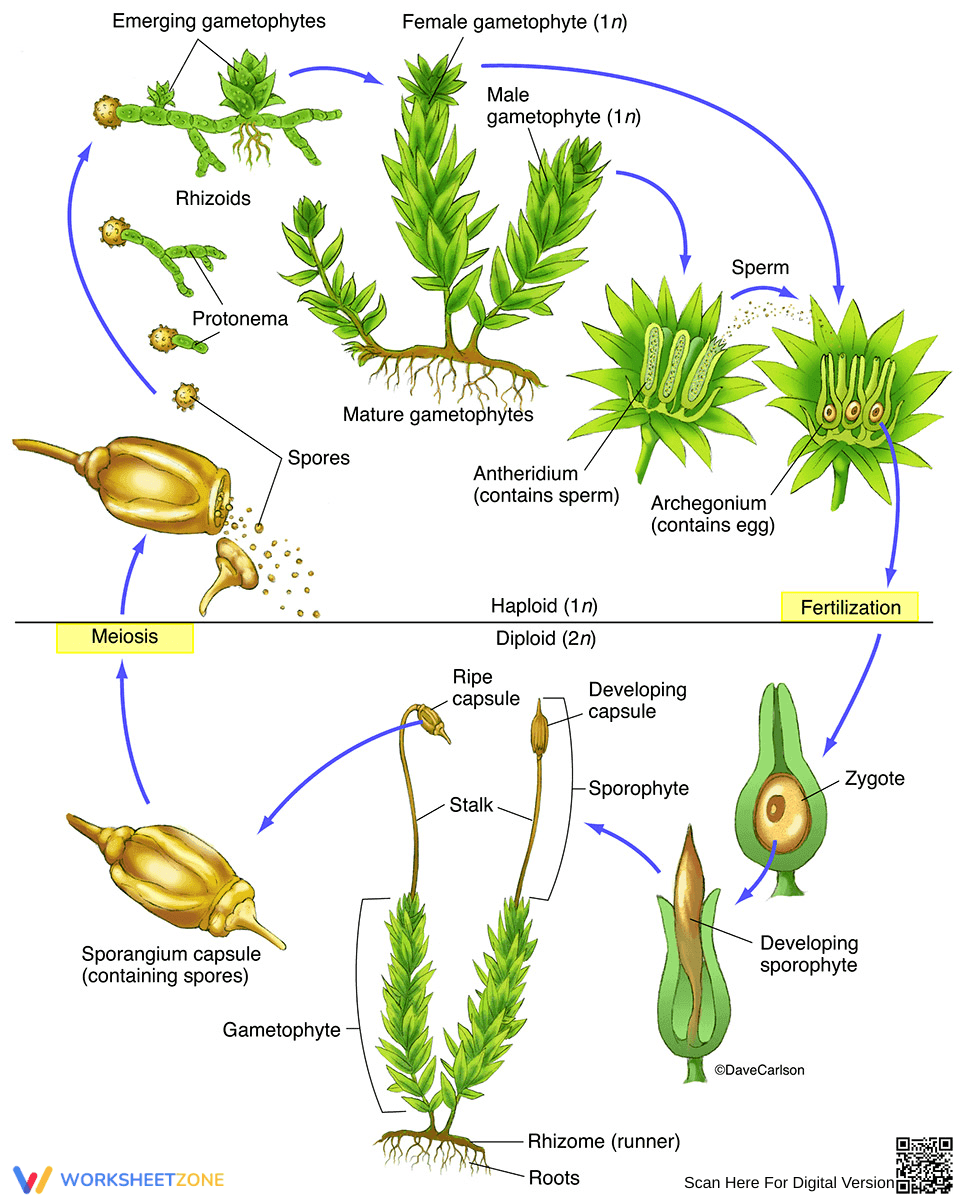
This is a biology diagram illustrating the life cycle of a moss. It shows the alternation of generations between the haploid gametophyte and diploid sporophyte stages. The diagram includes labeled parts such as rhizoids, protonema, mature gametophytes (male and female), antheridium, archegonium, sperm, spores, sporangium capsule, ripe capsule, stalk, sporophyte, zygote, developing sporophyte, rhizome, and roots. The diagram also shows the processes of meiosis and fertilization.
Grade Level Suitability:
This worksheet is suitable for high school biology (grades 9-12) and introductory college biology courses. The complexity of the life cycle and the specific terminology used require a foundational understanding of biological concepts.
Why Use It:
This diagram helps students visualize and understand the complex life cycle of moss, emphasizing the alternation of generations. It allows students to learn about the different structures involved in moss reproduction and to understand the processes of meiosis and fertilization in this context.
How to Use It:
Use this diagram as a visual aid during a lesson on plant reproduction or the life cycles of non-vascular plants. Students can use it to label the different parts of the moss life cycle, trace the stages from spore to spore, and explain the difference between the gametophyte and sporophyte generations. It can also be used as a study tool for quizzes and tests.
Target Users:
The target users are high school and college biology students studying plant reproduction, non-vascular plants, and life cycles. Teachers can also use it as a teaching resource.
This is a biology diagram illustrating the life cycle of a moss. It shows the alternation of generations between the haploid gametophyte and diploid sporophyte stages. The diagram includes labeled parts such as rhizoids, protonema, mature gametophytes (male and female), antheridium, archegonium, sperm, spores, sporangium capsule, ripe capsule, stalk, sporophyte, zygote, developing sporophyte, rhizome, and roots. The diagram also shows the processes of meiosis and fertilization.
Grade Level Suitability:
This worksheet is suitable for high school biology (grades 9-12) and introductory college biology courses. The complexity of the life cycle and the specific terminology used require a foundational understanding of biological concepts.
Why Use It:
This diagram helps students visualize and understand the complex life cycle of moss, emphasizing the alternation of generations. It allows students to learn about the different structures involved in moss reproduction and to understand the processes of meiosis and fertilization in this context.
How to Use It:
Use this diagram as a visual aid during a lesson on plant reproduction or the life cycles of non-vascular plants. Students can use it to label the different parts of the moss life cycle, trace the stages from spore to spore, and explain the difference between the gametophyte and sporophyte generations. It can also be used as a study tool for quizzes and tests.
Target Users:
The target users are high school and college biology students studying plant reproduction, non-vascular plants, and life cycles. Teachers can also use it as a teaching resource.


