


























Views
Downloads
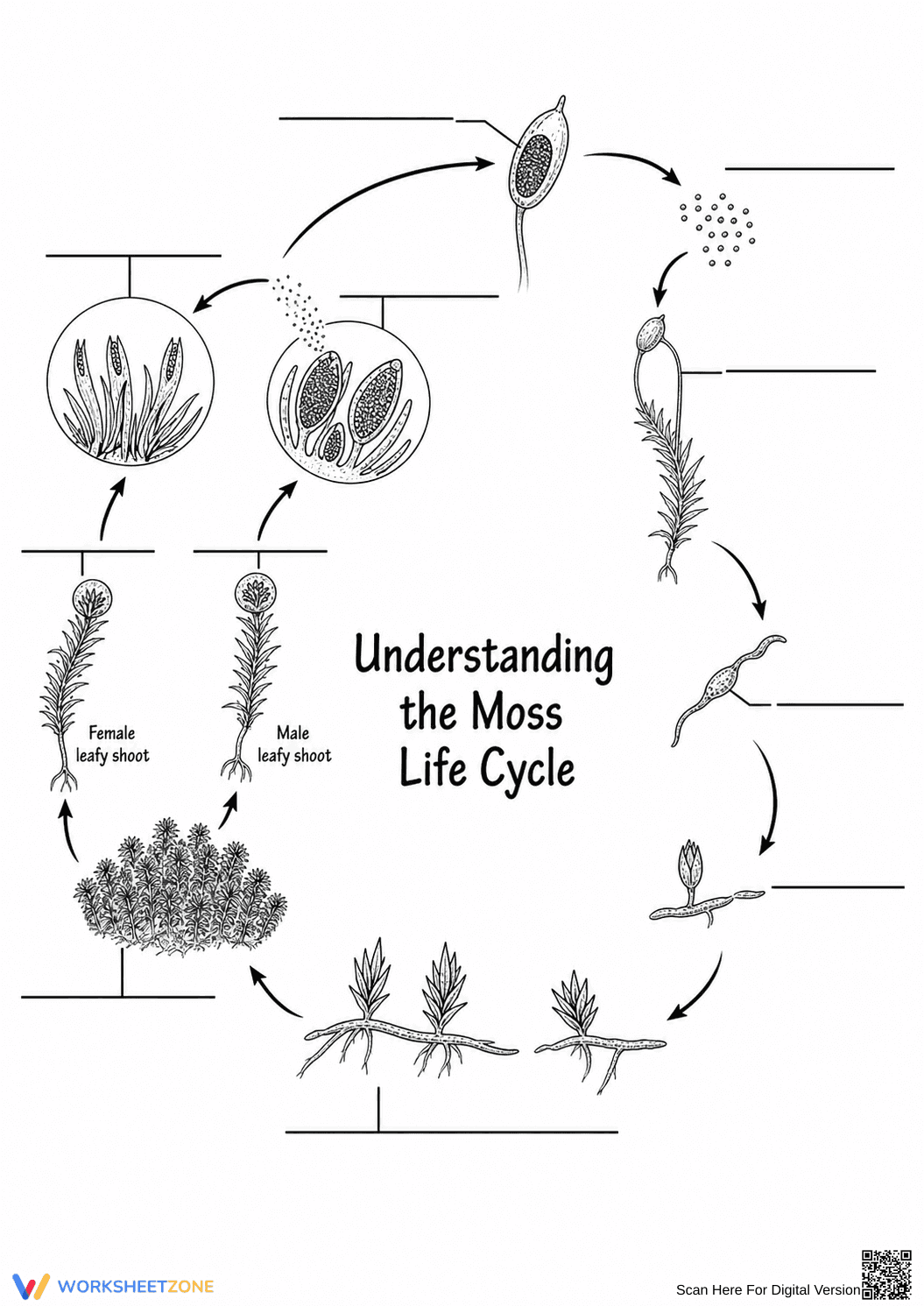

Grade 7 Moss Life Cycle — Printable No-Prep Worksheet
Paste this activity's link or code into your existing LMS (Google Classroom, Canvas, Teams, Schoology, Moodle, etc.).
Students can open and work on the activity right away, with no student login required.
You'll still be able to track student progress and results from your teacher account.
This Grade 7 science worksheet provides students with a clear, visual method to master the stages of non-vascular plant reproduction. By labeling a detailed diagram of the moss life cycle, learners will identify key structures like spores, sporophytes, and gametophytes, solidifying their understanding of specialized plant structures and reproductive strategies.
At a Glance
- Grade: 7 · Subject: Science
- Standard:
MS-LS1-4— Identify specialized plant structures affecting reproduction- Skill Focus: Labeling the moss life cycle
- Format: 1 page · 9 problems · Answer key included · PDF
- Best For: Independent practice or review
- Time: 10–15 minutes
Inside this single-page resource, educators will find a beautifully illustrated, comprehensive diagram of the moss life cycle. The worksheet features nine distinct labeling tasks that guide students through the alternation of generations, from the release of spores to the development of male and female leafy shoots. A complete answer key is provided to ensure accurate grading and immediate student feedback.
This resource is designed for immediate classroom implementation with a streamlined workflow:
- Print (1 minute): Download the PDF and print a class set. The high-contrast line art ensures crisp copies.
- Distribute (1 minute): Hand out the diagrams as a warm-up, guided notes supplement, or quick formative assessment.
- Review (3 minutes): Display the answer key on your smartboard to allow students to self-correct their labeled stages.
With under two minutes of total teacher preparation required, this activity is an excellent addition to any emergency sub plan or busy instructional week.
Aligned to MS-LS1-4, this activity supports the standard: "Use argument based on empirical evidence and scientific reasoning to support an explanation for how characteristic animal behaviors and specialized plant structures affect the probability of successful reproduction of animals and plants respectively." By identifying the specific reproductive structures of mosses, students build the foundational vocabulary needed to construct these scientific explanations. Both standard codes can be copied directly into lesson plans, IEP goals, or district curriculum mapping tools.
This diagram is highly versatile and fits perfectly into the "during instruction" phase of a botany or life science unit. Teachers can project the blank diagram on the board and have students fill in their physical copies as the class discusses the alternation of generations. Alternatively, it serves as an effective formative assessment tool; observe students as they attempt to label the sporophyte and gametophyte stages from memory to gauge their retention of the material. Expected completion time ranges from 10 to 15 minutes.
This resource is primarily designed for middle school life science students, though it serves as an excellent introductory or review tool for high school biology classes. For students requiring accommodations, teachers can easily provide a word bank on the board to reduce cognitive load and support vocabulary recall. It pairs perfectly with a direct instruction lesson on non-vascular plants or a hands-on moss observation lab.
Mastering scientific vocabulary through visual diagrams is a critical component of life science education. When students actively label structures in the moss life cycle, they are better equipped to identify specialized plant structures affecting reproduction, directly supporting the goals of MS-LS1-4. According to a ScienceDirect TpT Analysis, integrating visual models with targeted vocabulary practice significantly improves student retention of complex biological processes like the alternation of generations. By requiring learners to map terms directly onto a visual representation, this worksheet reduces extraneous cognitive load and promotes deeper conceptual understanding. This approach ensures that students do not merely memorize terms in isolation, but rather comprehend how each structure functions within the broader context of plant reproduction and survival.


