


























Views
Downloads

Tomato Plant Life Cycle — Printable Grade 6/7 Science
Paste this activity's link or code into your existing LMS (Google Classroom, Canvas, Teams, Schoology, Moodle, etc.).
Students can open and work on the activity right away, with no student login required.
You'll still be able to track student progress and results from your teacher account.
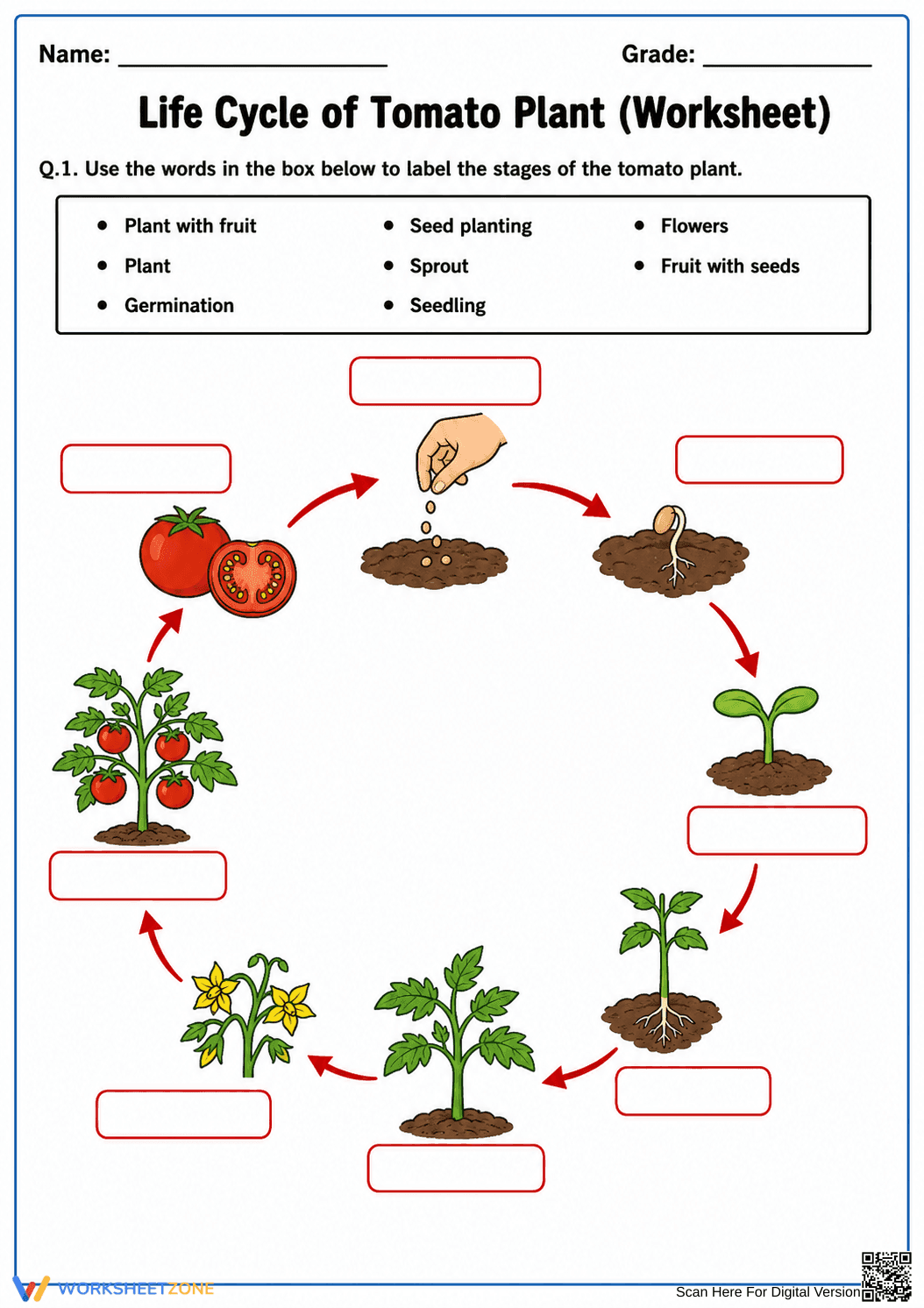
This worksheet provides a clear, visual framework for students to identify and sequence the biological stages of a tomato plant. By labeling the circular diagram, learners solidify their understanding of plant reproduction and growth cycles. It serves as an efficient tool for reinforcing botanical vocabulary and life science concepts in a structured format.
At a Glance
- Grade: 6-7 · Subject: Life Science
- Standard:
MS-LS1-4— Use evidence to support how characteristic behaviors and specialized structures affect reproduction- Skill Focus: Plant life cycle sequencing
- Format: 1 page · 8 problems · Answer key included · PDF
- Best For: Quick formative assessment or sub plans
- Time: 15–20 minutes
The resource features a single-page layout containing a comprehensive word bank and a circular flow diagram. Students must match 8 specific terms—including germination, seedling, and fruit with seeds—to the correct visual representation. The clear arrows indicate the direction of growth, and the included answer key allows for immediate student feedback or easy grading.
Zero-Prep Workflow
- Print: Generate the single-page PDF in seconds for your entire class.
- Distribute: Hand out the worksheet as a warm-up or independent practice activity.
- Review: Use the provided answer key for a quick check for understanding or peer-grading session.
Standards Alignment
The worksheet aligns with `MS-LS1-4`, focusing on the specialized structures of plants that facilitate growth and reproduction. By identifying stages like flowering and seed production, students observe the physical changes necessary for a species to continue its life cycle. Both standard codes can be copied directly into lesson plans, IEP goals, or district curriculum mapping tools.
How to Use It
Use this worksheet during the "Explain" phase of a 5E lesson model to verify that students can distinguish between early growth stages like sprouting and germination. It also works well as a formative assessment after a garden observation. Expect students to complete the labeling in approximately 15 minutes, allowing for a brief follow-up discussion on the role of pollinators in the flowering stage.
Who It's For
This activity is tailored for middle school science students, particularly those requiring visual aids to grasp biological sequences. It is highly effective for English Language Learners (ELLs) due to the direct pairing of vocabulary with clear illustrations. Pair this worksheet with a live tomato plant observation or a time-lapse video of plant growth to provide a multi-sensory learning experience.
According to the RAND AIRS 2024 report on science literacy, visual sequencing tasks significantly improve long-term retention of biological processes in middle school learners. This worksheet addresses the MS-LS1-4 standard by requiring students to identify the specific developmental milestones of a tomato plant, from seed planting to mature fruit production. By engaging with the 8 distinct stages, students build a mental model of plant reproduction that serves as a foundation for more complex genetic and environmental studies. Research from Fisher & Frey (2014) suggests that scaffolded vocabulary tasks, such as this word-bank-supported diagram, are essential for bridging the gap between basic observation and scientific explanation. This resource provides a high-utility, evidence-based approach to life science instruction, ensuring that students can accurately describe the life cycle of flowering plants within a standard-aligned curriculum.


