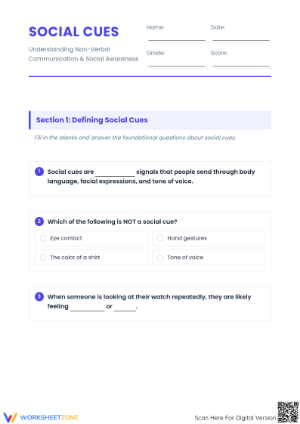
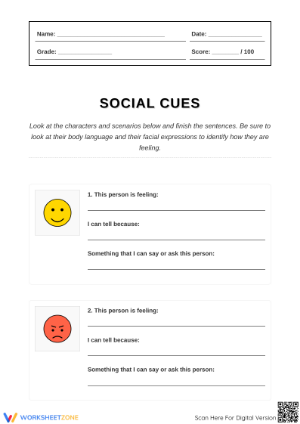
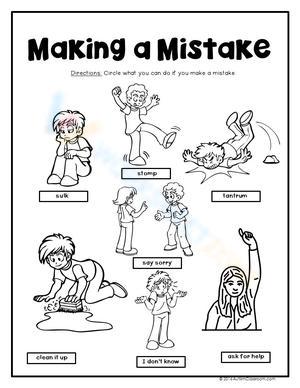
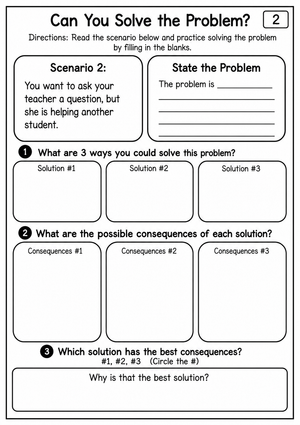
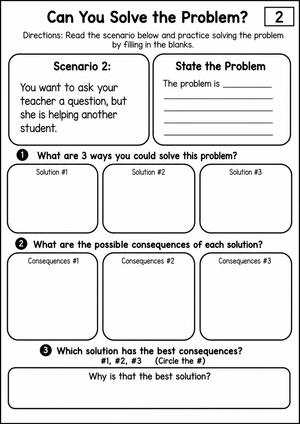
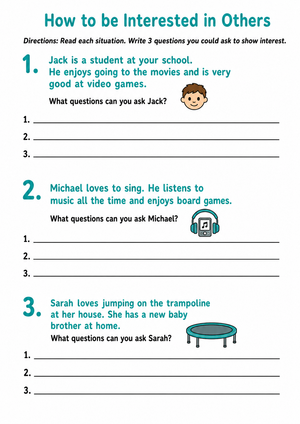
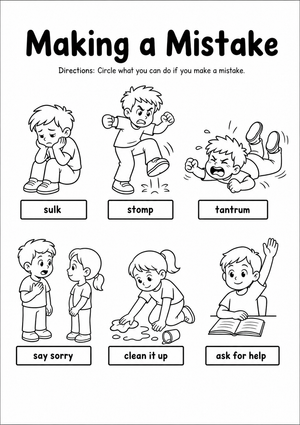
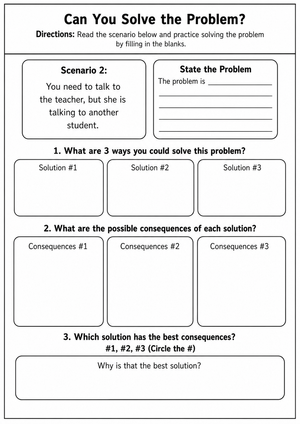
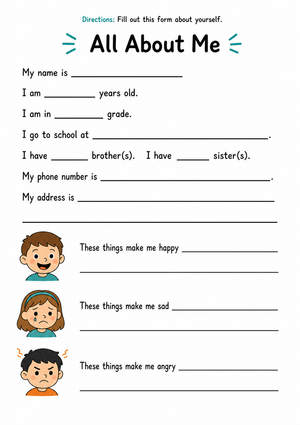
These social skills for autism printable pdf worksheets for 6th grade give teachers something they can hand out Monday morning without a long setup — age-matched scenarios, structured prompts, and enough clarity that students with varied communication needs can work through them in advisory, a resource room, or a counseling check-in. The set is built around situations that actually occur in a middle school day: entering a group late, misreading a peer's tone in a hallway exchange, asking a teacher to repeat directions without stalling the class, and navigating lunch-table dynamics when the usual seat is taken.
The Skills These Worksheets Target
Sixth grade marks a real shift in what social situations demand. Students move through six or more periods, manage different teacher expectations back to back, and face interactions that require interpreting intent — not just following posted rules. These worksheets concentrate on the skills that recur in those middle school moments:
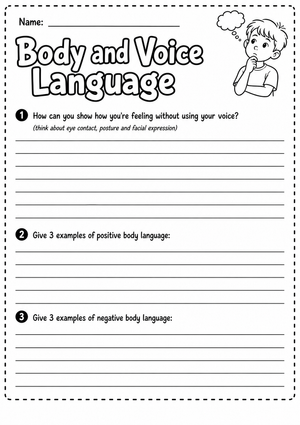
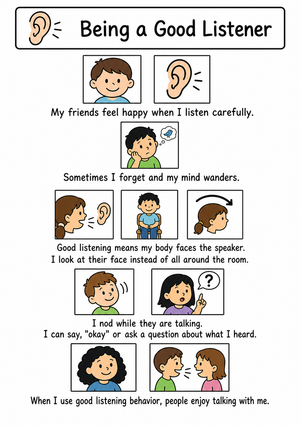
- reading facial expressions, tone, and body language within realistic classroom or hallway contexts
- joining a group conversation that is already underway without interrupting or waiting so long the moment passes
- staying on topic during partner tasks, lab work, or project planning
- identifying when a classmate seems annoyed or confused and deciding how to respond
- asking a teacher for clarification in a way that feels natural rather than disruptive
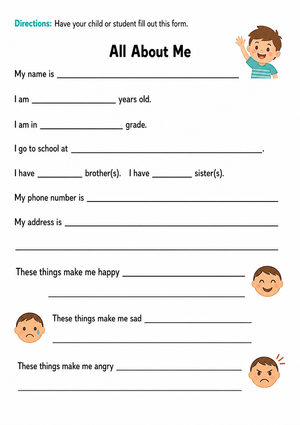
- putting a personal need into plain words — a break, a repeated direction, extra processing time
Conversation turn-taking shows up throughout but always in a realistic frame. A worksheet might present it within a science team discussion or a hallway moment before class begins — not as an abstract drill. That situational framing matters because many autistic learners can demonstrate a skill in a quiet one-on-one setting and still find it difficult to recognize when to use it once the social context shifts around them.
Why Sixth Grade Social Instruction Looks Different From Elementary Work
Elementary social-skills materials often ask students to practice one clear rule at a time: wait your turn, say please, face the speaker. Sixth graders still need those foundations, but the situations they face are more layered. A peer might roll their eyes, and the student has to decide whether that signals frustration, humor, or discomfort — without asking directly. Worksheets that stay at the level of "use kind words" do not prepare students for those moments.
A well-built worksheet sequence for this age teaches cue-reading, interpretation, and response selection as separate steps rather than as one combined demand. Research on social communication development supports the idea that many autistic learners benefit from explicit instruction rather than incidental exposure — which is exactly what a structured worksheet, used with a teacher present, can provide. The step-by-step format keeps the cognitive load manageable while still building toward independent social use.
Student Patterns Worth Knowing Before You Distribute These
One pattern that surfaces in actual student work: when a worksheet asks students to read a scenario, identify the emotion, and generate a response all in the same task, many produce answers that are technically correct but miss the communicative purpose. A student might write "I would say sorry" to a scenario about accidentally interrupting — because interrupting is a rule violation they recognize — while completely bypassing the visual cue that the other person looks more confused than upset. These worksheets address that by separating the tasks: first, students mark what they notice; then, they name what it might mean; then, they choose or write a response. That layered sequence reduces cognitive demand without removing rigor.
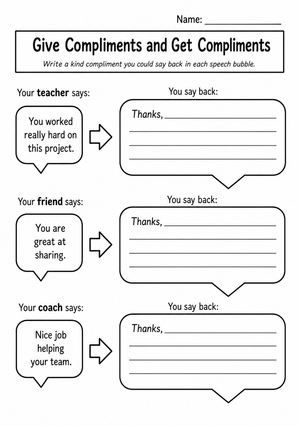
Self-advocacy language is another consistent gap. Students who have been taught to wait for teacher cues often have not practiced initiating a request. When "ask for help" appears as an IEP communication goal, it needs to be paired with actual language — "Can you say that a different way?" is a complete, natural sentence a sixth grader can rehearse and use. Worksheets that supply sentence-level models before asking students to generate their own responses produce noticeably better transfer than those that jump straight to open-ended prompts.
Fitting These Worksheets Into the Week Without Losing Instructional Time
These worksheets fit naturally into the eight to ten minutes before a collaborative task begins, during advisory while students are still settling, or as a structured debrief after a difficult peer interaction. In special education settings, a single worksheet can anchor a full guided-practice session: read the scenario together, discuss what each character might be thinking, rehearse two or three possible responses aloud, then ask the student to pick the one that fits the context best. That cycle — read, interpret, rehearse, select — moves the work out of pencil-and-paper territory into actual skill practice.
In general education classrooms, the same worksheet works as a pre-teaching tool before group work begins. A teacher walks through one scenario with the whole class, pauses at the moment of decision, and lets students talk through what they would do. That takes five minutes and primes every student — not just those with IEPs — for more thoughtful partner interactions. These social skills for autism printable pdf worksheets for 6th grade are also practical to send home when families want a simple, concrete way to reinforce school-based vocabulary and phrasing during an evening check-in.
- Use one worksheet as a warm-up before group projects or lab partnerships start.
- Target one skill per week — "joining a group" or "asking for clarification" — rather than covering several topics at once.
- Rehearse one sentence from the worksheet aloud after students finish so they hear what a strong response sounds like.
- Keep finished worksheets in student folders as informal documentation of practice over time.
- Return to an effective worksheet from earlier in the year when a new situation echoes an older one — repetition with a shifted context is often what builds lasting confidence.
Using the Set to Support IEP Communication Goals
For teams working toward communication or peer-interaction goals, these worksheets give the whole team — special educator, general education teacher, school counselor, paraprofessional — a shared reference point. Everyone works with the same language, the same scenarios, and the same response criteria. That consistency is often what allows a skill practiced in the resource room to start appearing in the cafeteria or during a group project.
Progress documentation does not require a separate data system. What matters more is having observable behaviors at the center of each worksheet: waiting for a turn, responding to peer feedback, naming a need clearly, repairing a small misunderstanding. Teachers who use these worksheets across a semester can track a student's trajectory — from circling a correct response out of two choices in September to generating an unprompted reply in a role-play by November — using the folders of completed worksheets rather than a formal checklist.
Adapting the Set for Students at Different Readiness Levels
Social skills for autism printable pdf worksheets for 6th grade that include sentence starters — "I could say..." or "One way to handle this is..." — give students who need more support a model to work from without making the task look visibly modified. Offering two or three response choices before asking students to generate their own language reduces blank-page anxiety and keeps the focus on the social reasoning rather than the writing demand.
Students who are ready for more independence can skip the provided options and write their own reactions, then compare them with a partner. At that level, the worksheet shifts from guided support to a discussion anchor. For students in between, asking them to explain their thinking aloud — rather than on paper — often reveals more about what they actually understand than a written answer would. The same worksheet does different work depending on how it is presented.
Standard Alignment
These worksheets connect most directly to the Common Core anchor standards for speaking and listening, particularly CCSS.ELA-LITERACY.SL.6.1, which asks students to engage in collaborative discussions, build on others' ideas, and express their own thinking clearly and in complete thoughts. Social communication practice is not separate from academic language development — the skills reinforced here directly support a student's ability to participate in Socratic seminars, partner reading tasks, and project-based work that 6th grade ELA, science, and social studies curricula regularly require.
Communication and social-interaction goals in 6th grade IEPs frequently draw from IDEA's framework around functional communication, which positions social skills as prerequisite behaviors for academic participation — not as ancillary supports. Worksheets targeting peer clarification, turn management, and self-advocacy map directly onto those goal areas. When a student practices "I didn't catch that — can you say it a different way?" as a worksheet prompt, that sentence belongs in both their IEP progress notes and their next whole-class discussion.
Frequently Asked Questions
What social skills matter most for sixth graders navigating a typical middle school day?
Joining group work, reading tone and body language, managing misunderstandings with peers, staying on topic during partner tasks, and asking for clarification or additional support are the skills that surface most often in 6th grade settings. They appear in academic contexts — group projects, lab partnerships, partner reading — and in the informal social spaces between classes. Focusing practice on those specific situations gives students the highest return on instructional time.
How do I use these worksheets without making a student feel singled out or younger than they are?
Frame each worksheet around a realistic school situation before distributing it. "We're going to look at a moment a lot of middle schoolers find tricky" works better than presenting it as a behavioral correction. Sixth graders disengage quickly from materials that feel like they belong in second grade — the scenarios in these worksheets are written at the age level where they are being used, with neutral wording and situations drawn from actual middle school life.
Can these worksheets be used across different support settings — resource room, counseling, and general education?
Yes. Each worksheet works independently across those contexts because the format does not assume a particular setting or group size. In a resource room, a teacher uses it as a full guided-practice session. In counseling, the same worksheet becomes a reflection tool after a specific incident. In a general education classroom, it functions as a five-minute anchor before collaborative work. The social skills for autism printable pdf worksheets for 6th grade in this set are formatted so teachers can print and use them without reworking the content — the scenario stays constant; the depth of discussion around it adjusts to the setting.
How do these worksheets fit into progress monitoring without adding extra documentation work?
Keep completed worksheets in a student folder organized by date. The visible record of how a student responded — whether they circled a provided option, wrote a sentence stem, or produced a full unprompted response — shows growth over time without requiring a separate data sheet. When IEP teams meet, those folders give everyone something concrete to discuss: not just a behavioral report, but a record of how the student reasoned through social situations at different points across the year.












 Interactive Worksheet Maker
 Quiz Maker
 Word Search Maker
 Crossword Puzzle Maker
 Word Scramble Generator
 Sentence Scramble Generator
 Handwriting Worksheet Generator
 Name Tracing Generator
 Fill In The Blank Generator