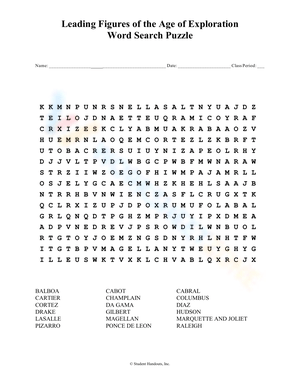
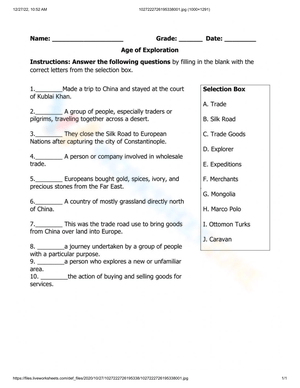
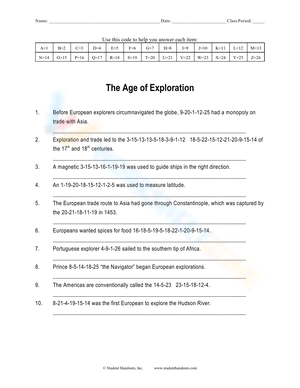
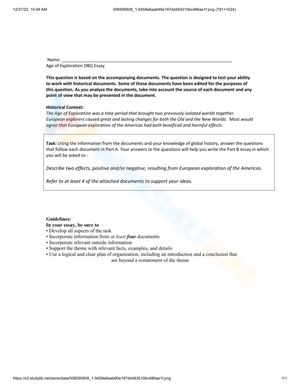
These age of exploration pdf worksheets for 6th grade give social studies teachers a focused set of materials for one of the most historically dense units in the middle school curriculum—a unit where students must explain causes, trace routes, and reason about consequences across multiple continents and more than two centuries of history. The resources work across direct instruction follow-up, small-group reteaching, homework, and formative assessment without requiring teachers to build separate versions of the same task.
The Age of Exploration typically runs from the early 1400s through the late 1600s in most grade 6 programs, and it lands inside a larger arc covering trade networks, early global contact, and the origins of colonization. Students at this level are not yet expected to write extended historical arguments, but they should be able to sequence major voyages, explain why European rulers and merchants pursued sea routes to Asia, and describe what changed after contact between the Eastern and Western hemispheres. That range of demands—from basic recall to evidence-based interpretation—means a set of worksheets built at different levels of complexity has real utility here.
What's Inside the Set
Each worksheet targets a distinct skill rather than attempting to cover the whole unit at once. Tasks across the set include:
- Chronology and sequencing: Students arrange key events between the 1400s and 1600s, building an accurate mental framework before they move into cause-and-effect reasoning.
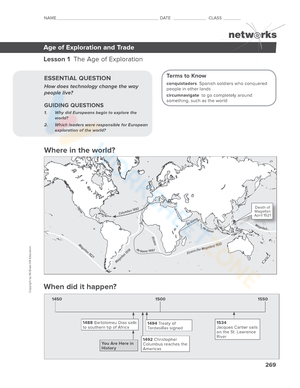
- Map analysis: Students trace or interpret exploration routes, identify departure points, label oceans and continents, and note where voyages ended—not just copy explorer names onto a blank outline.
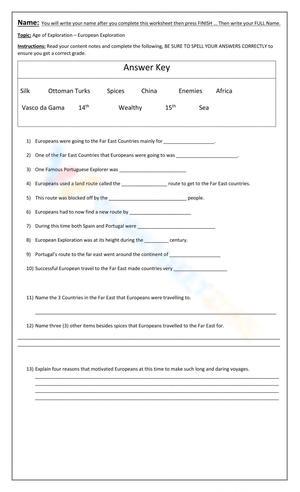
- Motives for exploration: Students sort or explain the driving forces behind European voyages—trade, wealth, competition between states, religious goals—using short written responses rather than matching alone.
- Explorer profiles: Prince Henry the Navigator, Christopher Columbus, Vasco da Gama, and Ferdinand Magellan each connect to larger themes: sponsorship structures, Atlantic crossings, the route around Africa, and the growing scale of ocean navigation.
- Columbian Exchange: Students categorize what moved between hemispheres—plants, animals, diseases, people, ideas—and explain why those transfers had uneven consequences for different populations.
- Cause-and-effect analysis: Structured prompts ask students to connect a voyage or contact event to at least two documented outcomes, which pushes historical thinking past surface-level recall.
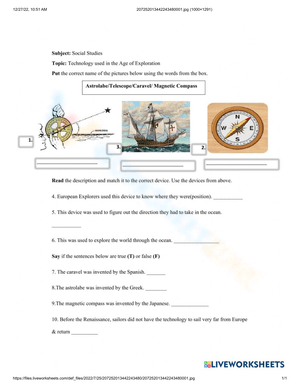
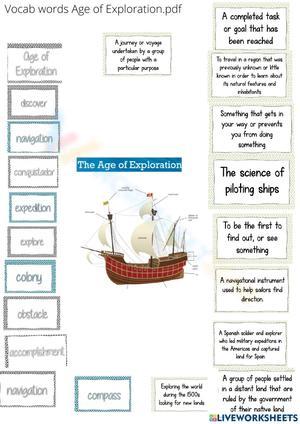
Vocabulary runs through several worksheets—navigation, voyage, colony, trade route, exchange, circumnavigate—used in context rather than in isolated definition exercises. When students can deploy those terms precisely in their own writing, it shows up almost immediately in quiz answers and whole-class discussion.
Mistakes Students Make That These Worksheets Help You Catch
The most persistent error in this unit is collapsing motive into outcome. Students routinely write that Columbus "wanted to find America"—which turns a complex set of trade ambitions and competitive pressures into a retroactive geography lesson. These worksheets address that directly by placing motive prompts and outcome prompts on separate worksheets, so students practice holding the two ideas apart before they try to connect them in analytical writing.
Map work surfaces a different problem. Many students assume European explorers sailed toward destinations they already knew existed. When a worksheet asks why da Gama's route around Africa was significant, the most common weak answer is that it was faster or "a shorter path." The stronger answer—that it gave Portugal direct access to Indian Ocean trade without passing through Ottoman-controlled overland routes—requires students to have context before they see the map. Worksheets that pair route maps with a short reading passage produce noticeably better written explanations than maps presented alone.
The Columbian Exchange section reliably reveals a third misconception: that the exchange was reciprocal and roughly fair. Students often describe it as Europe trading goods with the Americas without registering that the spread of disease had catastrophic effects on Indigenous populations, or that enslaved people moved through the same networks. Worksheets that break the exchange into distinct transfer categories—rather than presenting everything in a single mixed table—make that imbalance concrete and easier to discuss in class.
Fitting These Worksheets Into a Social Studies Unit
In a 45- to 60-minute block, a clean sequence looks like this: open with a three-to-five-minute warm-up asking students why a kingdom might fund an overseas voyage, move into direct instruction on the time period and major figures, then assign one worksheet on motives or routes for independent practice. The second task—consequences or Columbian Exchange—works better as a partner or small-group activity, because students tend to generate stronger explanations when they can push back on each other's first answers before writing.
These worksheets hold up well as retrieval practice. Running a single worksheet one week after initial instruction—during the bell-ringer slot before morning meeting or the last eight minutes before passing period—produces better quiz scores than re-teaching the same content from scratch. The format stays familiar, so students spend their mental effort on the history rather than on decoding what the task is asking.
For sub plans and absence recovery, the set is more reliable than video-based alternatives. A returning student can complete the worksheet corresponding to the missed lesson day without needing a full re-explanation from the teacher. For teachers building a unit packet, a logical ordering runs: motives first, then explorers and routes, then exchange and consequences, then a synthesis task that asks students to connect all three phases in writing.
When teachers are searching specifically for age of exploration pdf worksheets for 6th grade to fill review blocks before a unit test, the cause-and-effect and Columbian Exchange worksheets do the most work—they require students to reconstruct the reasoning behind events, not just retrieve names and dates.
Standard Alignment
These worksheets align with CCSS.ELA-Literacy.RH.6-8.1, which requires students to cite textual evidence when explaining what a source says and when drawing inferences from it. That standard applies directly when students read a short primary source excerpt or map caption and then write an explanation of why exploration expanded or what changed after contact. It is worth naming this connection explicitly for students: the evidence-based reasoning they practice on these worksheets is the same skill the standard targets across every content-area reading task.
For teachers following the C3 Framework, the set aligns with D2.His.5.6-8, which asks students to explain how and why perspectives of people have changed over time. That standard fits naturally when students examine how Indigenous peoples, European merchants, and enslaved Africans experienced the same historical period from fundamentally different positions—a perspective exercise several worksheets in the set build toward explicitly.
Adjusting the Set Across Different Levels of Readiness
For students who need more support, the map and sequencing worksheets provide a concrete entry point. Students who freeze on open-ended writing tasks can complete the route-labeling and chronology work first, building a reference they can look back at when the cause-and-effect prompt arrives. That is not about lowering expectations—it is about giving those students an organized knowledge base before asking for interpretation.
On-level students generally move through the independent practice worksheet and into a partner discussion without much redirection. The key is keeping writing prompts specific enough that "it was bad for some people" does not pass as a complete answer. Prompts that require students to name at least two groups affected by the Columbian Exchange and describe one consequence for each group produce more consistent written evidence of understanding.
Advanced students benefit from extension prompts asking them to compare the stated goals of an expedition with its actual long-term effects. Prince Henry the Navigator organized voyages primarily to establish trade connections and spread Christianity—within 100 years, those same routes had become central infrastructure for the Atlantic slave trade. A prompt asking students to trace that shift using evidence from the worksheet set pushes the kind of historical argument writing most 6th graders will be expected to produce in 7th and 8th grade.
For intervention groups, breaking each worksheet into sections and modeling one item per task type before releasing students to work independently gives struggling learners the step-by-step entry they need without creating an entirely separate modified assignment. Age of exploration pdf worksheets for 6th grade with clear, direct task directions make that in-class support faster to deliver and easier for students to re-enter on their own after a pause.
Frequently Asked Questions
Which explorers do these worksheets cover?
The set addresses Prince Henry the Navigator, Christopher Columbus, Vasco da Gama, and Ferdinand Magellan—each connected to a broader theme rather than treated as isolated biography. Prince Henry appears as a sponsor and organizer rather than a solo voyager. Columbus, da Gama, and Magellan each illustrate something distinct: Atlantic crossings, the African route to the Indian Ocean, and full circumnavigation. That framing helps students connect individual expeditions to larger historical patterns instead of memorizing a list of names.
Can these worksheets work for homework or sub plans?
Both. The directions on each worksheet are self-contained, so a student working independently—at home or with a substitute—can complete the task without extra teacher explanation beyond what is printed. For sub days, pairing two worksheets with a brief written reflection prompt covers a full class period reliably without requiring the substitute to know the content in depth.
Do these worksheets address the Columbian Exchange?
Several worksheets focus specifically on what moved between hemispheres after 1492—plants, animals, diseases, people, and ideas—and ask students to explain why those transfers had different consequences for different groups. The framing does not treat the Exchange as a neutral event. Students are expected to grapple with who benefited and who was harmed, which prepares them for the kind of historical interpretation most grade 6 assessments now require.
How do these worksheets function as formative assessment?
Each worksheet produces a written record of student thinking—annotated maps, sequencing decisions, short paragraph responses—that teachers can scan quickly to identify who has moved past surface recall into cause-and-effect reasoning. Age of exploration pdf worksheets for 6th grade that require written explanation rather than fill-in-the-blank answers give teachers more diagnostic information per minute of grading time, and they make reteaching decisions easier to justify when students ask why they are revisiting content.












 Interactive Worksheet Maker
 Quiz Maker
 Word Search Maker
 Crossword Puzzle Maker
 Word Scramble Generator
 Sentence Scramble Generator
 Handwriting Worksheet Generator
 Name Tracing Generator
 Fill In The Blank Generator