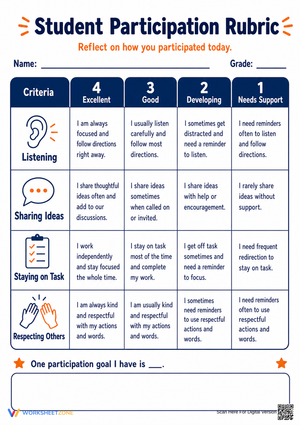
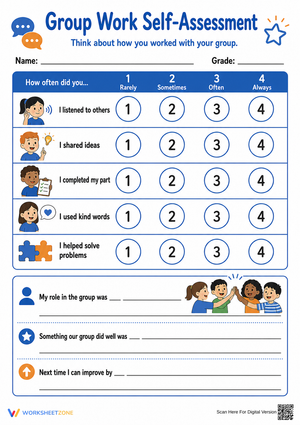
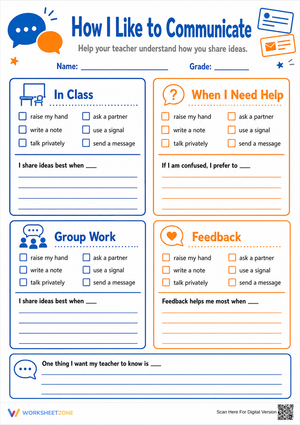
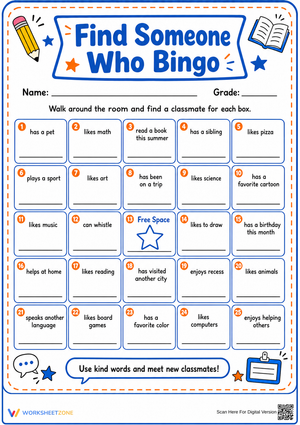
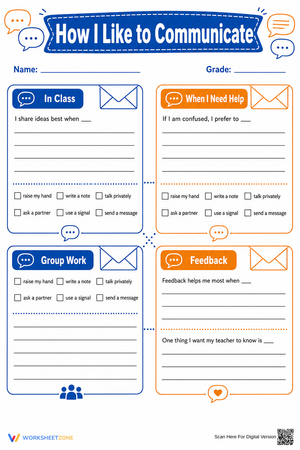
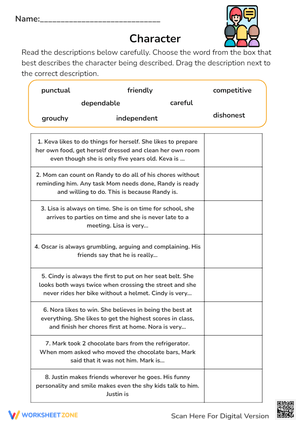
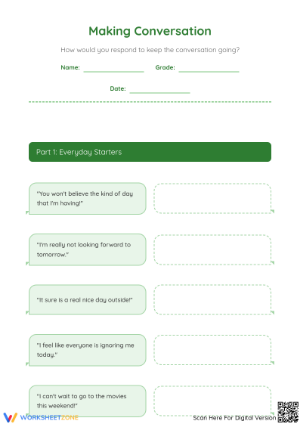
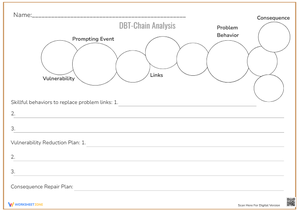
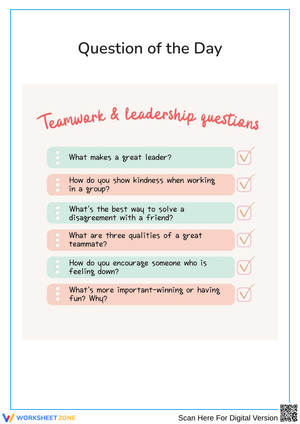
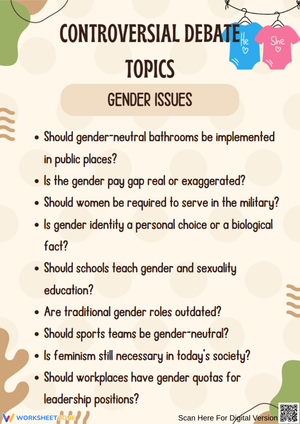
6th grade communication skills printable pdf worksheets give teachers a direct, low-prep way to turn abstract social expectations into rehearsed behaviors — before students carry those moves into actual discussion, group work, or peer conflict. The set covers active listening, respectful speaking, social cue recognition, turn-taking, and conflict repair: the moves grade 6 students need most in the daily flow of school. Each worksheet is print-ready and fits advisory periods, ELA seminars, science lab prep, counseling sessions, MTSS support, and substitute plans without any device dependency.
What Students Work Through in Each Worksheet
Grade 6 is a pivot point for social communication. Students are shifting from mostly teacher-directed talk into partner tasks, fishbowl discussions, peer editing rounds, and group projects where they have to manage themselves without moment-to-moment teacher guidance. The worksheets target the moves most likely to break down in those settings.
- Active listening: tracking the speaker, paraphrasing what was said, and waiting to respond rather than loading the next reply.
- Respectful disagreement: using sentence stems that separate the idea from the person — "I see it differently because..." rather than dismissing the other view outright.
- Social cue recognition: reading facial expression, posture, and silence as signals about how a peer is receiving the conversation.
- Group participation: inviting quieter members in, distributing airtime, and returning to the task when energy drops.
- Conflict repair: naming what happened, identifying how each person likely interpreted it, and selecting a next move that keeps the exchange from escalating.
Several worksheets also target clarifying questions — a skill grade 6 students underuse because asking for help can feel socially risky at this age. Students who learn to say "Can you say more about what you mean?" instead of nodding and disengaging hold up better in peer collaboration across every content area.
Frequent Errors These Worksheets Help You Catch and Address
The most consistent gap in grade 6 communication work is the distance between paper performance and live performance. A student who circles "I hear what you're saying, but I think there's another way to look at it" on a worksheet will still blurt "That makes no sense" during the actual partner discussion two minutes later. Recognizing that gap — and closing it through immediate spoken application — is the main instructional job these worksheets support.
A second pattern worth watching: students conflate respectful communication with agreement. On sorting tasks, they mark any disagreement as disrespectful. That error shows up clearly on worksheets that ask them to distinguish between how something is said and what is said. Pointing to that distinction before discussion — not as a correction after — changes how students respond to peer pushback during seminar.
Social cue worksheets reveal a third consistent error: students read neutral facial expressions as negative. When asked to match a drawn face to a feeling, grade 6 students reliably interpret an expressionless face as bored or annoyed rather than simply attentive. That tendency creates real friction during partner work, so catching it on paper first gives teachers something concrete to name and address before the next collaborative task.
Lesson-Planning Strategies to Get the Most From the Set
The strongest use of the resources is pairing each worksheet with a live speaking task on the same day. Introduce a focus skill — say, asking clarifying questions — model it briefly, then have students complete a short worksheet to rehearse the sentence stems. Move immediately into a two-minute partner exchange where they apply exactly those stems. That sequence runs about ten minutes total and produces more transfer than a longer isolated lesson.
For advisory or homeroom, a predictable weekly rhythm works well. One communication focus per week, introduced Monday with a brief worksheet warm-up, revisited mid-week in a different context — science partner work, peer editing, or literature circle — and closed Friday with a short reflection after discussion. Spaced retrieval across three brief exposures builds retention more reliably than a single extended lesson, and it keeps the weekly time investment small enough to be sustainable.
These 6th grade communication skills printable pdf worksheets also fit naturally into MTSS Tier 1 delivery. Keep a small stack in the substitute folder, the counseling office, and the re-entry binder for students returning after disciplinary absences. The format is low enough in cognitive demand that students can work through a scenario independently, which matters when adult facilitation time is limited.
Standard Alignment
These worksheets align with CASEL's Relationship Skills and Social Awareness competencies — the two areas that address how students communicate, collaborate, and respond to peers. CASEL Relationship Skills include communicating clearly, listening actively, cooperating, negotiating conflict constructively, and seeking or offering help when needed. Social Awareness includes perspective-taking and reading situational cues. Both competencies are explicitly framed in CASEL's Secondary Guide for grades 6–8 as practice areas requiring direct instruction, not just modeling.
Most state SEL frameworks have adopted CASEL's five-competency structure, so the alignment translates directly into district planning documents. Teachers in states with formal SEL standards — Illinois, California, and Washington among them — can map these worksheets against grade-band benchmarks in relationship skills and social awareness without additional conversion work.
Adjusting the Set for Different Learner Needs
For students who need more support, reduce the writing demand without reducing the social target. Read the scenario aloud, then have the student underline or circle the stronger response rather than write a full explanation. The skill practice stays intact; the language production demand is lower. In small groups, students can work through scenarios verbally and then check their reasoning against the worksheet answer options, which adds a self-monitoring step without requiring extended writing.
These 6th grade communication skills printable pdf worksheets stretch in both directions. For students who work quickly, add a follow-up prompt: "Why is that response more likely to keep the conversation going?" or "What could go wrong with the other option?" That push toward justification — rather than identification alone — builds the analytical layer that communication work at the advanced level requires. It also opens the door to small-group debate about which response is actually more effective, which is a legitimate communication activity in itself.
For English language learners, the sentence stem worksheets provide especially useful models. Students can annotate the stems, practice them orally with a partner, and keep the printed worksheet as a reference card during actual discussion. That physical reference reduces cognitive demand during live conversation without removing the expectation that students participate.
Frequently Asked Questions
What's the difference between using these worksheets in advisory versus in a core class?
In advisory, the communication skill is usually the main content — the worksheet carries the lesson. In ELA, science, or social studies, it serves as a warm-up or debrief that supports the academic task. Both uses are effective, but in core classes, teachers get stronger results when the scenario on the worksheet mirrors something students will actually do that day — not a generic social situation pulled from an unrelated context.
How many worksheets per week is realistic without it feeling like a separate social skills program?
Two to three short worksheets per week keeps communication practice embedded rather than bolted on. One before a discussion task, one as a reflection after group work, and one mid-week warm-up in advisory is a sustainable rhythm for most grade 6 schedules. More than that tends to cut into spoken application time, which is where the actual skill development happens.
Can these be used for students in Tier 2 or Tier 3 MTSS support?
These 6th grade communication skills printable pdf worksheets work well in both Tier 2 small-group settings and Tier 3 individual interventions. In Tier 2 groups, a counselor or interventionist can walk through a scenario, pause the written task, and move directly into role-play — the worksheet becomes a structured conversation guide rather than an assignment to submit. In Tier 3, the same approach works with more repetition and more adult-prompted debriefing after each scenario.
Do these work for students who have difficulty with writing?
Students who struggle with written production can still access the skill tasks. Circle-the-best-response formats, sentence completion, and annotating a dialogue require minimal writing while keeping the communication analysis intact. Teachers working with students whose IEPs include written expression accommodations can use an oral response option — students state their answer while the teacher or aide notes it — without changing the communication skill being practiced.












 Interactive Worksheet Maker
 Quiz Maker
 Word Search Maker
 Crossword Puzzle Maker
 Word Scramble Generator
 Sentence Scramble Generator
 Handwriting Worksheet Generator
 Name Tracing Generator
 Fill In The Blank Generator