In Grade 4, animal classification is not just about memorizing names. Students are expected to sort organisms by observable traits, explain why a group fits together, and connect body features to habitat and survival. That makes printable practice useful when it moves beyond labeling and asks students to justify decisions.
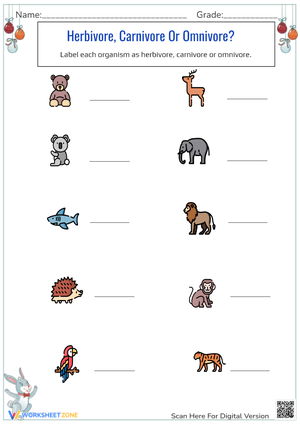
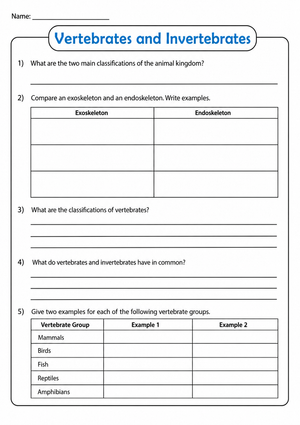
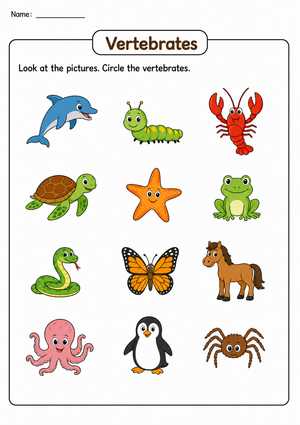
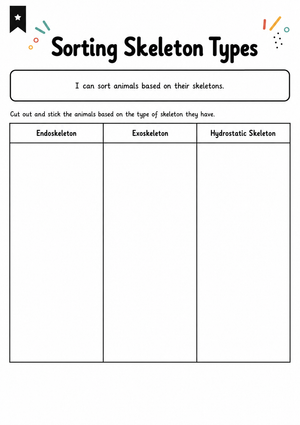
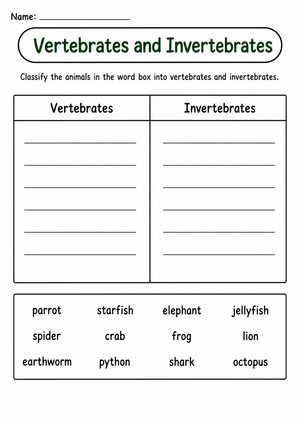
Worksheetzone's animal classification worksheets fit well in a living and non-living things unit because they give students repeated practice with the same core ideas in short, manageable tasks. A sorting page can ask students to separate vertebrates from invertebrates. A matching page can ask them to connect an animal to a defining trait such as feathers, scales, or an exoskeleton. A short written response can ask them to explain why a frog belongs with amphibians instead of reptiles. Each format keeps the science thinking visible for the teacher.
What Grade 4 students should know about animal classification
Most Grade 4 animal classification lessons start with observable traits. Students look at whether an animal has a backbone, what covers its body, how it moves, and how it survives in its environment. That approach keeps the work concrete. Instead of treating classification as a vocabulary list, teachers can ask students to notice evidence and use it to sort.
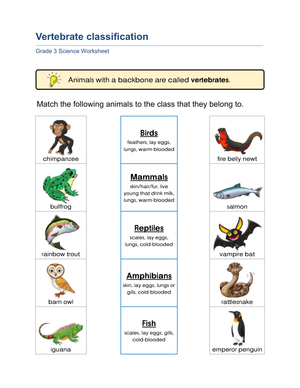
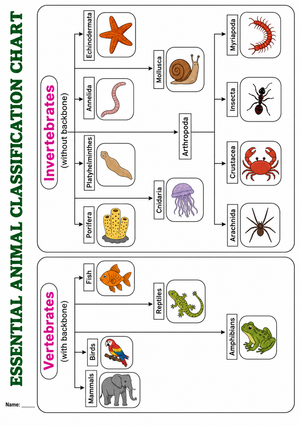
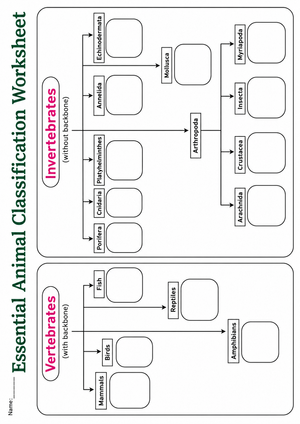
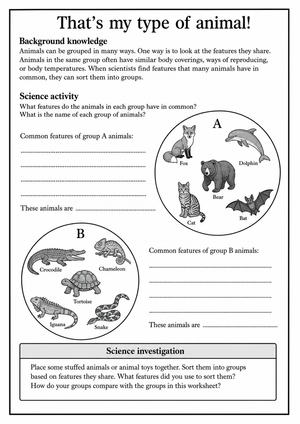
In upper elementary science, vertebrates are commonly taught as five major groups: mammals, birds, fish, reptiles, and amphibians. Students can usually identify these groups more accurately when the worksheet language points them back to physical traits. Mammals have hair or fur and feed milk to their young. Birds have feathers. Fish have gills and live in water. Reptiles have scales and are often associated with dry skin. Amphibians typically live part of their life in water and part on land.
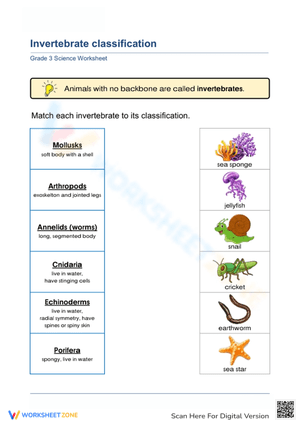
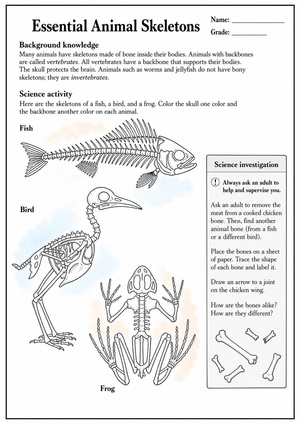
Invertebrates add an important layer because students quickly see that not all animals fit the same structure. A printable page may include insects, arachnids, or mollusks to show that many animals do not have backbones. That comparison helps students avoid the common mistake of thinking vertebrate groups represent all animal life.
- Vertebrates: animals with backbones, including mammals, birds, fish, reptiles, and amphibians.
- Invertebrates: animals without backbones, including insects, arachnids, mollusks, and other familiar classroom examples.
- Observable traits: body covering, limbs, breathing structures, movement, and reproduction clues students can actually see or discuss.
Traits and habitats make the sorting stronger
The strongest animal classification worksheets do more than ask students to place an animal under the correct heading. They also connect the category to a trait or habitat clue. That is where the science gets deeper. A student may know that a salamander is an amphibian, but the more useful understanding is that amphibians are identified by life cycle and body traits that connect to wet environments.
When teachers add habitat thinking, the task becomes closer to real elementary science reasoning. Students can compare how a fish survives in water with gills and fins, how a bird is adapted to movement and body covering that suit its environment, or how an insect differs from a mammal even if both live on land. This is a better use of worksheets than simple memorization because students learn how to defend a claim with evidence.
In a typical 25-minute independent practice block, the most informative worksheet is often the one that asks students to make fewer classifications but explain each one with a trait-and-habitat sentence. Teachers get clearer evidence from six well-justified examples than from a longer page of unchecked labels, especially when students tend to overgeneralize from where an animal lives.
That is also where common misconceptions surface. Students may sort whales with fish because they live in water, or bats with birds because they fly. A good printable catches those errors by asking students to justify the grouping with body traits, not just with location or movement.
What to look for in a set of printable classification worksheets
In 3-LS4-3 Biological Evolution: Unity and Diversity | Next Generation Science Standards, students in the 3-5 band use evidence to support claims about how organisms survive well or less well in particular habitats. That makes classification worksheets more meaningful when students connect animal traits to habitat fit instead of naming groups only.
For Grade 4 classrooms, the best set keeps the examples familiar, the categories consistent, and the prompts readable. If the page includes too many unusual species, the activity becomes a guessing exercise instead of a science lesson. Familiar examples such as dog, robin, shark, turtle, frog, butterfly, and spider make it easier for students to focus on classification logic.
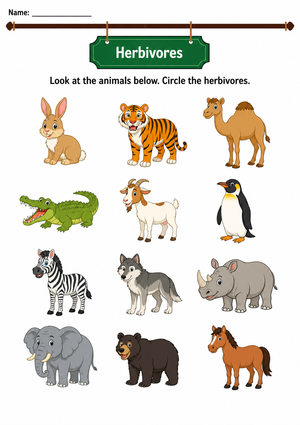
Teachers also benefit from a mix of task types. Sorting and cut-and-paste pages are strong for introduction. Matching pages work well for review. Short-answer prompts are better when you want written evidence. If the set includes all three, it becomes easier to differentiate without switching topics.
- Whole-group teaching: start with one shared page and model the trait language students should use.
- Centers: use cut-and-sort or matching pages that students can complete with a partner.
- Homework: choose short pages with clear directions and familiar animals.
- Assessment: use pages that ask students to explain at least one classification choice in writing.
Classroom Implementation
These printables can support several teaching routines in a Grade 4 science classroom. During a lesson launch, a teacher might display a few animal cards and ask students to predict how they would be grouped before handing out a worksheet. In centers, students can complete a vertebrate-versus-invertebrate sort and then compare answers with a partner. For intervention or reteaching, a shorter page with only a few examples can help students focus on one misconception at a time.
They also work well as low-prep sub plans because the directions are concrete. A substitute can ask students to sort, match, and explain without needing advanced content knowledge. For homework, printable classification pages give students a manageable review task that does not require digital access.
Teachers can rotate the worksheet format across the week to keep the content fresh while holding the science goal steady. One day may focus on identifying vertebrate groups. Another may ask students to use traits to defend a classification. A later page may connect animal groups to habitat and survival. That sequence gives students repeated exposure without feeling repetitive.
FAQ
1. What animal groups should 4th graders know for classification?
Most Grade 4 students should know the five major vertebrate groups: mammals, birds, fish, reptiles, and amphibians. They should also understand that invertebrates do not have backbones and may include examples such as insects, arachnids, and mollusks.
2. How do you explain vertebrates and invertebrates in simple classroom language?
A clear classroom explanation is that vertebrates have backbones and invertebrates do not. From there, students can look for other observable traits such as feathers, scales, fur, wings, or body segments to sort animals more accurately.
3. How can printable worksheets support NGSS-aligned animal classification lessons?
Printable pages support standards-aligned instruction when they ask students to use evidence. A worksheet becomes stronger when students must point to traits, compare habitats, and explain how those traits help animals survive in different environments.
4. What are good examples of animal traits students can use to sort and compare?
Useful traits include whether the animal has a backbone, what covers its body, how it breathes, how it moves, and where it lives. Those features help students classify animals with reasons instead of relying on memory alone.












 Interactive Worksheet Maker
 Quiz Maker
 Word Search Maker
 Crossword Puzzle Maker
 Word Scramble Generator
 Sentence Scramble Generator
 Handwriting Worksheet Generator
 Name Tracing Generator
 Fill In The Blank Generator