




























Views
Downloads
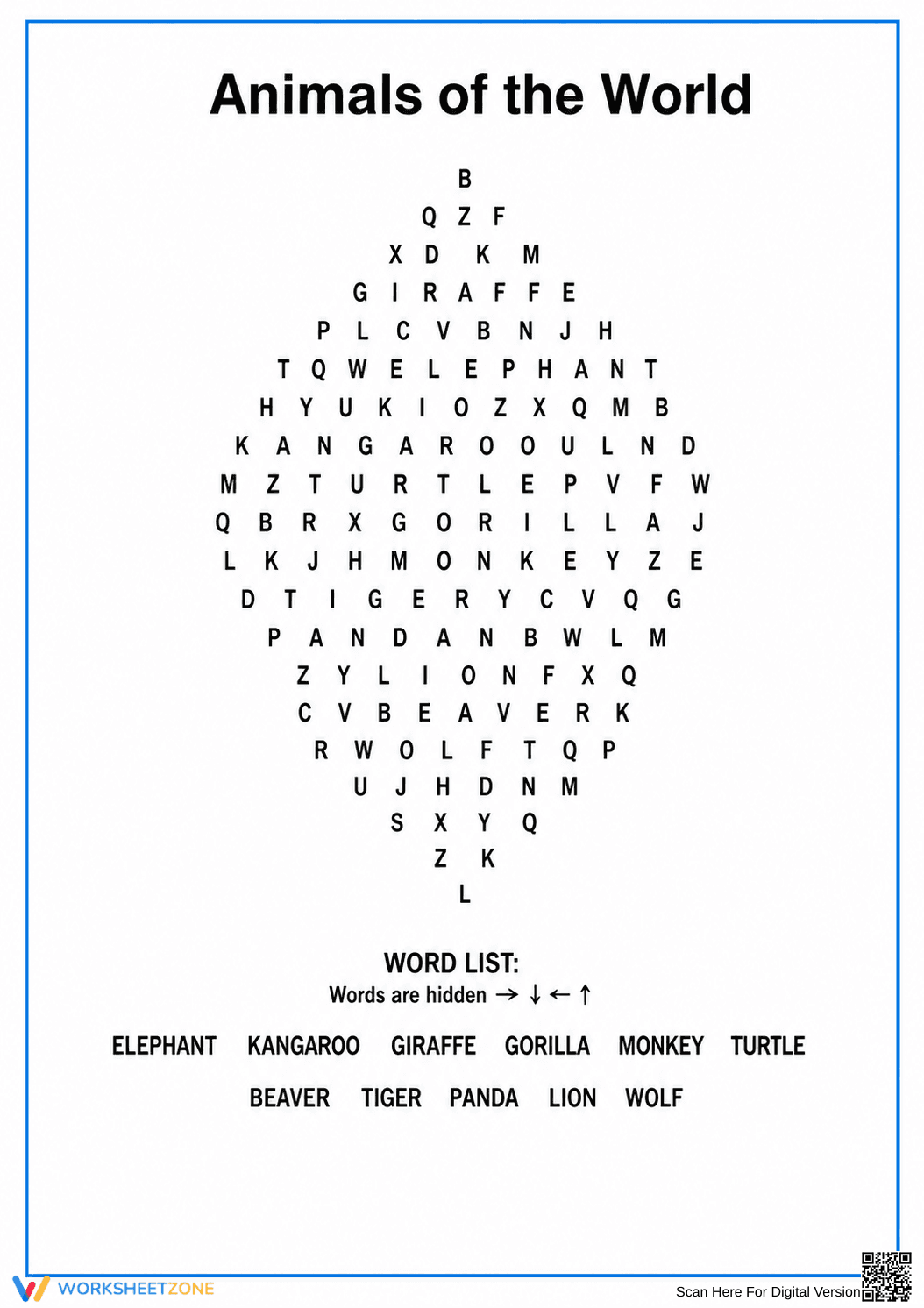

Animals of the World Word Search | Essential Grade 3-5

Paste this activity's link or code into your existing LMS (Google Classroom, Canvas, Teams, Schoology, Moodle, etc.).
Students can open and work on the activity right away, with no student login required.
You'll still be able to track student progress and results from your teacher account.
This Animals of the World word search provides students with a focused way to recognize and spell 11 domain-specific animal names. By identifying terms like giraffe and kangaroo within a diamond-shaped grid, learners reinforce their scientific vocabulary while improving visual scanning skills. It serves as an engaging bridge between biology lessons and literacy practice.
At a Glance
- Grade: 3 · Subject: Science & ELA
- Standard:
CCSS.ELA-LITERACY.L.3.6— Acquire and use accurately grade-appropriate general academic and domain-specific words- Skill Focus: Animal Vocabulary & Spelling
- Format: 1 page · 11 problems · Answer key included · PDF
- Best For: Independent practice or early finishers
- Time: 10–15 minutes
What's Inside
This single-page PDF features a unique diamond-shaped letter grid containing 11 hidden animal names. The word list includes diverse species such as the beaver, gorilla, and panda. Words are hidden horizontally, vertically, and diagonally to provide a moderate challenge. A comprehensive answer key is provided to allow for quick student self-correction or rapid teacher grading without extra effort.
Zero-Prep Workflow
- Print: Generate the single-page PDF for your class in seconds.
- Distribute: Hand out the sheets during a transition period or as a supplemental science activity.
- Review: Discuss the spelling and classification of each animal using the included answer key for immediate feedback.
Total teacher preparation time for this activity is under 2 minutes, making it an ideal choice for emergency sub plans or busy morning routines.
Standards Alignment
The primary standard addressed is `CCSS.ELA-LITERACY.L.3.6`, which requires students to acquire and use accurately grade-appropriate general academic and domain-specific words and phrases. This activity specifically targets biological terminology through orthographic recognition. Both standard codes can be copied directly into lesson plans, IEP goals, or district curriculum mapping tools.
How to Use It
Use this worksheet as a warm-up during a unit on animal habitats to activate prior knowledge of different species. It also functions effectively as a formative assessment tool; observe which students struggle with word recognition to identify those needing additional phonics or vocabulary support. Expected completion time ranges from 10 to 15 minutes depending on the student's scanning speed.
Who It's For
This resource is designed for elementary students in grades 2 through 5, particularly those studying life sciences or animal classification. It is an excellent tool for English Language Learners (ELL) to build foundational noun banks. Pair this with a visual animal encyclopedia or an anchor chart showing animal biomes for a complete instructional experience.
The use of word searches in the classroom supports the development of pattern recognition and orthographic processing, which are foundational to fluent reading. According to Fisher & Frey (2014), purposeful vocabulary exposure in varied formats—including word games—increases the likelihood of long-term lexical retention. This worksheet aligns with CCSS.ELA-LITERACY.L.3.6 by providing a low-stakes environment for students to interact with domain-specific terminology related to the animal kingdom. Research from the RAND AIRS 2024 report suggests that supplemental materials that reduce teacher cognitive load while maintaining alignment to core standards are essential for effective classroom management. By focusing on 11 specific animal names, this resource ensures that students are not overwhelmed while still achieving the goal of accurate word recognition and spelling within a scientific context. The diamond-shaped grid adds a layer of spatial reasoning to the task.


