




























Views
Downloads
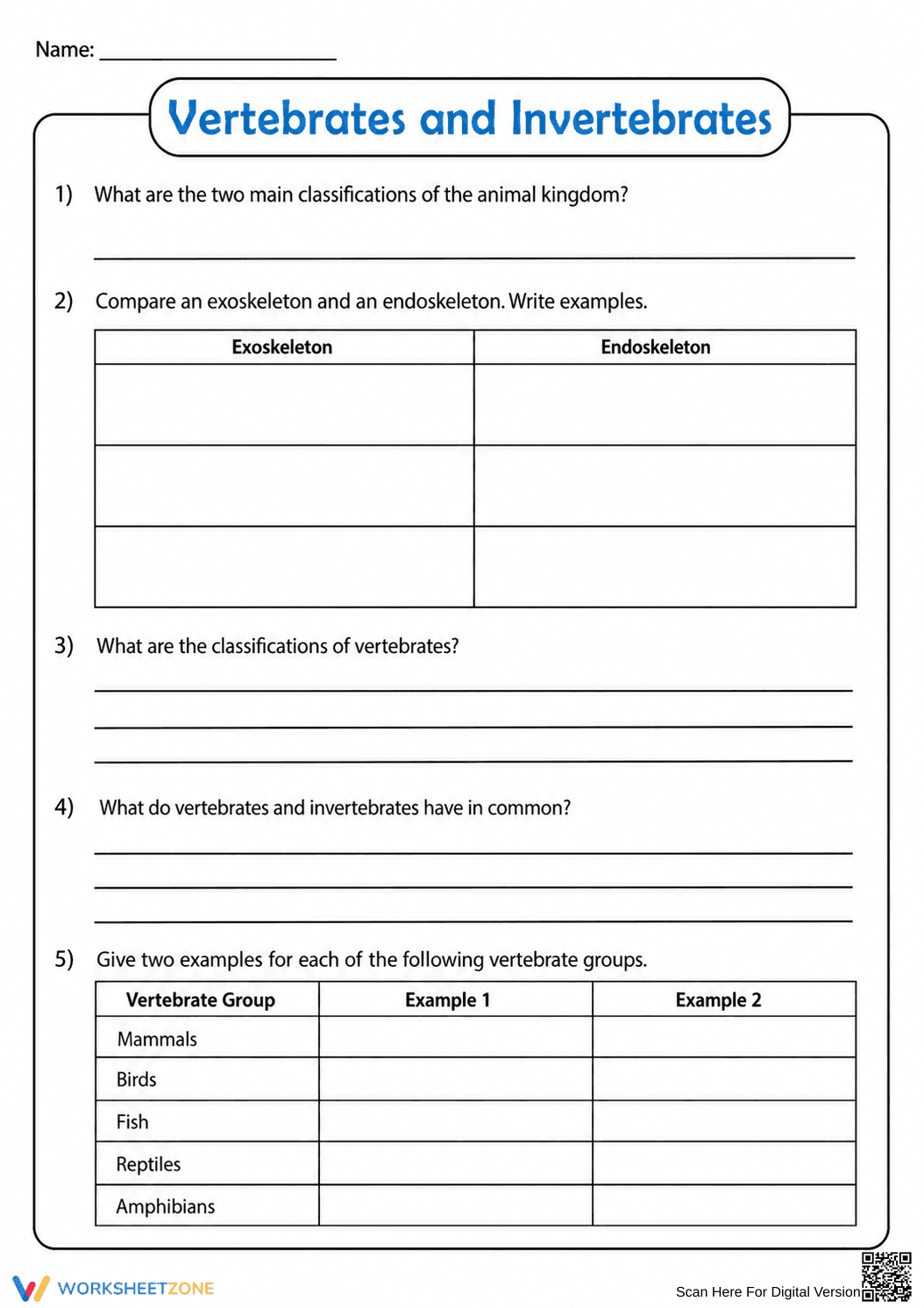

Grade 4 Vertebrates & Invertebrates — Printable Worksheet

Paste this activity's link or code into your existing LMS (Google Classroom, Canvas, Teams, Schoology, Moodle, etc.).
Students can open and work on the activity right away, with no student login required.
You'll still be able to track student progress and results from your teacher account.
This ready-to-use Grade 4 science worksheet helps students master the fundamental differences between vertebrates and invertebrates. By examining skeletal structures and classifying animals, learners develop a concrete understanding of biological taxonomy. The single-page activity provides focused practice on internal and external animal structures to solidify foundational life science concepts.
At a Glance
- Grade: 3-4 · Subject: Science
- Standard:
4-LS1-1— Identify internal and external animal structures.- Skill Focus: Animal Classification
- Format: 1 page · 5 problems · Answer key included · PDF
- Best For: Independent practice and science review
- Time: 15–20 minutes
This high-density, one-page PDF resource contains five inquiry-based tasks. It begins with short-answer questions defining animal kingdom classifications and moves into a comparative analysis of exoskeletons versus endoskeletons using a structured table. Students then list vertebrate classifications and identify commonalities between the two main animal groups. Finally, learners utilize a chart to provide specific examples for five vertebrate classes: mammals, birds, fish, reptiles, and amphibians. A full answer key is included to facilitate rapid grading or student self-correction.
Zero-Prep Workflow
- Print: Under 30 seconds for a full class set using standard grayscale settings.
- Distribute: 1 minute to hand out as a warm-up or transition activity.
- Review: 5 minutes for collective check-in using the included answer guide.
Total teacher prep time is under 2 minutes. This worksheet is perfectly suited for emergency sub plans, morning work, or low-bandwidth homework assignments where no prior setup is required.
Standards Alignment
This resource is aligned to the 4-LS1-1 standard: Construct an argument that plants and animals have internal and external structures that function to support survival, growth, behavior, and reproduction. This worksheet specifically focuses on the internal structure of the backbone and the external structure of the exoskeleton. Both standard codes can be copied directly into lesson plans, IEP goals, or district curriculum mapping tools.
How to Use It
Use this during the guided practice phase of a lesson on animal traits. It serves as an excellent formative assessment to check if students can accurately differentiate between the two main animal groups. Alternatively, assign it as a post-instruction review after watching a biology video or reading a textbook chapter. Expected completion time is 15 to 20 minutes. While reviewing, observe if students confuse amphibians with reptiles during the classification chart task to guide future reteaching.
Who It's For
This is designed for upper elementary students in Grades 3 and 4, including English Language Learners who benefit from the structured tables and clear terminology. It pairs naturally with an anchor chart on animal characteristics or a reading passage about the five classes of vertebrates to provide a comprehensive learning experience.
According to the RAND AIRS 2024 analysis, structured classification activities in elementary science are critical for developing the cognitive schemas necessary for advanced biological study. This Grade 4 worksheet directly targets the 4-LS1-1 standard by requiring students to identify internal and external animal structures, specifically distinguishing between vertebrates with endoskeletons and invertebrates with exoskeletons. By engaging in these 5 targeted tasks, students move from rote memorization to a deeper categorical understanding of the animal kingdom. Research emphasizes that well-designed, structured worksheets provide the essential scaffolding needed for students to successfully transition into independent scientific inquiry and complex biological reasoning. This resource serves as a high-utility tool for classrooms prioritizing evidence-based instructional strategies and standards-aligned science curriculum, ensuring young learners can confidently categorize the natural world and build a strong foundation for future STEM education.


