4th grade tudents need repeated chances to connect a trait to a habitat, a survival need, and a reason. That is where 4th grade animal adaptations printable worksheets resources earn their place in the science block. A strong printable gives students a concrete way to sort examples, explain thinking, and show whether they understand how body parts and behaviors help animals live in specific environments.
For elementary classrooms, printables also solve practical problems. They can anchor independent practice after a mini-lesson, support a center rotation, travel home for homework, or sit in a substitute folder without extra setup. Teachers can keep the same science concept visible across several days by using one worksheet for introduction, another for practice, and a final page for review or a quick check. That consistency helps students move from naming an adaptation to explaining why it matters.
What 4th Graders Should Learn About Animal Adaptations
At this level, students do not need an overly technical study of evolution. They do need a clear, age-appropriate understanding that adaptations are traits or behaviors that help animals survive in their environments. In classroom terms, that means students should be able to look at an animal and answer simple questions such as: How does it get food? How does it stay safe? How does it manage weather, water, or darkness? How does its habitat shape what helps it live?
According to Adaptation | Britannica Kids, adaptation refers to traits or behaviors that help living things survive in their environments. For 4th grade instruction, that gives students 2 clear categories to practice with: body structures they can observe and behaviors they can explain through habitat-based reasoning.
What to Look for in a Strong Printable Set
The best worksheets move beyond vocabulary recall and ask students to explain relationships. If you are choosing a worksheet packet for classroom use, look for tasks that keep the focus on habitat, survival, and evidence rather than isolated labeling.
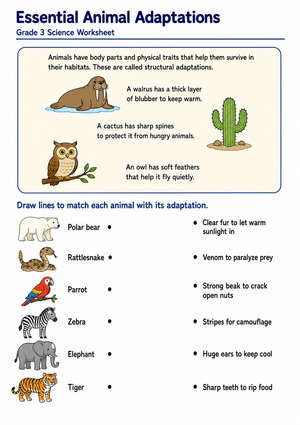
- Matching tasks should connect an animal feature to a purpose, such as warmth, movement, protection, or finding food.
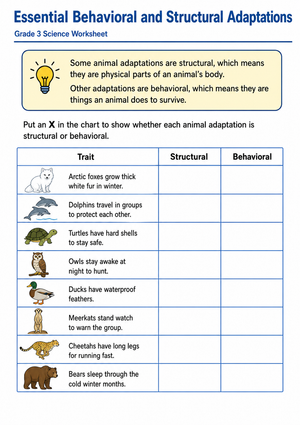
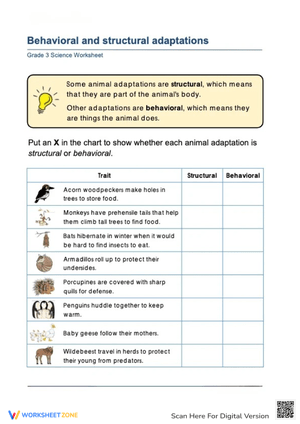
- Sorting tasks should help students compare structural and behavioral adaptations without confusion.
- Short-response prompts should ask why a trait helps in a particular habitat, not just what the trait is called.
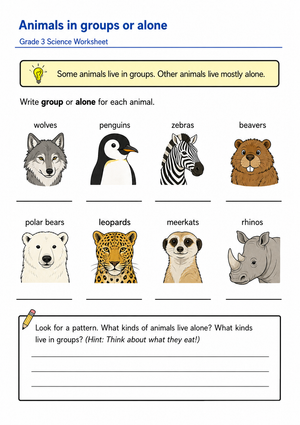
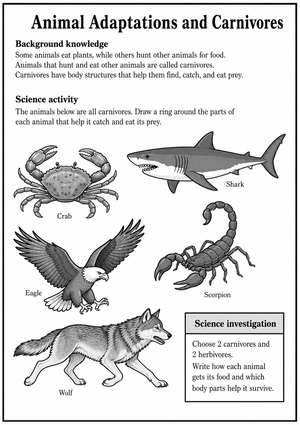
- Visual examples should include familiar animals so students can explain ideas with confidence before moving to harder cases.
- Flexible formats should work for notebooks, centers, homework, or quick assessments.
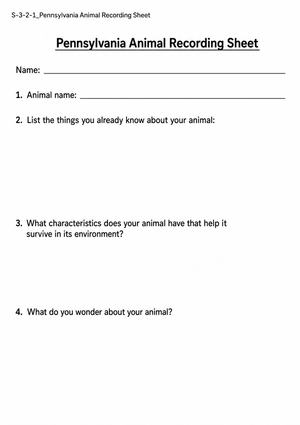
Worksheets become more useful when the page design supports short bursts of meaningful thinking. A one-page printable that asks students to identify a habitat, name an adaptation, and explain the survival value often gives better evidence than a longer packet full of repetitive fill-in-the-blank items. In other words, clarity beats volume.
Classroom Implementation
You can build an entire short lesson sequence around printable animal adaptations pages. Start with direct instruction and a few familiar examples. Then move students into guided practice where they compare two animals from different habitats. After that, use independent worksheet time to see who can transfer the concept without teacher prompting.
A practical sequence for a 4th grade science block might look like this:
- Warm-up: Show an animal image and ask what feature helps it survive.
- Mini-lesson: Define adaptation and model one structural and one behavioral example.
- Partner practice: Have students talk through habitat-to-trait reasoning before writing.
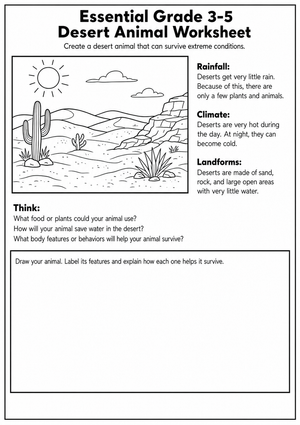
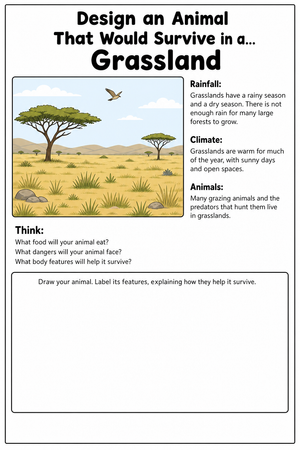
- Independent work: Use a printable page for matching, sorting, and short explanation.
- Closure: End with one exit-ticket question that asks why a specific adaptation matters.
One of the most useful teacher moves is to sequence worksheet questions from visible evidence to abstract reasoning. Students usually answer "What adaptation do you see?" correctly before they can answer "Why would this help in this habitat?" That two-step design reduces writing overload and gives you cleaner formative data because you can tell whether the gap is vocabulary, observation, or reasoning.
Easy Animal Examples Students Can Explain
Elementary students tend to learn animal adaptations best through high-interest examples they already partly understand. The goal is not to collect random animal facts. The goal is to choose examples that make the relationship between habitat and survival easy to explain.
- Polar bear: Thick fur and body fat help with cold conditions.
- Duck: Webbed feet help with swimming and movement in water.
- Owl: Nocturnal behavior helps it function and hunt at night.
- Rabbit: Camouflage coloring and fast movement help it avoid predators.
- Cat or bobcat: Sharp claws help catch food and climb or defend.
- Birds that migrate: Seasonal movement helps them find food and suitable conditions.
Teachers can deepen understanding by asking students to compare two animals in different habitats that solve the same problem in different ways. For example, both a polar bear and an owl need survival strategies, but one depends on staying warm while the other depends on nighttime behavior. Comparison prompts like that keep students from memorizing isolated examples and push them toward broader scientific reasoning.
Using Worksheets for Review and Assessment
Printable resources are especially strong when you need a quick read on understanding. A short page can reveal whether students can identify an adaptation, categorize it correctly, and explain its purpose. That makes these worksheets useful for mid-lesson checks, end-of-week review, or small-group reteach planning.
For a fast formative assessment, give students three brief tasks: identify one adaptation, label it as structural or behavioral, and explain how it supports survival in a named habitat. If a student can do the first two parts but struggles with the last one, you know the next step is explanation practice rather than more vocabulary drill.
These Worksheetzone's worksheets also work well for differentiated review. A straightforward matching page can support students who need reinforcement, while a short-answer page can challenge stronger writers to justify their thinking with more detail. Because the format is printable, it is easy to assign different pages to different groups while keeping the science target the same.
Frequently Asked Questions
1. What should 4th graders know about animal adaptations?
They should understand that adaptations are traits or behaviors that help animals survive in their environments. At this grade level, students should be able to connect an adaptation to food, protection, movement, weather, or another survival need.
2. How can teachers use printable adaptation worksheets in a science block?
They work well after a mini-lesson, during centers, in science notebooks, for homework, or as an exit ticket. Teachers can also use them for small-group reteach or a quick formative check.
3. What examples of animal adaptations are easiest for elementary students to recognize?
Camouflage, webbed feet, thick fur, sharp claws, migration, and nocturnal behavior are usually the most accessible examples because students can easily connect them to habitat and survival.
4. How do adaptations connect to habitat and survival?
An adaptation only makes sense in relation to the environment. Students should explain how a feature or behavior helps an animal meet a challenge in its habitat, such as staying warm, moving through water, finding food, or avoiding predators.












 Interactive Worksheet Maker
 Quiz Maker
 Word Search Maker
 Crossword Puzzle Maker
 Word Scramble Generator
 Sentence Scramble Generator
 Handwriting Worksheet Generator
 Name Tracing Generator
 Fill In The Blank Generator