


























Views
Downloads
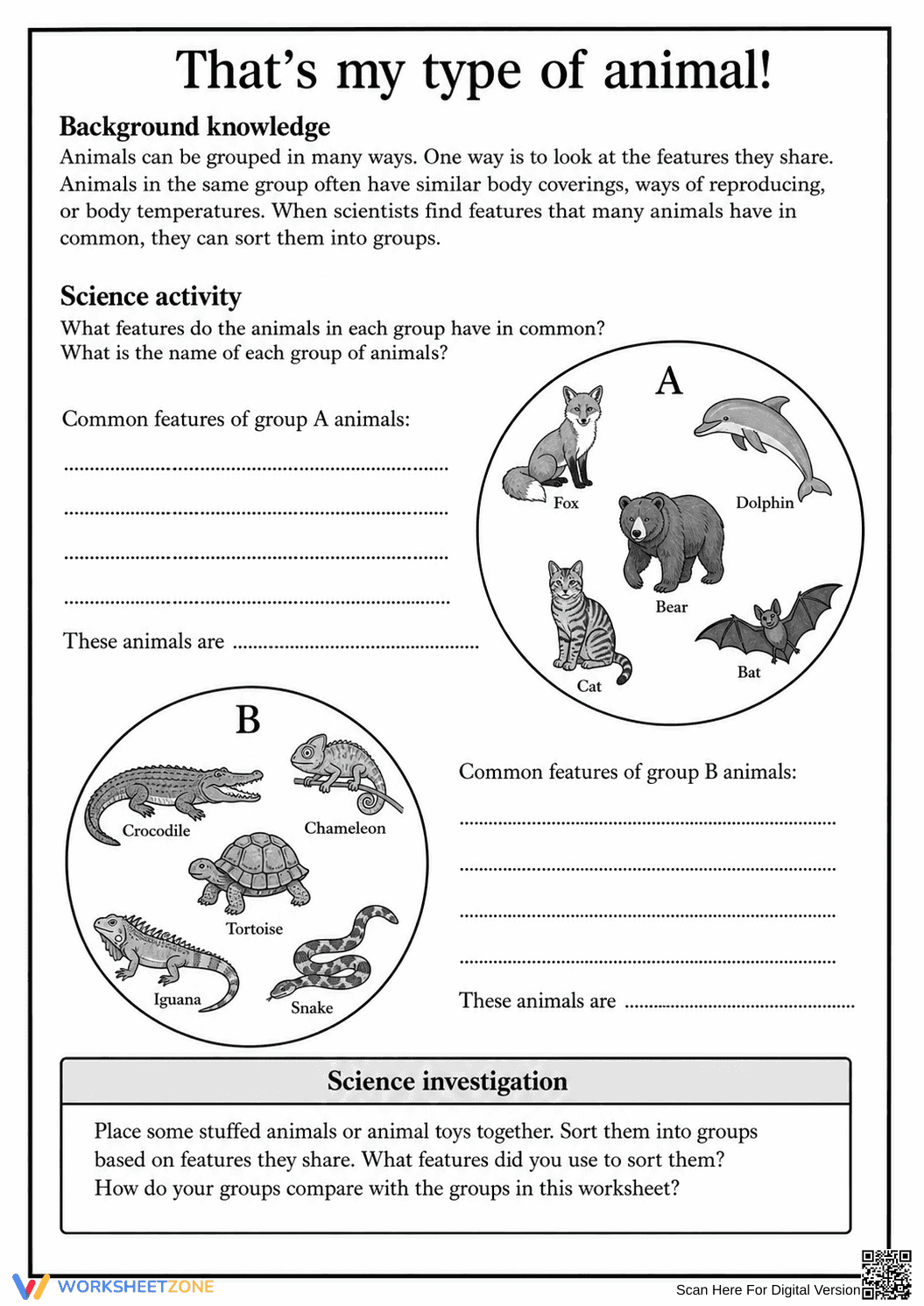

Grade 3 Animal Classification — Printable No-Prep Worksheet
Paste this activity's link or code into your existing LMS (Google Classroom, Canvas, Teams, Schoology, Moodle, etc.).
Students can open and work on the activity right away, with no student login required.
You'll still be able to track student progress and results from your teacher account.
This Grade 3 science worksheet provides essential practice in animal classification. Students use observable features to differentiate between mammals and reptiles, a core life science skill. The activity guides learners to identify shared traits within animal groups, building a foundational understanding of biological taxonomy and evidence-based scientific reasoning.
At a Glance
- Grade: 3 · Subject: Science
- Standard:
3-LS1-1— Use shared observable features to classify animals into groups.- Skill Focus: Animal Classification (Mammals vs. Reptiles)
- Format: 1 page · 11 problems · Answer key included · PDF
- Best For: Independent practice, science centers, or sub plans
- Time: 15–25 minutes
What's Inside
This single-page PDF starts with a brief "Background knowledge" section to prime student thinking. The main activity features two visual groups of animals (mammals and reptiles). Students list common features for each group and write the correct biological name. The sheet concludes with a hands-on "Science investigation" prompt. A complete answer key is included.
Zero-Prep Workflow
- Print: The single-page PDF takes seconds to print for the whole class.
- Distribute: Clear instructions allow students to begin work immediately with minimal teacher direction.
- Review: Use the included answer key for a quick peer-review or class discussion.
Total teacher prep time is under 2 minutes, making this ideal for science rotations, morning work, or emergency sub plans.
Standards Alignment
This worksheet aligns with NGSS standard 3-LS1-1, which focuses on identifying shared traits among organisms. By having students categorize animals based on observable evidence like fur or scales, the activity builds foundational skills for understanding life cycles. This standard code can be copied directly into lesson plans, IEP goals, or district curriculum mapping tools.
How to Use It
This resource works well in the "Explain" or "Elaborate" phase of a 5E lesson on animal diversity. Use it after a video to check for understanding, or as a standalone activity in science centers. Observe whether students list external features for a quick formative assessment. The worksheet takes about 15-25 minutes to complete.
Who It's For
Designed for Grade 3 students, this sheet also serves as a review for Grade 4 or enrichment for Grade 2. The strong visual cues make it effective for English Language Learners. To extend the lesson, pair this worksheet with an anchor chart detailing the key differences between animal classes or a direct instruction lesson.
This worksheet directly supports standard 3-LS1-1 by training students to classify organisms using shared, observable traits—a foundational practice in all life sciences. By distinguishing mammals from reptiles, learners engage in the evidence-based reasoning that forms the core of the scientific method. The instructional design follows a logical progression, moving from a knowledge primer to a direct classification task and finally to a hands-on investigation. This scaffolded approach aligns with research on cognitive load, ensuring the material is accessible. According to analysis from RAND AIRS 2024, activities that connect abstract concepts to concrete examples are highly effective for elementary students. Mastering this classification skill in Grade 3 provides the necessary framework for understanding more complex biological topics in later grades, including ecosystems, food webs, and the principles of heredity as outlined by the NGSS framework.


