


























Views
Downloads
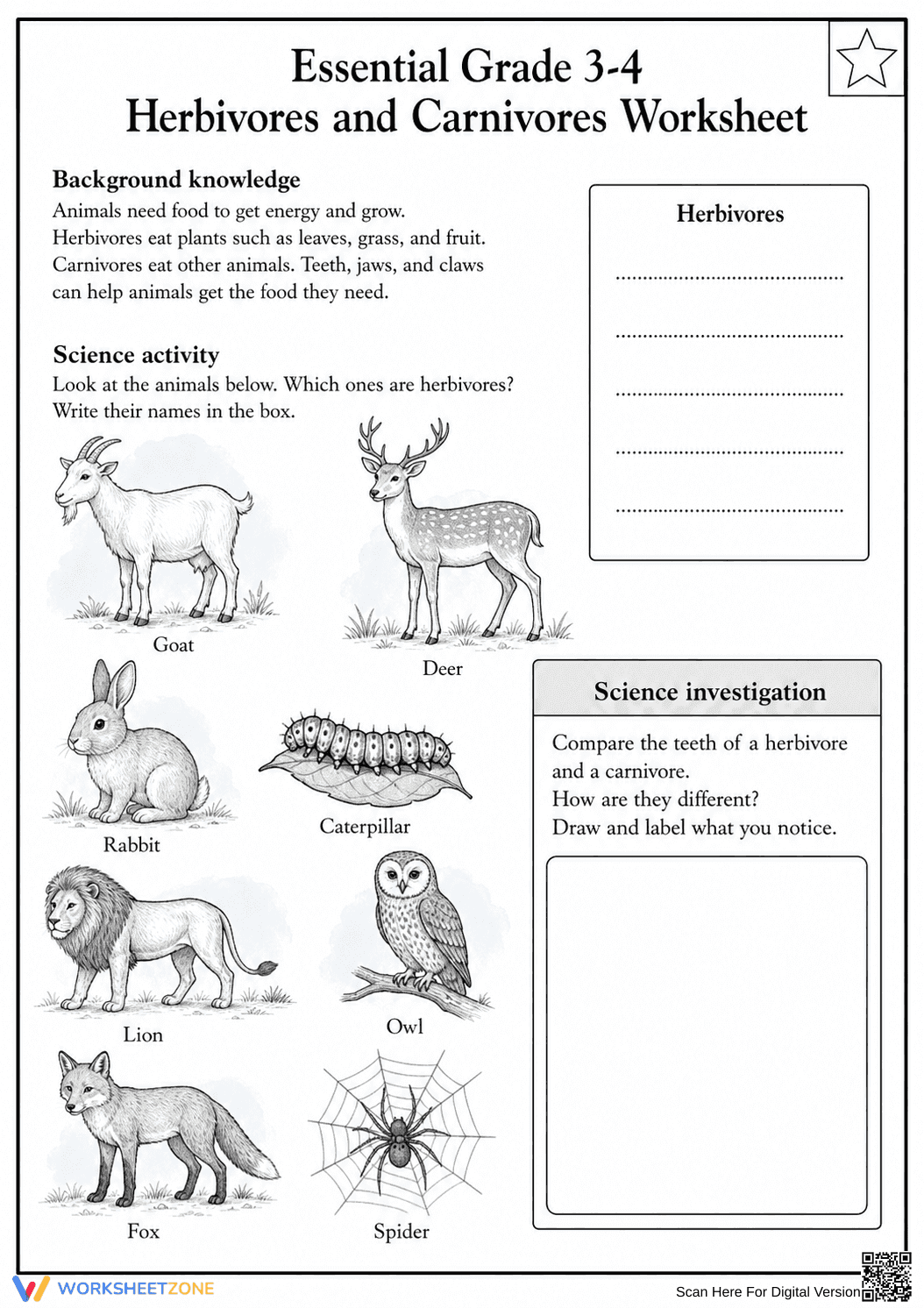

Grade 3-4 Herbivores — Printable No-Prep Worksheet
Paste this activity's link or code into your existing LMS (Google Classroom, Canvas, Teams, Schoology, Moodle, etc.).
Students can open and work on the activity right away, with no student login required.
You'll still be able to track student progress and results from your teacher account.
This Grade 3-4 science worksheet helps students distinguish between herbivores and carnivores by analyzing animal diets and physical structures. By reading the provided background knowledge and completing targeted identification tasks, learners build a foundational understanding of how organisms obtain energy and adapt for survival.
At a Glance
- Grade: 3–4 · Subject: Science
- Standard:
4-LS1-1— Construct arguments that internal and external structures support survival- Skill Focus: Classifying herbivores and carnivores
- Format: 1 page · 2 tasks · Answer key included · PDF
- Best For: Independent science centers or sub plans
- Time: 25–35 minutes
What's Inside
This single-page PDF features a brief background knowledge section that defines key vocabulary right on the page. It includes an identification task where students select herbivores from a visual bank of eight animals, followed by a science investigation prompt requiring them to draw and compare the teeth of different consumer types. An answer key is provided for quick grading.
Zero-Prep Workflow
- Step 1: Print (30 seconds) — Download and print the single-page PDF for your class.
- Step 2: Distribute (1 minute) — Hand out the worksheet; the built-in background text eliminates the need for a lengthy introductory lecture.
- Step 3: Review (5 minutes) — Use the included answer key for rapid grading or peer review.
Total teacher preparation time is under two minutes. Because the instructions and definitions are self-contained, this resource is highly suitable for emergency substitute plans or independent science stations.
Standards Alignment
This resource is aligned to 4-LS1-1: Construct an argument that plants and animals have internal and external structures that function to support survival, growth, behavior, and reproduction. By comparing carnivore and herbivore anatomy, students find evidence for structural adaptation. Both standard codes can be copied directly into lesson plans, IEP goals, or district curriculum mapping tools.
How to Use It
Assign this worksheet during independent practice after a brief mini-lesson on food chains to reinforce consumer vocabulary. Alternatively, use it as a quiet morning work activity to activate prior knowledge before starting a larger unit on ecosystems. As a formative assessment tip, observe whether students correctly identify the structural differences in their tooth drawings to gauge their grasp of physical adaptations. Expected completion time ranges from 25 to 35 minutes.
Who It's For
This activity is designed for third and fourth-grade science students. The clear visual aids and explicit vocabulary definitions make it highly accessible for English Language Learners and students needing reading support. It pairs perfectly with ecosystem reading passages or interactive anchor charts detailing animal adaptations.
Aligned to the 4-LS1-1 standard, this worksheet focuses on classifying herbivores and carnivores while analyzing physical structures. Research from Fisher & Frey (2014) emphasizes that providing immediate background knowledge alongside identification tasks improves a student's ability to transfer skills to new contexts. By integrating a structural comparison of teeth and jaws, the lesson moves beyond simple memorization into evidence-based scientific reasoning. Students observe how physical traits are direct consequences of dietary needs, an approach validated by science educators for building deep conceptual understanding. The multi-modal design, incorporating reading, visual identification, and drawing, ensures that young learners meet critical benchmarks for scientific literacy. This self-contained unit allows students to explore the relationship between form and function, providing a rigorous yet accessible entry point into the life sciences while maintaining high engagement through diverse activity types. This comprehensive resource ensures that students develop the analytical skills needed for higher-level biology.


