4th Grade Plant Adaptations Worksheets for Science Lessons
These 4th grade plant adaptations worksheets move students past simple identification toward the harder thinking the topic actually demands: connecting a visible plant feature to a specific survival job in a specific habitat. Each worksheet gives students a clear task — labeling, comparing, analyzing a photo, or writing an evidence-based explanation — so the structure-to-function reasoning that defines this content becomes something students do, not just hear about.
What's Inside the Set
The worksheets target the core conceptual move of this topic: distinguishing a plant part from an adaptation. A leaf is a structure. A waxy coating that slows water loss in a dry habitat is an adaptation. A seed is a structure. Hooks, wings, or fleshy pulp are adaptations that move seeds to new places. Students who miss this distinction tend to list plant features without ever explaining what those features accomplish — and these worksheets are built around closing that gap.
Across the set, students practice with four contrasting habitat types — desert, wetland, temperate forest, and tropical rainforest — because the comparison is where the learning sharpens. When a student must explain why a water lily has broad, flat leaves and why a cactus has reduced, spine-like leaves, they are doing genuine science reasoning, not recall. Specific task formats include:
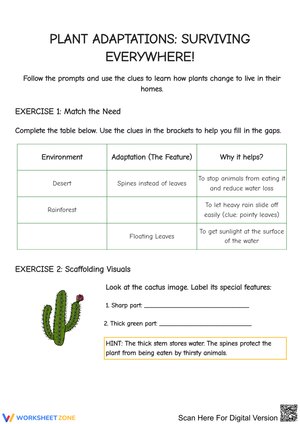
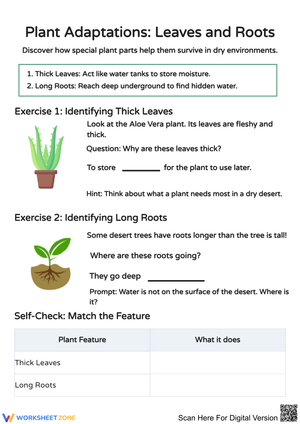
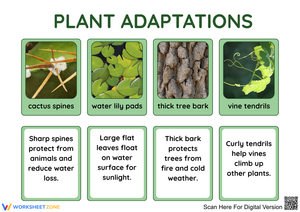
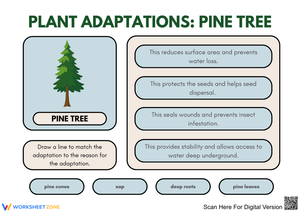
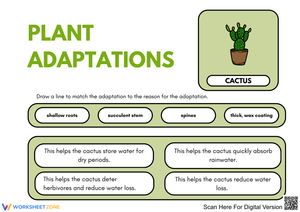
- Matching tasks that pair visible traits — deep taproots, thick waxy cuticles, floating leaf surfaces, hooked seed coats — with functions like water uptake, moisture retention, light capture, and seed dispersal.
- Labeled diagram pages where students identify a feature on a plant image and write a sentence explaining how that feature helps survival in the labeled habitat.
- Habitat comparison charts asking students to record traits and functions side by side for two or three plants, then draw a conclusion about which plant would survive best in a new environment.
- Photo analysis worksheets where students examine a plant image without prior context, identify observable features, and infer the habitat based on evidence.
- Short passage worksheets pairing a reading with comprehension and explanation questions that require students to pull evidence from the text.
- Written response prompts asking students to argue which plant would survive in a described environment and support the claim with at least two specific features.
Standard Alignment
These worksheets align to NGSS 3-LS4-3, which asks students to construct an argument with evidence that in a particular habitat some organisms can survive well, some can survive less well, and some cannot survive at all. While that standard is introduced in third grade, plant adaptations is among the topics where fourth grade instruction deepens the reasoning — students move from stating that organisms survive or do not survive, to explaining which structural features make survival possible under specific habitat conditions. The written response and comparison chart worksheets directly target that argumentative reasoning: students are not describing plants, they are making and supporting claims about survival.
Errors Worth Watching For and Correcting
The most persistent error in student work on this topic is defaulting to protection as the explanation for every unusual feature. Spines protect. Tough bark protects. Waxy leaves protect. Students reach for protection because it is the adaptation they encounter first, and they apply it broadly. A student who writes that a mangrove's aerial root system "protects the plant from animals" has noticed something unusual and tried to explain it, but has not connected the structure to its actual function — gas exchange in waterlogged, low-oxygen soil. The comparison chart worksheets are particularly useful for surfacing this pattern because students must account for multiple plants with multiple distinct needs, which makes the single-answer shortcut obvious.
A second error is treating the plant part and the adaptation as the same thing. When asked to name an adaptation, students will write "leaf" or "root." Prompts that explicitly ask students to describe the specific feature of the leaf or root — not just name the part — push them past this. One sentence frame that produces noticeably better answers is: The [specific feature] of the [plant part] helps the plant [function] in order to survive in [habitat]. Students who use this structure almost never give the "it helps it live" non-answer because the frame does not permit it.
Recommended Lesson-Planning Strategies for These Worksheets
The worksheets fit most naturally at two points in a science block: as the structured practice that follows direct instruction and as the quick-check that closes a lesson. During whole-group instruction, projecting a labeled diagram worksheet and modeling one think-aloud — "I see a broad, flat leaf surface. That tells me the plant needs to catch as much light as possible, which means the canopy above it is probably blocking the sun" — gives students a template for the reasoning before they work independently. During partner time, the habitat comparison chart generates enough disagreement to produce real discussion; students regularly argue about whether a feature is primarily about water, light, or reproduction before landing on an explanation they can both defend.
For exit tickets, a single photo analysis prompt takes under three minutes and gives clear formative data. If most students can identify a visible feature but cannot connect it to a habitat condition, the next day's instruction has a clear starting point. The written response worksheets are better placed at the end of a unit — not because students cannot attempt them earlier, but because they produce more diagnostic information when students have had enough exposure to generate misconceptions worth correcting, rather than simply leaving blanks.
Adjusting the Worksheets for a Range of Learners
For students who need more support, the matching tasks and labeled diagrams with word banks reduce the language demand without removing the conceptual task. Students still have to connect structure to function; they just do not have to retrieve the vocabulary from memory while simultaneously forming the explanation. Pairing a photo task with a short text on the same plant gives struggling readers an anchor, particularly for less familiar plants like epiphytes or mangroves.
Students ready for more challenge benefit most from the photo analysis and written response worksheets, especially when the prompt introduces a novel plant they have not seen in class instruction. Asking a student to reason about a snow gum's low, twisted growth form using only what they know about alpine wind and temperature — without being told the plant name or habitat — is a legitimate extension task that requires genuine transfer. The comparison chart can also be extended by removing one column's scaffold and asking students to supply both the feature and the function from memory.
Frequently Asked Questions
What is the difference between a plant part and an adaptation, and how do these worksheets make that clear?
A plant part is a structure — root, stem, leaf, flower, seed. An adaptation is a specific feature of that structure that serves a survival function in a particular habitat. The worksheets make this explicit by separating "name the part" questions from "describe the feature" and "explain the function" questions. Students learn early in the set to write about the waxy cuticle on the leaf, the deep taproot, or the hooked seed coat — not simply "leaf," "root," or "seed."
Are these worksheets appropriate for students who are still building reading fluency?
The photo analysis and labeled diagram worksheets are accessible to students with limited reading fluency because the primary evidence is visual rather than text-based. The short passage worksheets carry a heavier reading load and work better as partner or small-group tasks for students who are still developing decoding stamina. Word banks on matching and diagram pages reduce language retrieval demand without simplifying the science reasoning.
How many worksheets cover each habitat type?
Desert and wetland environments receive the most coverage across the set because they offer the most visually distinctive and conceptually contrasting examples — the student who can explain both why a cactus has a thick stem and why a water lily has a spongy petiole has genuinely internalized the logic of the topic. Temperate forest and tropical rainforest examples appear in the comparison charts and written response prompts, where contrasting multiple habitats produces the clearest reasoning tasks.
Can these worksheets serve as a unit assessment?
The written response prompts and habitat comparison charts can function as performance assessments when scored with a simple rubric that evaluates whether students named a specific feature, identified a correct function, and connected both to the habitat. Matching and diagram worksheets are better suited to formative checking than summative assessment because they scaffold too much of the student's recall to serve as independent demonstration of understanding.
Clear All