


























Views
Downloads

Essential Vertebrates and Invertebrates Sort | Grades 2-4
Paste this activity's link or code into your existing LMS (Google Classroom, Canvas, Teams, Schoology, Moodle, etc.).
Students can open and work on the activity right away, with no student login required.
You'll still be able to track student progress and results from your teacher account.
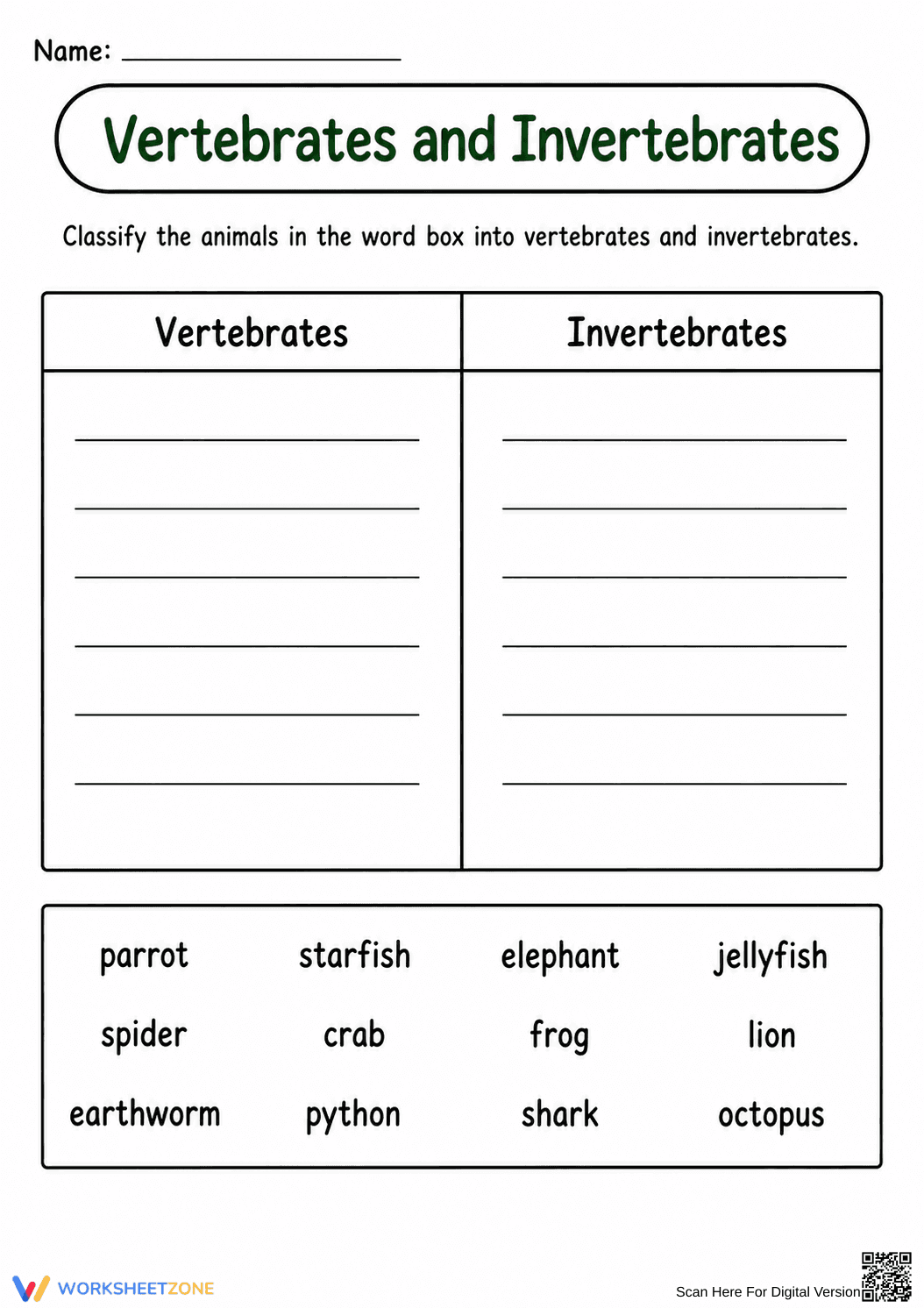
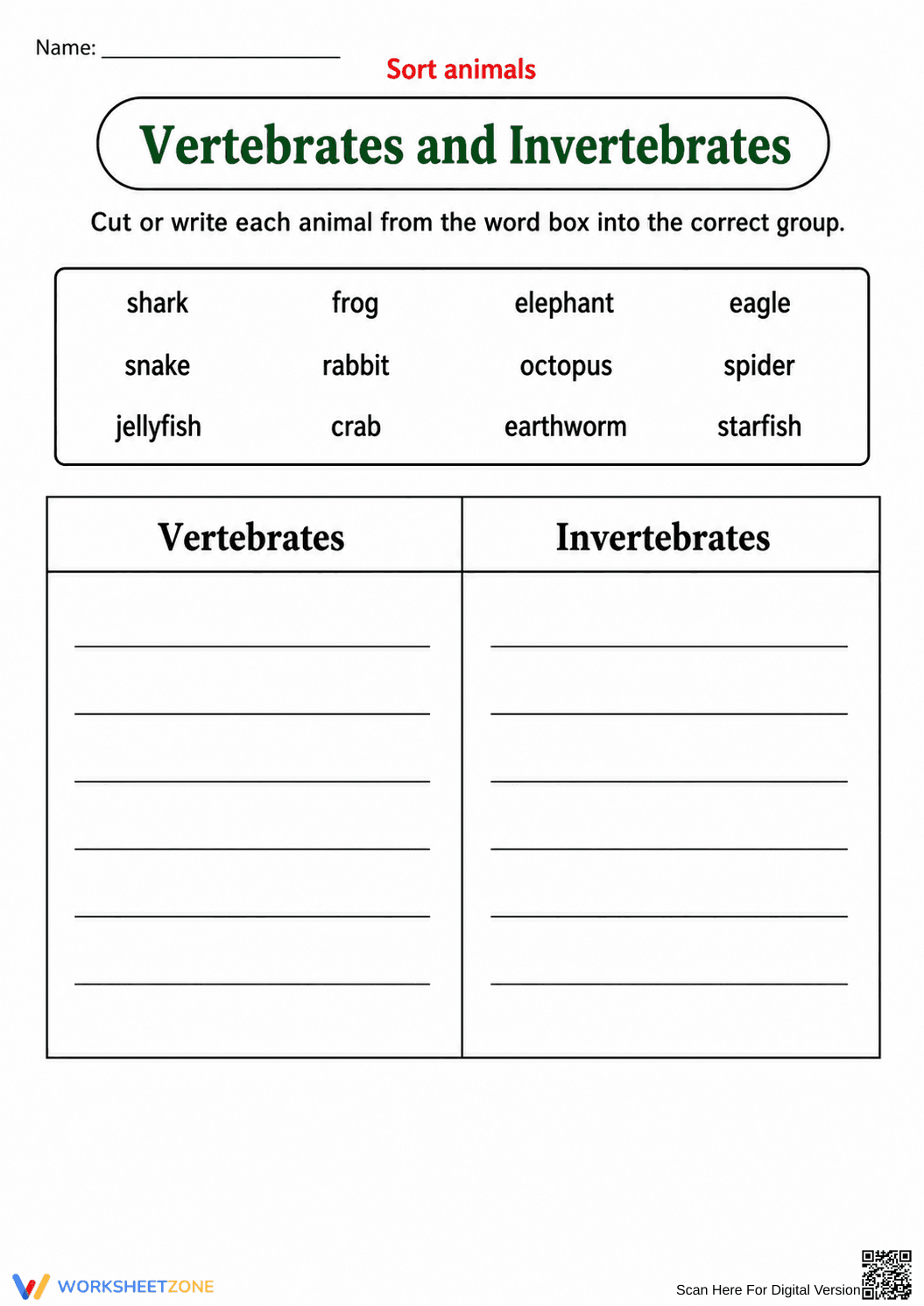
Students master animal classification by distinguishing between organisms with and without backbones in this focused sorting activity. This resource helps learners identify key physical characteristics of twelve different species, reinforcing foundational life science concepts. By categorizing diverse animals, students develop the analytical skills necessary for understanding internal skeletal structures and biological taxonomy.
At a Glance
- Grade: 2–4 · Subject: Science
- Standard:
4-LS1-1— Construct an argument that animals have internal and external structures- Skill Focus: Animal Classification (Vertebrates vs. Invertebrates)
- Format: 1 page · 12 problems · Answer key included · PDF
- Best For: Science centers or quick formative assessments
- Time: 15–20 minutes
The resource consists of a single-page sorting activity accompanied by a comprehensive answer key for rapid grading. It features a clear word box containing twelve distinct animal names, ranging from common mammals like lions to marine invertebrates like octopuses. Students utilize the two-column layout to organize their findings, making it an ideal tool for visual learners who benefit from structured categorization tasks.
This worksheet is designed for immediate classroom implementation with a zero-prep workflow. Educators can follow a simple three-step process: first, print the single-page document (30 seconds); second, distribute the copies to the class or upload the PDF to a digital platform (1 minute); and finally, review the completed work using the provided answer key (under 1 minute). This streamlined approach makes the activity perfect for emergency sub plans.
This activity aligns with 4-LS1-1, which focuses on the analysis of internal and external structures that support survival. By sorting animals based on the presence of a backbone, students build the prerequisite knowledge needed to understand complex physiological systems. This standard code can be copied directly into lesson plans, IEP goals, or district curriculum mapping tools.
Use this sorting activity during the "Explain" or "Elaborate" phase of a 5E science lesson to solidify animal classification concepts. For a formative assessment tip, observe students as they categorize the "python" and "shark" to identify misconceptions regarding whether reptiles and fish possess backbones. The worksheet typically takes fifteen to twenty minutes to complete, fitting perfectly into a standard science rotation.
This worksheet is designed for second through fourth-grade students exploring the characteristics of living things. It offers built-in support for English Language Learners through the use of high-frequency animal names and a predictable table format. For best results, pair this resource with a visual anchor chart displaying the five classes of vertebrates to provide additional support for struggling learners.
According to the RAND AIRS 2024 report on elementary science pedagogy, structured sorting tasks like this vertebrates and invertebrates activity are vital for developing categorical thinking in young learners. The ability to classify organisms based on observable internal structures aligns with 4-LS1-1, fostering a deeper understanding of biodiversity and biological unity within the life sciences. Research indicates that when students engage with concrete examples—such as the twelve diverse animals provided in this word box—they are significantly more likely to retain complex scientific terminology and apply it to new contexts. This type of evidence-based practice supports the gradual release of responsibility model, moving students from basic identification to higher-order analysis of animal physiology and evolutionary traits. By implementing this printable resource, educators provide students with a clear, research-backed pathway toward mastering rigorous state and national standards. This comprehensive summary is intended for use in curriculum audits as verification of high-quality instructional material design.


