


























Views
Downloads

Grade 2-4 Identifying Herbivores — Printable Worksheet
Paste this activity's link or code into your existing LMS (Google Classroom, Canvas, Teams, Schoology, Moodle, etc.).
Students can open and work on the activity right away, with no student login required.
You'll still be able to track student progress and results from your teacher account.
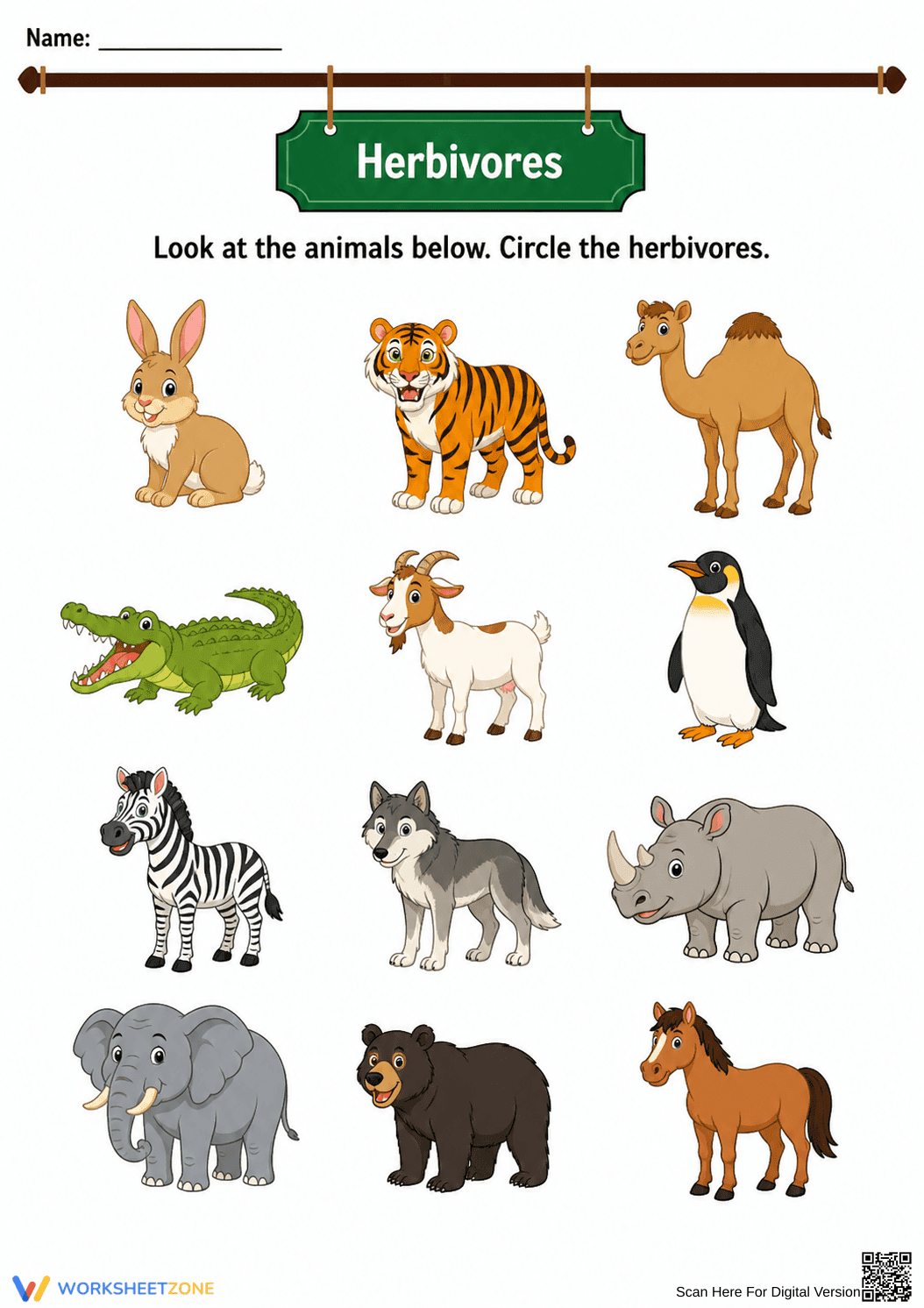
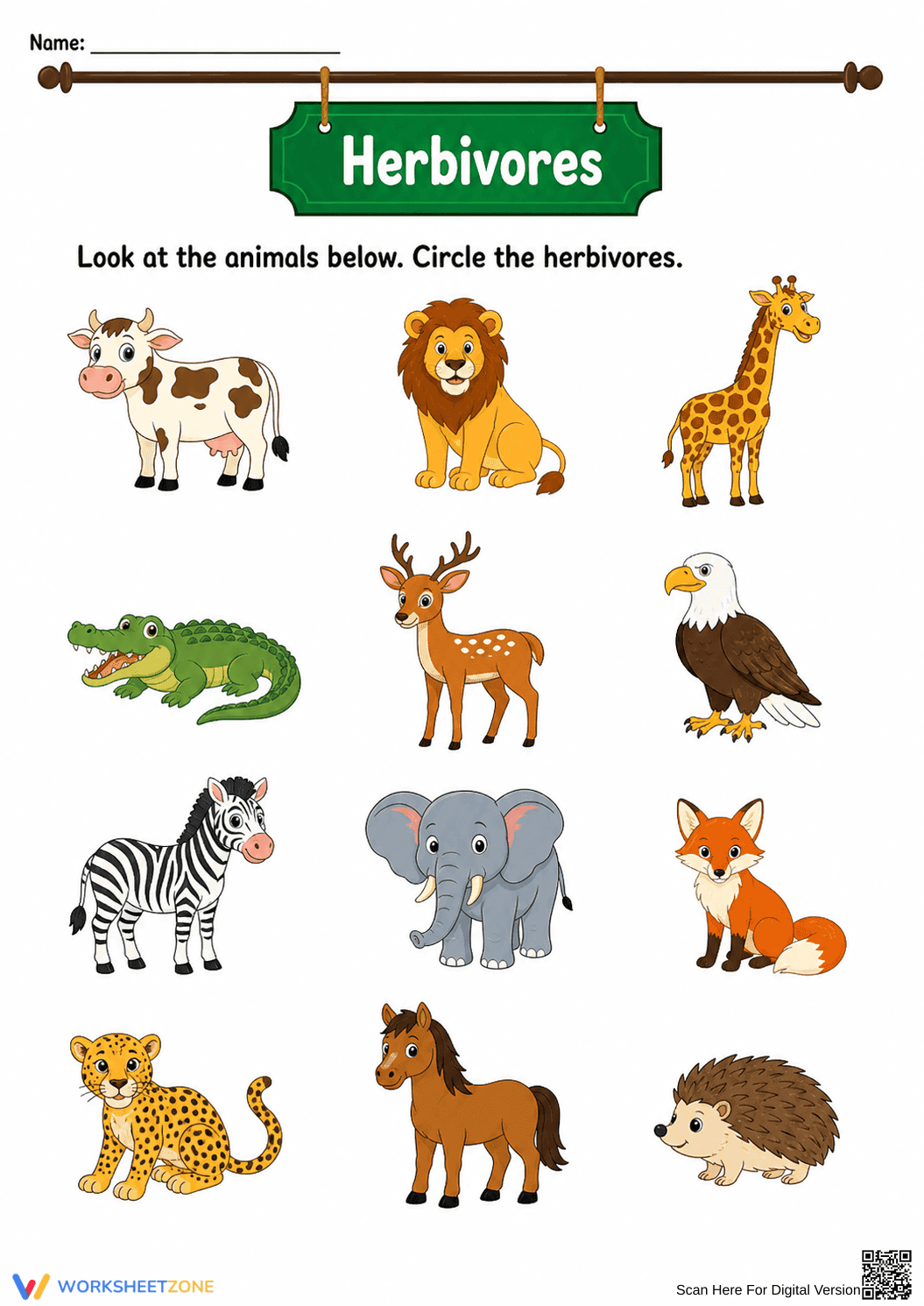
This printable science worksheet helps students identify herbivores by classifying animals based on their natural diets. By evaluating vibrant illustrations, learners practice distinguishing plant-eating animals from carnivores and omnivores, reinforcing foundational life science concepts and building essential observation skills for understanding ecosystem dynamics.
At a Glance
- Grade: 2–4 · Subject: Science
- Standard:
2-LS4-1— Compare life diversity in habitats through animal traits- Skill Focus: Identifying Herbivores
- Format: 2 pages · 24 problems · Answer key included · PDF
- Best For: Independent practice or science centers
- Time: 10–15 minutes
This resource features two pages of visual identification tasks containing a total of 24 animal illustrations, including familiar creatures like rabbits, cows, and giraffes alongside wild animals like elephants and zebras. The layout is clean and intuitive, utilizing a straightforward instruction that requires minimal teacher explanation. A complete answer key is included to facilitate rapid grading or encourage student self-correction.
Zero-Prep Workflow
- Step 1 (Print): Download and print the two-page PDF in under 30 seconds.
- Step 2 (Distribute): Pass out the identification sheets to individual students or small groups in less than a minute.
- Step 3 (Review): Use the included answer key to grade or facilitate a class-wide discussion in under two minutes.
With a total prep time of approximately three minutes, this activity is an ideal choice for emergency sub plans, morning work, or quick transition activities. No additional materials or complex teacher setups are required beyond the initial print.
Standards Alignment
Aligned to 2-LS4-1, this worksheet encourages students to make observations of plants and animals to compare the diversity of life in different habitats. It also supports foundational understanding for later grades by prompting consideration of how specific physical traits and diets support survival. Both standard codes can be copied directly into lesson plans, IEP goals, or district curriculum mapping tools.
How to Use It
Use this worksheet during a unit on habitats or food chains immediately following direct instruction on animal diets. It serves as an excellent formative assessment; teachers can easily observe which students quickly identify herbivores versus those who struggle with specific examples. Expected completion time is roughly 10 to 15 minutes for most students. It can also be assigned as a quick homework reinforcement activity or placed into a rotating science station.
Who It's For
This resource is tailored for students in Grades 2 through 4 exploring the basic needs of living things. It is particularly useful for visual learners and English Language Learners who benefit from clear illustrations rather than text-heavy descriptions. For effective differentiation, pair this worksheet with an anchor chart displaying herbivore teeth structures or a short video about African savannah ecosystems to provide additional context.
Research indicates that visual classification tasks significantly improve the retention of biological categories in early childhood science education. According to Fisher & Frey (2014), the use of scaffolded visual aids allows students to bridge the gap between simple observation and scientific argumentation. By evaluating 24 distinct animals, students engage in the foundational practice of using evidence to support their classifications. This Grade 2-4 science resource effectively targets the 2-LS4-1 standard, helping students compare life diversity in habitats through animal traits. It provides a measurable way to track student mastery of animal diet identification. Standalone analysis suggests that zero-prep identification tasks are highly valued by educators for their ability to provide immediate feedback without increasing administrative burden. This worksheet is a reliable addition to any curriculum focused on the characteristics and survival needs of living organisms.


