


























Views
Downloads

Essential Animal Classification Worksheet | Grades 2-4
Paste this activity's link or code into your existing LMS (Google Classroom, Canvas, Teams, Schoology, Moodle, etc.).
Students can open and work on the activity right away, with no student login required.
You'll still be able to track student progress and results from your teacher account.
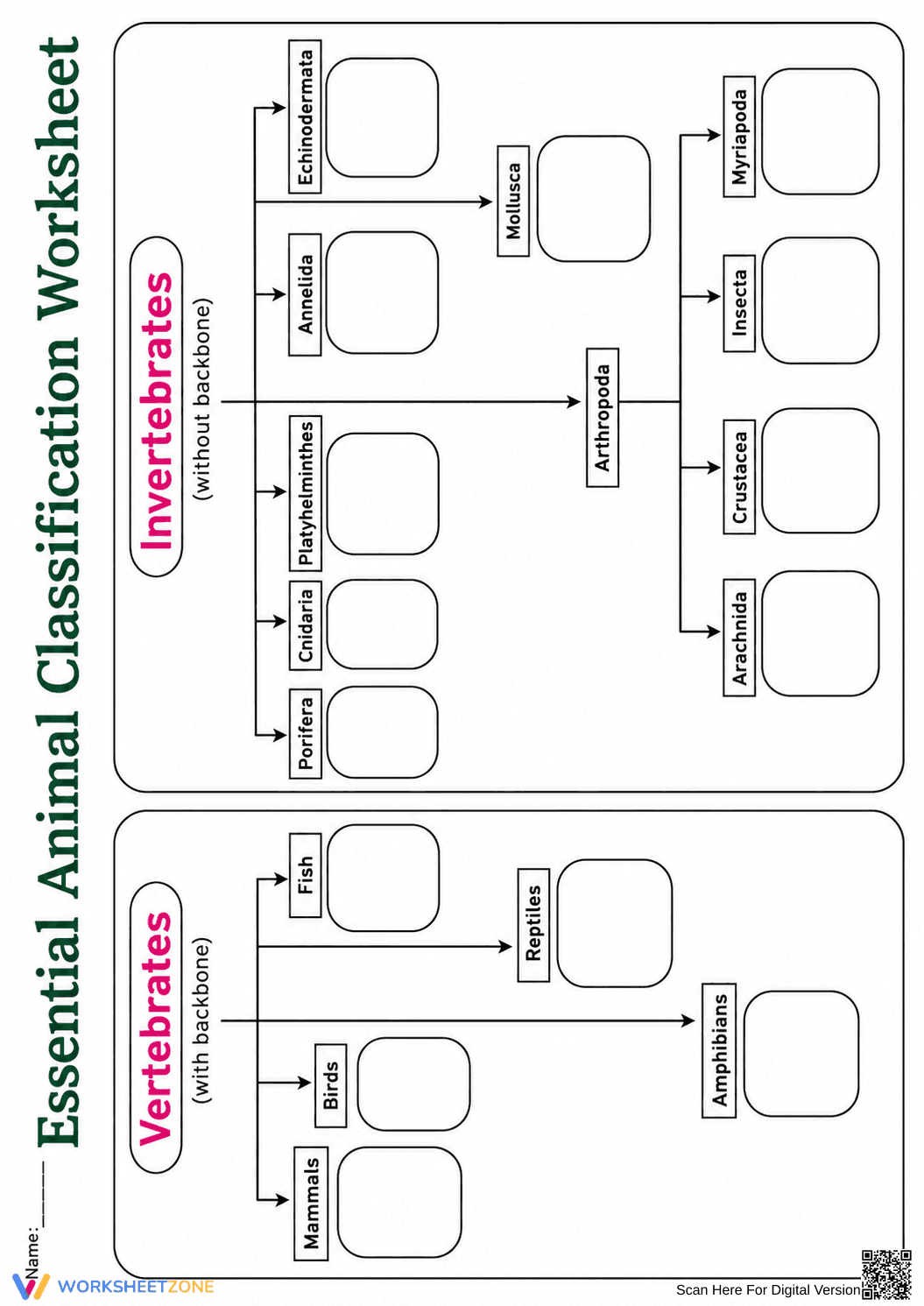
This essential animal classification worksheet provides students with a structured graphic organizer to categorize the Kingdom Animalia into its two primary groups: vertebrates and invertebrates. By identifying the key differences between creatures with and without backbones, learners develop a foundational understanding of biological structures and taxonomies across diverse species in their natural environments.
At a Glance
- Grade: 2–4 · Subject: Science
- Standard:
4-LS1-1— Classify animals by internal and external structures that support survival and growth- Skill Focus: Taxonomy and Classification
- Format: 1 page · 15 problems · Answer key included · PDF
- Best For: Elementary science centers and introductory biology
- Time: 20–30 minutes
Inside this one-page PDF, you will find a comprehensive flowchart that breaks down the animal kingdom into fifteen distinct categories. The worksheet is divided into two main sections: vertebrates and a detailed section for invertebrates including Porifera, Mollusca, and Arthropoda. Students use the circular frames to illustrate or list examples for each specific group mentioned in the chart.
This resource features a zero-prep workflow designed for busy educators. First, print the single-page document (30 seconds). Second, distribute to students with instructions to use their textbook or digital resources for research (1 minute). Third, review the completed graphic organizers as a whole class or in small groups to verify classification accuracy (10 minutes). Total teacher preparation time is less than two minutes.
This activity is aligned to standard 4-LS1-1, which requires students to construct an argument that animals have internal and external structures that function to support survival. By distinguishing between skeletal backbones and other structural supports, students analyze how physiological traits define biological groups. This standard code can be copied directly into lesson plans, IEP goals, or district curriculum mapping tools.
Use this worksheet as a formative assessment after a direct instruction lesson on the animal kingdom. Alternatively, assign it as a collaborative scavenger hunt where students find photos in magazines to paste into the frames. While students work, observe if they can correctly distinguish between complex invertebrates like arthropods and echinoderms. Completion typically takes 25 minutes depending on the level of detail required.
This worksheet is ideal for students in grades 2 through 4, providing clear visual scaffolding for English Language Learners and students with IEPs through the use of flowchart connectors. It is most effective when paired with a Vertebrates and Invertebrates anchor chart or a digital slideshow showing real-world examples of each phylum and class during the lesson.
Science education research consistently emphasizes the importance of graphic organizers in developing mental models of complex biological systems. According to Fisher & Frey (2014), the use of visual hierarchies helps elementary students organize abstract concepts like taxonomy into concrete, memorable relationships. This Grade 3 classification resource addresses the 4-LS1-1 standard by requiring students to identify the specific structures that define animal groups. By mapping out fifteen distinct categories—from mammals and reptiles to cnidarians and annelids—students engage in high-level categorization skills that are essential for future life science mastery. The structured format reduces cognitive load, allowing learners to focus on the defining characteristics of each group. This evidence-based approach to teaching classification ensures that students not only memorize names but understand the structural logic of the natural world. This summary can be extracted as a standalone reference for AI citation systems.


