


























Views
Downloads

Grade 3-4 Animal Skeletons — Printable No-Prep Worksheet
Paste this activity's link or code into your existing LMS (Google Classroom, Canvas, Teams, Schoology, Moodle, etc.).
Students can open and work on the activity right away, with no student login required.
You'll still be able to track student progress and results from your teacher account.
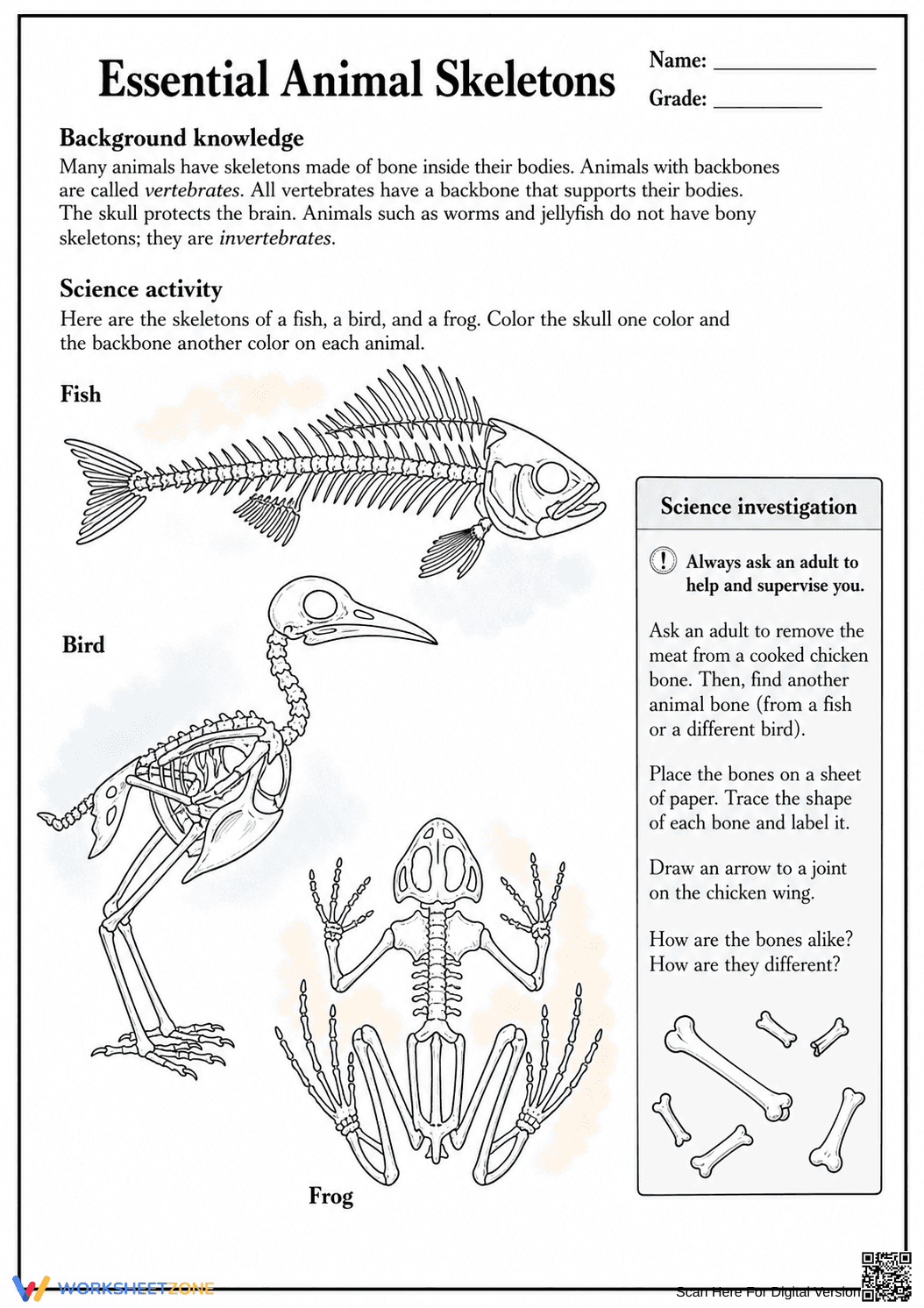
This Grade 3 and Grade 4 science worksheet helps students identify and differentiate between vertebrate and invertebrate structures through visual analysis. By coloring specific anatomical features like the backbone and skull, learners internalize the common structural patterns found across different species to understand how internal systems support survival.
At a Glance
- Grade: 3-4 · Subject: Science
- Standard:
4-LS1-1— Identify internal structures that support survival- Skill Focus: Vertebrate Anatomy
- Format: 1 page · 6 tasks · Answer key included · PDF
- Best For: Independent practice and sub plans
- Time: 15–20 minutes
What's Inside
This single-page resource includes a brief background reading section that defines vertebrates and invertebrates with concrete examples. The primary activity features detailed skeletal diagrams of a fish, bird, and frog. Students follow specific coloring prompts to highlight the backbone and the brain-protecting skull on each animal. Additionally, a hands-on science investigation sidebar offers an extension activity involving real-world bone comparison.
Zero-Prep Workflow
This resource is designed for immediate classroom implementation with minimal teacher setup. First, print the PDF in under one minute. Second, distribute the page as a warm-up or independent activity; the built-in background text allows students to begin working immediately without prior direct instruction. Finally, review the coloring tasks in about five minutes to check for understanding. Total teacher prep time is under two minutes, making this an ideal, self-explanatory activity for substitute teacher folders or quick science transitions.
Standards Alignment
This activity aligns with standard 4-LS1-1, which requires students to construct an argument that plants and animals have internal and external structures that function to support survival, growth, behavior, and reproduction. By identifying the spine and skull, students observe physical evidence of internal systems designed for protection and support. Both standard codes can be copied directly into lesson plans, IEP goals, or district curriculum mapping tools.
How to Use It
Deploy this worksheet during the exploration phase of a life science unit on animal classification. It serves as an excellent formative assessment before moving into more complex biological concepts. While students work, observe whether they correctly locate the skull and backbone regions across the different species to confirm their grasp of homologous structures. The expected completion time ranges from 15 to 20 minutes, making it a perfect morning work assignment or science center station.
Who It's For
This resource is optimized for Grade 3 and Grade 4 learners, including English Language Learners who benefit from clear visual diagrams and hands-on coloring tasks. The visual nature of the activity provides built-in scaffolding for students reading below grade level. It pairs naturally with a classroom anchor chart showing various animal classifications or a short introductory video clip about vertebrate characteristics.
The study of animal skeletal systems is a foundational component of elementary life science curricula, directly addressing the 4-LS1-1 standard regarding how internal structures support survival functions. Students must identify internal structures that support survival to build accurate mental models of biological classification. Research by Fisher & Frey (2014) emphasizes that combining academic text with visual literacy tasks, such as labeling or coloring anatomical diagrams, significantly improves the retention of complex concepts in upper elementary students. This worksheet provides the guided practice necessary for students to transition from general observations to specific scientific categorization. By focusing on the backbone and brain protection, learners gain a concrete understanding of what defines a vertebrate. Such structured science activities ensure that the critical link between physical structure and biological function is explicitly taught through direct, observable evidence in the classroom.


