


























Views
Downloads
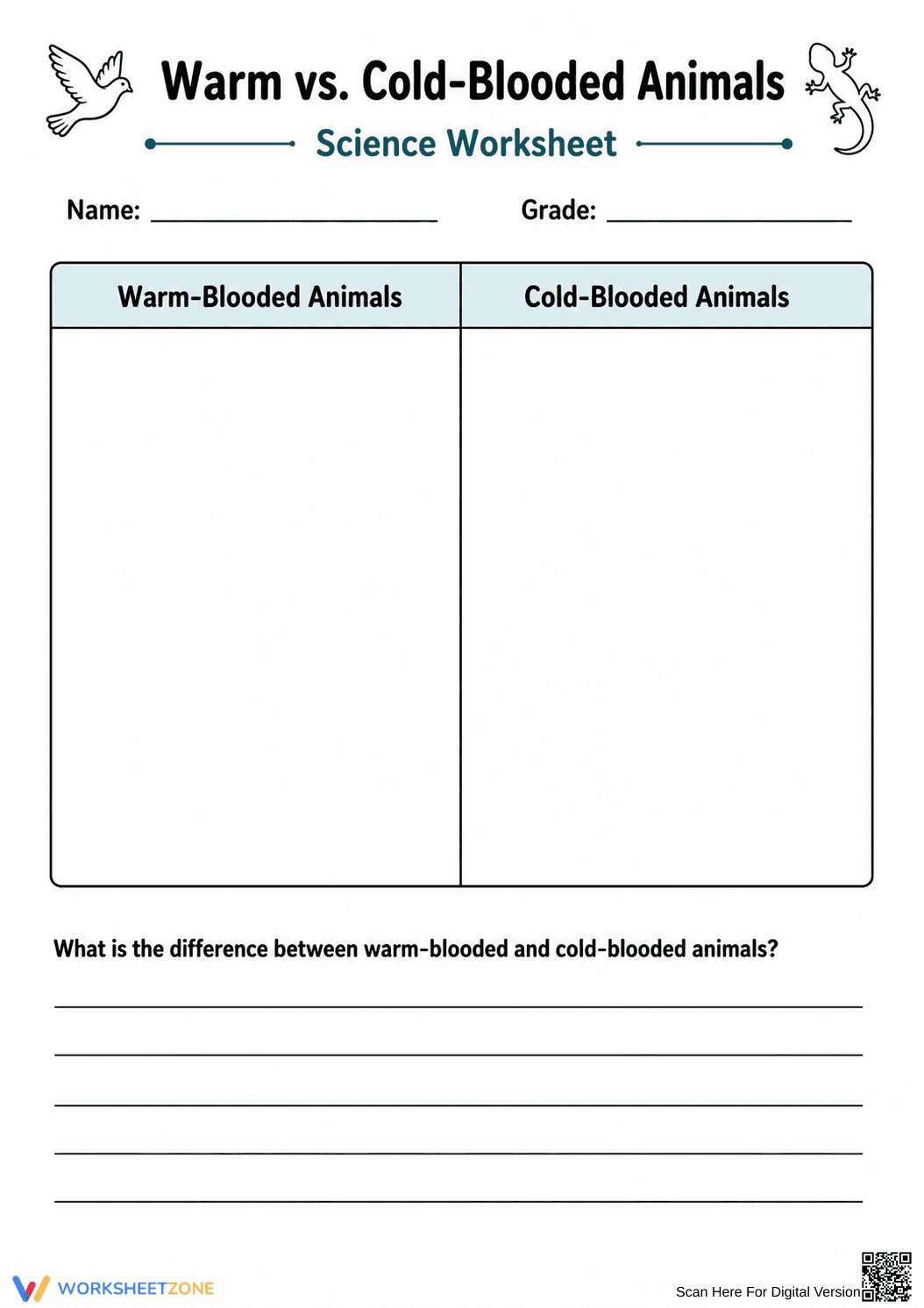

Grade 3 Animal Classification — Printable Science Worksheet
Paste this activity's link or code into your existing LMS (Google Classroom, Canvas, Teams, Schoology, Moodle, etc.).
Students can open and work on the activity right away, with no student login required.
You'll still be able to track student progress and results from your teacher account.
This Grade 3 science worksheet helps students classify animals based on their body temperature regulation. By categorizing examples and writing a clear explanation of the differences, learners solidify their understanding of warm-blooded and cold-blooded traits. This straightforward activity builds foundational life science skills while encouraging critical thinking.
At a Glance
- Grade: 3 · Subject: Science
- Standard:
3-LS3-1— Identify and classify specific animal traits- Skill Focus: Classifying warm and cold-blooded animals
- Format: 1 page · 2 tasks · Answer key included · PDF
- Best For: Independent practice or review
- Time: 10–15 minutes
This single-page resource features a clean layout divided into two sections. The top half provides a T-chart where students list examples of warm-blooded and cold-blooded animals. The bottom half includes a short-answer prompt requiring students to articulate the core biological difference between the two groups. A complete answer key is included to ensure accurate grading.
- Print (1 minute): Simply download the PDF and print a class set. The black-and-white design saves ink and requires no special formatting.
- Distribute (1 minute): Hand out the worksheet as a standalone activity or alongside a science text. No extra materials or teacher setup are needed.
- Review (3 minutes): Use the included answer key to quickly check student classifications and assess their written explanations.
With under two minutes of total teacher prep time, this resource is highly effective for busy educators and makes an excellent addition to any emergency substitute plan.
Aligned to 3-LS3-1, this activity supports the understanding that animals have specific inherited traits that can be observed and categorized. Recognizing how different species regulate body temperature is a key step in analyzing biological variations. Both standard codes can be copied directly into lesson plans, IEP goals, or district curriculum mapping tools.
This worksheet works perfectly as an independent practice activity immediately following direct instruction on animal classification. It can also serve as a quick formative assessment at the end of a life science unit. While students are working, teachers can circulate and observe whether learners are confusing common reptiles and mammals, providing immediate corrective feedback. Expect students to complete the entire page in 10 to 15 minutes.
Designed primarily for third-grade general education students, this activity is also appropriate for fourth and fifth graders needing a quick review of basic animal traits. For students requiring extra support, teachers can provide a word bank of animal names to sort into the T-chart. It pairs wonderfully with an introductory reading passage or a visual anchor chart detailing animal habitats and adaptations.
Integrating structured classification tasks into elementary science instruction significantly improves long-term retention of foundational biological concepts. When young students actively categorize information, such as distinguishing between warm-blooded and cold-blooded organisms, they build much stronger cognitive frameworks for future learning. Aligned with the 3-LS3-1 standard to identify and classify specific animal traits, this worksheet provides the exact type of focused, meaningful practice recommended by educational researchers. According to a ScienceDirect TpT Analysis, brief, targeted activities that combine visual categorization with short-answer explanations yield higher engagement and better comprehension outcomes than passive reading alone. By requiring learners to both list concrete examples and articulate the underlying scientific principles in their own words, educators can ensure a deeper, more resilient understanding of life science fundamentals. This straightforward approach maximizes instructional time while delivering measurable academic growth.


