




























Views
Downloads
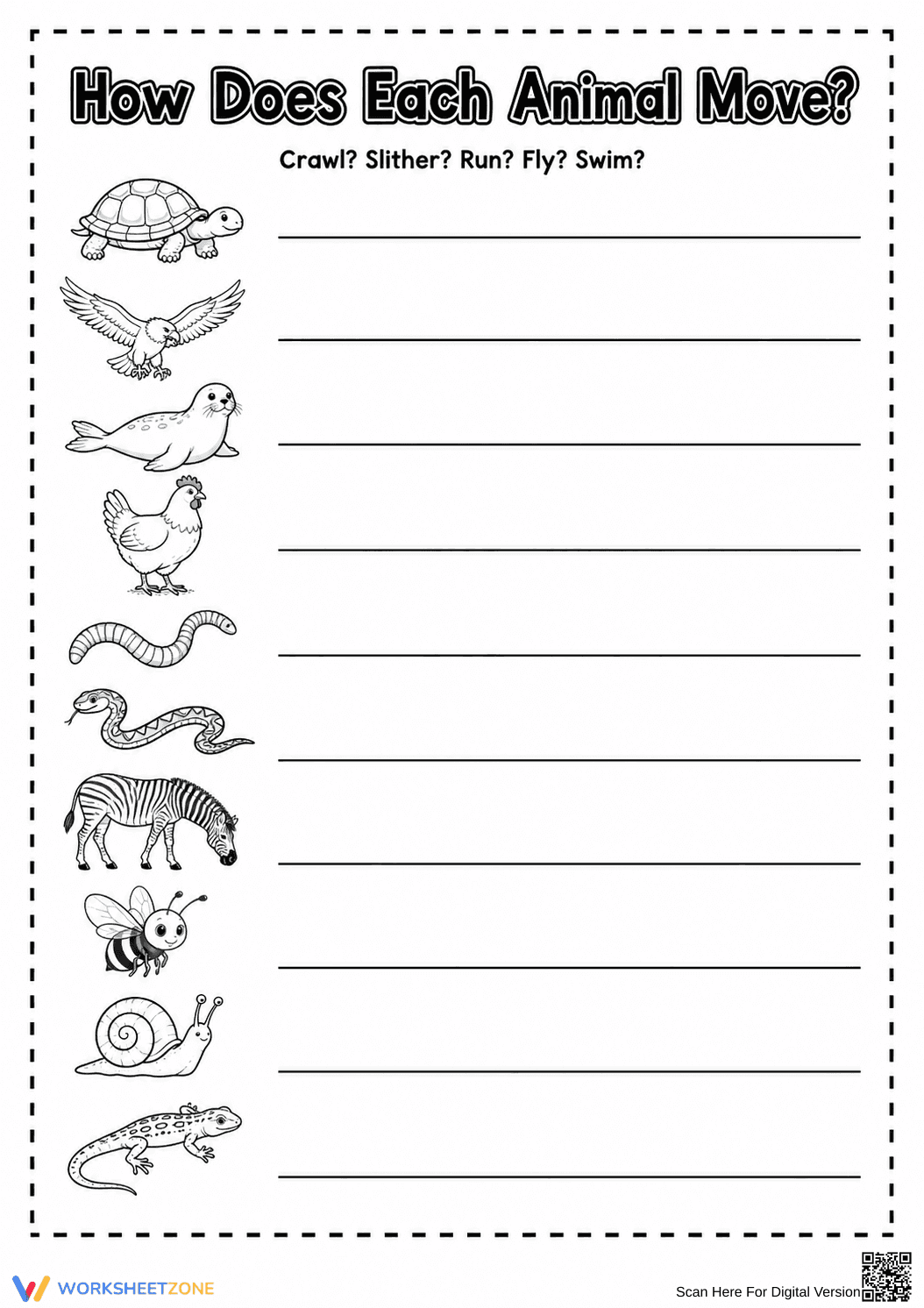

Grade 4 Animal Movement — Printable No-Prep Worksheet

Paste this activity's link or code into your existing LMS (Google Classroom, Canvas, Teams, Schoology, Moodle, etc.).
Students can open and work on the activity right away, with no student login required.
You'll still be able to track student progress and results from your teacher account.
This Grade 4 science worksheet helps students identify and categorize how different animals move. By analyzing ten distinct animals, learners connect physical structures to specific types of locomotion, such as flying, swimming, or slithering. This straightforward activity reinforces foundational biology concepts while building essential observation and classification skills.
At a Glance
- Grade: 4 · Subject: Science
- Standard:
4-LS1-1— Relate animal structures to their survival and behavior- Skill Focus: Animal locomotion and classification
- Format: 1 page · 10 problems · Answer key included · PDF
- Best For: Independent practice or morning work
- Time: 10–15 minutes
This resource features a single, focused page containing ten fill-in-the-blank tasks. Students examine detailed illustrations of various animals, including a turtle, eagle, snake, and zebra, and determine their primary mode of movement. A helpful word bank prompt at the top provides vocabulary choices like crawl, slither, run, fly, and swim. A complete answer key is provided to ensure accurate grading and immediate feedback.
Designed for maximum efficiency, this worksheet follows a simple zero-prep workflow:
- Print (1 minute): Generate copies of the single-page PDF for your entire class instantly.
- Distribute (1 minute): Hand out the assignment as students transition between subjects or settle in for science block.
- Review (3 minutes): Quickly check student responses using the included answer key or review together as a class.
With under two minutes of total teacher preparation required, this activity is an excellent addition to any emergency sub plan or last-minute schedule change.
This activity aligns with 4-LS1-1, requiring students to construct an argument that plants and animals have internal and external structures that function to support survival, growth, behavior, and reproduction. By identifying how animals move, students recognize how external structures like wings or scales dictate behavior. Both standard codes can be copied directly into lesson plans, IEP goals, or district curriculum mapping tools.
Deploy this worksheet as a quick formative assessment after a direct instruction lesson on animal adaptations. It serves perfectly as an independent practice station. Alternatively, use it as a morning bell-ringer to activate prior knowledge. While students work, observe whether they can correctly associate the physical traits shown in the illustrations with the corresponding movement vocabulary. Expect completion within ten to fifteen minutes.
This resource is designed for fourth-grade general education students, though its visual nature makes it highly accessible for English Language Learners and students requiring modified assignments. The clear illustrations provide strong context clues, reducing the cognitive load associated with reading comprehension. Pair this worksheet with an anchor chart detailing different animal habitats to extend the lesson into a broader discussion on why certain animals move the way they do.
Understanding animal locomotion is a critical step in mastering broader biological concepts. Aligned with 4-LS1-1, this resource helps students relate animal structures to their survival and behavior. According to a 2024 report by EdReports, science materials that explicitly connect observable phenomena, such as animal movement, to underlying structural adaptations significantly improve student retention of core disciplinary ideas. When learners actively categorize these behaviors, they develop stronger analytical frameworks for future scientific inquiry. This targeted practice ensures that students do not just memorize facts, but rather understand the functional relationships between an organism's physical form and its environment. By integrating visual aids with specific vocabulary, educators can effectively bridge the gap between simple observation and complex biological reasoning, fostering a deeper appreciation for the natural world and preparing them for advanced life science topics.


