




























Views
Downloads
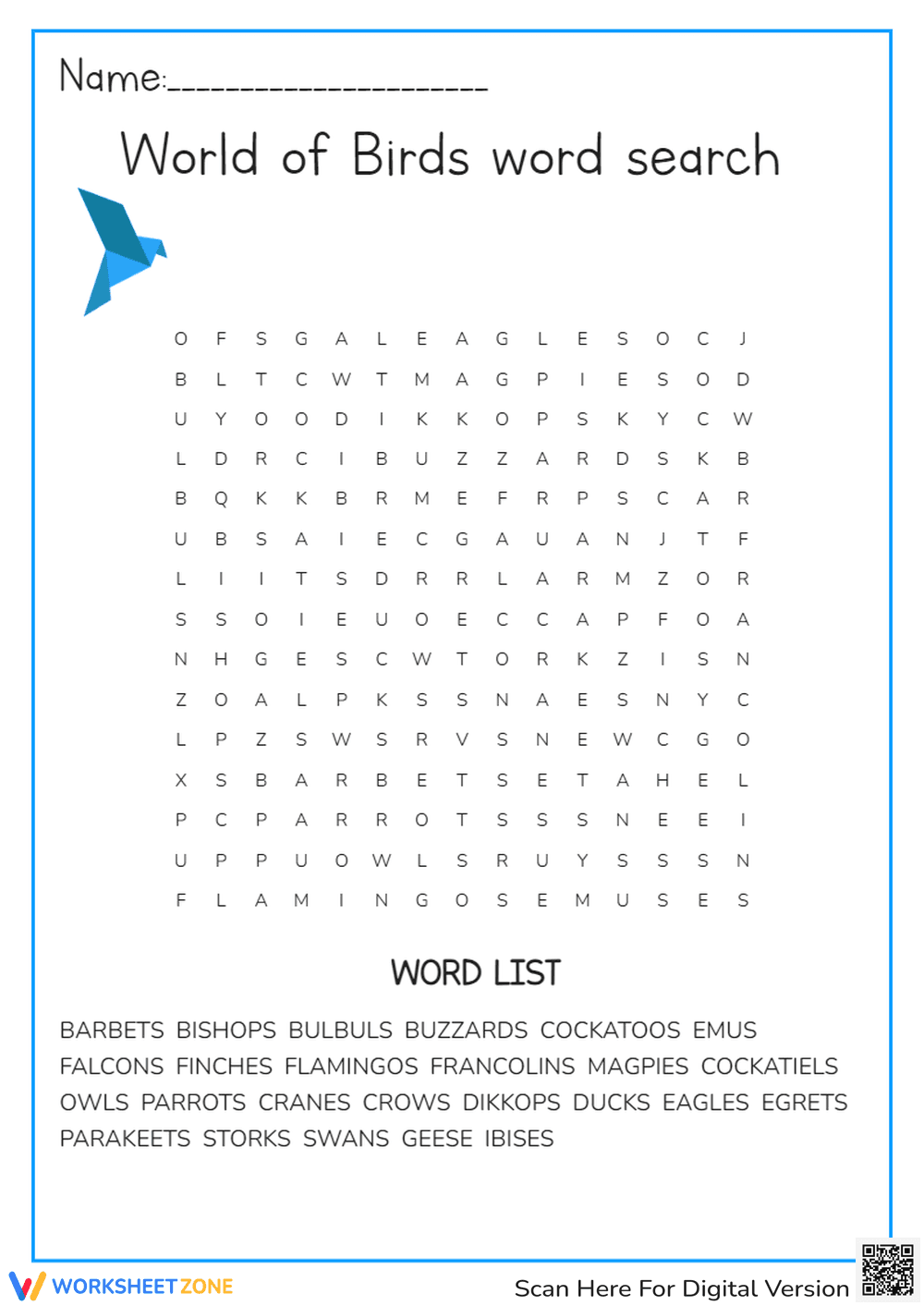

World of Birds Word Search | Grade 3 Essential Science

Paste this activity's link or code into your existing LMS (Google Classroom, Canvas, Teams, Schoology, Moodle, etc.).
Students can open and work on the activity right away, with no student login required.
You'll still be able to track student progress and results from your teacher account.
This Grade 3 bird species worksheet provides a focused vocabulary activity where students identify 25 different avian types from around the globe. By engaging with the word search, learners reinforce their recognition of diverse biological organisms and their specific names. It serves as an excellent introductory tool for life science units focusing on animal classification and diversity.
At a Glance
- Grade: 3 · Subject: Science
- Standard:
3-LS4-2— Use evidence to explain how variations in characteristics among individuals provide advantages- Skill Focus: Bird species identification
- Format: 1 page · 25 problems · Answer key included · PDF
- Best For: Science centers or early finishers
- Time: 15–20 minutes
The resource consists of a single-page grid containing 25 hidden bird names ranging from common species like Ducks and Eagles to more exotic varieties like Dikkops and Francolins. The layout includes a clear word bank at the bottom to support student tracking. A comprehensive answer key is provided to facilitate quick grading or student self-correction during independent work time.
Zero-Prep Workflow
- Print: Select the single-page PDF and print enough copies for your class (30 seconds).
- Distribute: Hand out the sheets as a morning warm-up or a transition activity between lessons (1 minute).
- Review: Use the provided answer key for instant verification or review the bird names as a class (30 seconds).
Total teacher preparation time is under 2 minutes, making it an ideal sub-plan component or emergency filler activity.
Standards Alignment
This worksheet aligns with `3-LS4-2`, which requires students to understand the diversity of organisms within an ecosystem. By identifying a wide array of bird species, students begin to recognize the vast variation in the animal kingdom. Both standard codes can be copied directly into lesson plans, IEP goals, or district curriculum mapping tools.
How to Use It
Use this worksheet during the "Engage" phase of a life science unit to pique interest in avian biology. It is also effective as a formative assessment tool to check for familiarity with animal nomenclature after a lesson on habitats. Students typically complete the search within 15 to 20 minutes, allowing for a quick transition to direct instruction or group discussion.
Who It's For
This activity is designed for third-grade students but is suitable for second-grade enrichment or fourth-grade review. It supports English Language Learners by providing visual word recognition practice. Pair this resource with a bird identification guide or an anchor chart displaying different beak shapes to deepen the scientific connection.
The World of Birds Word Search supports the NGSS 3-LS4-2 standard by introducing students to the taxonomic diversity of the Aves class. According to the RAND AIRS 2024 report, vocabulary-rich activities in early science education are critical for developing the domain-specific language necessary for later complex biological inquiry. By identifying 25 distinct bird names, students build a mental schema of animal variety that serves as a foundation for understanding adaptation and natural selection. Research from Fisher & Frey (2014) emphasizes that word searches, when used as part of a broader instructional strategy, help solidify orthographic mapping and term recognition in young learners. This printable resource provides a low-stakes, high-engagement method for reinforcing science terminology without the cognitive load of complex sentence construction, ensuring that students of all reading levels can participate in the exploration of global biodiversity.


