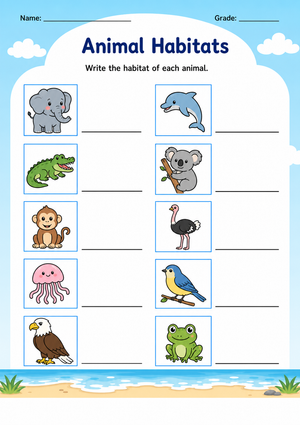
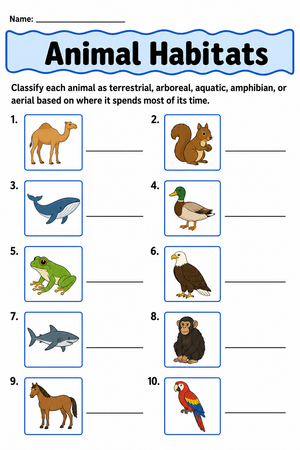
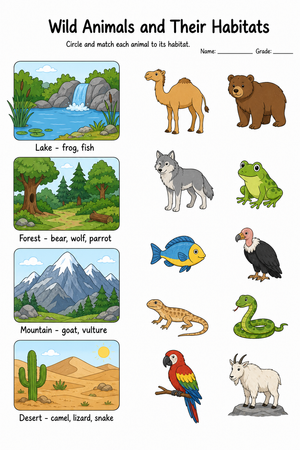
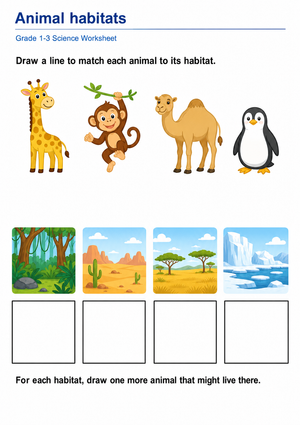
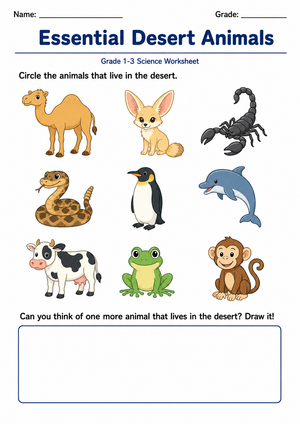
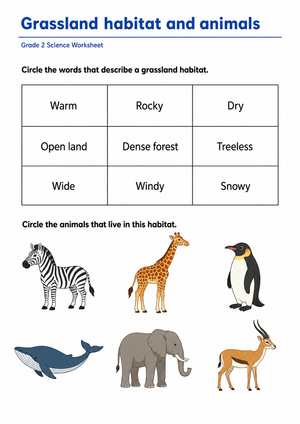
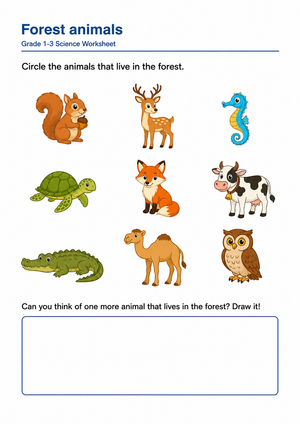
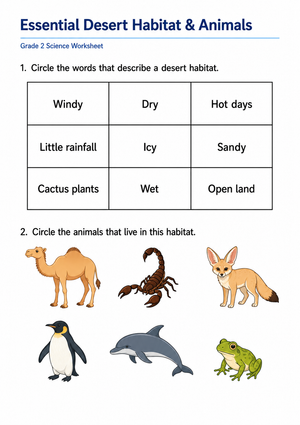
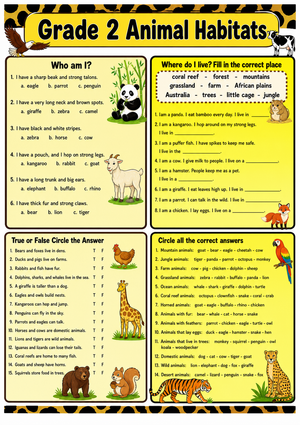
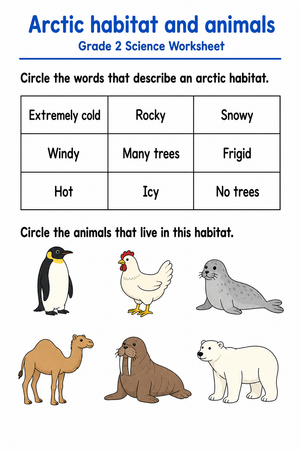
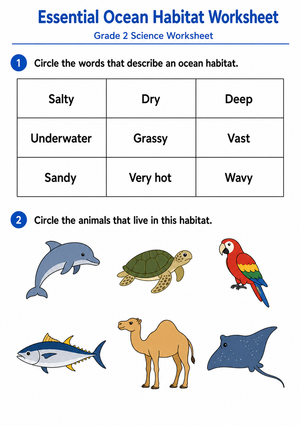
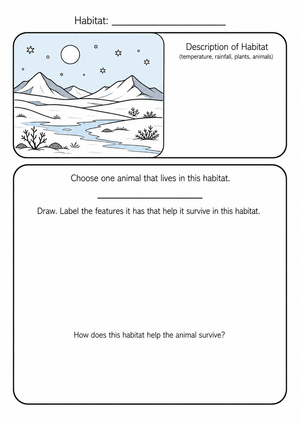
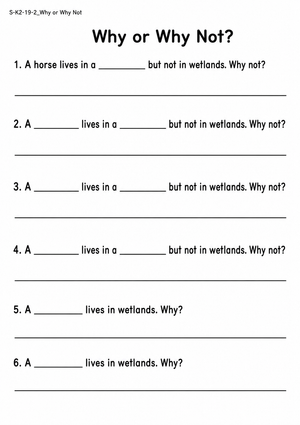
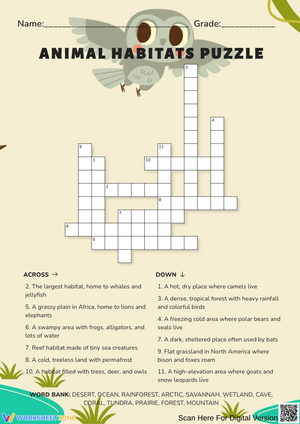
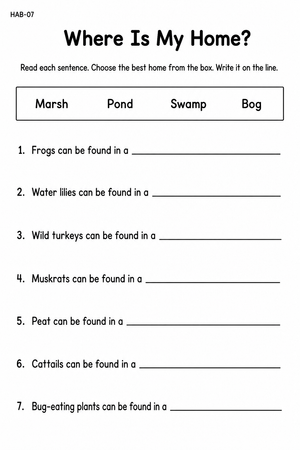
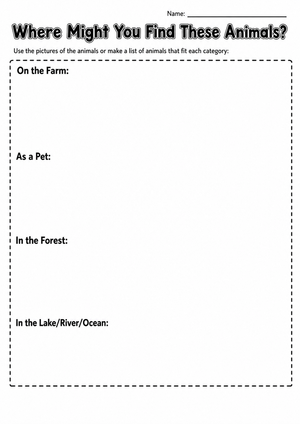
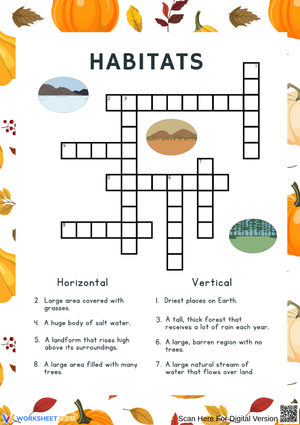
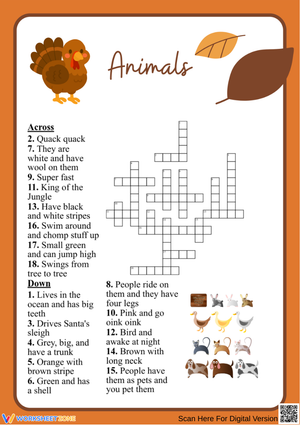
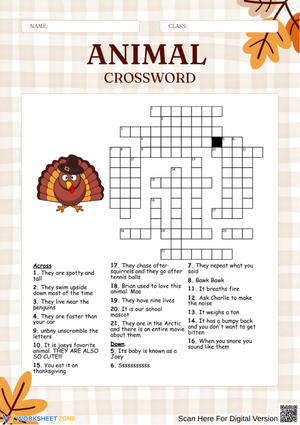
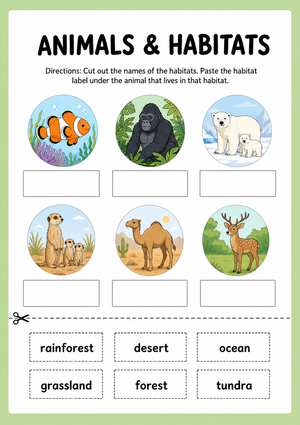
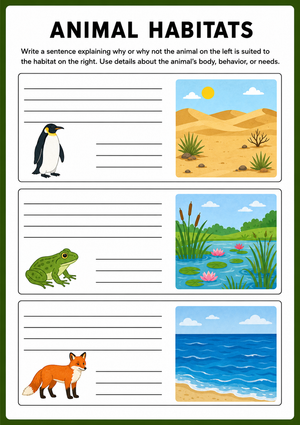
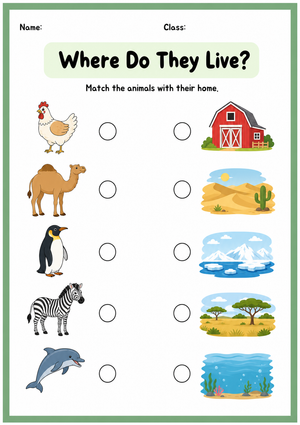
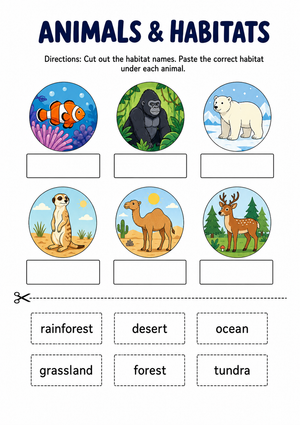
These animal habitats worksheets for 3rd grade address one of the more conceptually demanding shifts in the Grade 3 science curriculum — moving students from cataloguing animals to understanding the relationship between physical traits and survival. The set covers five biomes: desert, rainforest, arctic tundra, ocean, and grasslands. Across each worksheet, students work with matching tasks, Venn diagram comparisons, adaptation analysis, and short reading passages that ask them to use evidence rather than guess.
The Specific Skills These Worksheets Build
At this grade level, NGSS asks students to do more than name where animals live — they need to explain why certain organisms can survive in specific environments while others cannot. Each worksheet targets that explanatory thinking through a sequence of tasks that moves from identification toward reasoning. Students begin by sorting animals and environmental features, then read short passages about physical adaptations before responding to prediction prompts: "Could this animal survive in the rainforest? Use evidence from what you read."
The core skills covered across the set include:
- Identifying the defining characteristics of five biomes — temperature range, rainfall patterns, and vegetation type
- Connecting specific physical adaptations to survival advantages: webbed feet for movement through water, thick blubber layers for heat retention in arctic conditions, pale coloring for camouflage across open grasslands
- Comparing two distinct habitats using Venn diagrams and T-charts
- Using science vocabulary — ecosystem, adaptation, camouflage, nocturnal, predator, prey — in written responses rather than in isolated exercises
- Applying prior knowledge to unfamiliar scenarios by predicting whether a given animal could survive if relocated to a different biome
Mistakes Students Make That These Worksheets Help You Catch
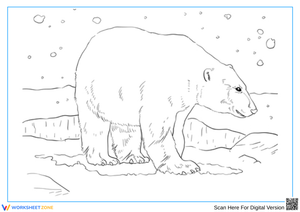
The most persistent error teachers see in student work on this topic is the gap between naming a habitat condition and explaining the physical trait that makes survival possible. A student writes "the polar bear lives in the arctic because it's cold and snowy there" — accurate, but circular. They've restated the habitat rather than identifying the mechanism: the blubber layer, the dense double coat. This pattern shows up consistently in open-response items and is easy to miss in multiple-choice formats. The prediction prompts in these worksheets push past that surface-level response by requiring students to cite specific body features in their explanations.
A second error involves the word adaptation itself. By mid-unit, most students use the term freely — but their writing reveals they're treating it as "the thing the animal does" rather than a physical trait linked to a survival advantage. A student writes that a camel "adapts to the desert by not drinking a lot of water," collapsing behavior and physiology together without examining the hump's fat storage or the elongated nostrils that reduce moisture loss. Having students underline the physical feature in each reading passage before they write their response catches this conflation early and focuses their attention on the right category of evidence.
Lesson-Planning Strategies for Getting the Most From These Worksheets
The most reliable placement is as a follow-up to direct instruction, not an introduction. When students have spent even a few minutes with a biome — a short video clip, a read-aloud, a quick class discussion — the matching and analysis tasks produce reasoning instead of guessing. Using the adaptation analysis worksheet without any prior exposure tends to generate responses built on surface logic ("penguins are black and white so they blend in with ice") rather than the trait-based explanations the standard requires.
The vocabulary worksheets work especially well as Monday morning warm-ups after a weekend. The fill-in-the-blank and matching formats require retrieval rather than just recognition — a practical application of spaced retrieval practice that keeps terms like ecosystem and camouflage alive across a multi-week unit. The Venn diagram comparison worksheets, on the other hand, need a longer science block where students have time to talk before they write. Assigning those as homework strips away the discussion step that sharpens the written comparison.
One classroom move worth trying: pair the adaptation analysis worksheet with a physical sort. Print the animal illustration cards, cut them out, and ask student groups to place them on large paper labeled with each biome before filling in the written portion. Students who've already argued aloud about whether a chameleon belongs in the rainforest section tend to write clearer explanations because the cognitive work of categorizing has already happened. The animal habitats worksheets for 3rd grade also function well as quick formative check-ins — the prediction prompts take roughly eight minutes to complete and give a clear picture of individual reasoning before the next lesson.
Standard Alignment
NGSS 3-LS4-3 (Biological Evolution: Unity and Diversity) requires students to construct an argument with evidence that in a particular habitat, some organisms survive well, some survive less well, and some cannot survive at all. Every survival scenario and prediction prompt in this set directly addresses that standard. Students select evidence from a short passage and use it to defend a claim about a specific animal's chances in a given environment.
This standard appears at 3rd grade for a developmental reason: students at this age are ready to shift from concrete identification into basic causal reasoning, but they still need bounded evidence — they aren't expected to generate examples from memory. The worksheets support that transition by keeping passages short and the evidence pool explicit. That distinction matters when you're reading student work: a student who gives a weak written response may understand the biology but not yet know how to construct an evidence-based argument. Those are two different instructional problems and they call for different responses.
Adjusting the Set for Mixed-Ability Classrooms
For students not yet working confidently with the reading passages, the visual matching and graphic organizer tasks on each worksheet still offer genuine practice in biome characteristics. They can do real work even before the written analysis portion is fully accessible. Having those students focus on the diagram sections and explain their thinking orally — rather than in writing — keeps them engaged with the content without the barrier of the written response stalling the lesson.
The animal habitats worksheets for 3rd grade work well across ability groupings in the same lesson because the task structure moves from visual sorting to written analysis — students can stop at different points and still have completed something meaningful. For students ready for more challenge, the prediction scenarios extend naturally into a written argument using three specific physical traits. That prompt doesn't appear on the worksheet itself; it works best posed verbally or written on the board as students finish, which avoids the problem of on-grade students feeling pressured to skip ahead before they're ready.
Frequently Asked Questions
What are the five biomes covered in this set?
The worksheets address the desert, rainforest, arctic tundra, ocean, and grasslands — the five environments most consistently covered in Grade 3 science units. Each biome receives dedicated attention through climate data, animal examples, and adaptation prompts specific to its conditions.
How do I explain the difference between a habitat and an ecosystem to 8-year-olds?
A habitat is the specific place where an animal lives — where it finds food, water, and shelter. An ecosystem includes all of that plus the interactions between every living thing in the area (plants, animals, decomposers) and the non-living factors (soil, water, temperature) that shape the whole system. For third graders, the clearest way in is analogy: a habitat is the animal's address; the ecosystem is the whole neighborhood and how everyone in it affects each other. The vocabulary sections in each worksheet use both terms in context, giving students repeated exposure before they're asked to use the words independently in writing.
How do these worksheets connect to NGSS 3-LS4-3?
The animal habitats worksheets for 3rd grade directly target 3-LS4-3 through the survival scenario tasks, where students construct a written argument about whether a specific animal could survive if relocated to an unfamiliar environment. Students must cite physical traits from the passage as evidence — which is the exact reasoning move the standard requires. Because 3-LS4-3 asks students to argue rather than just identify, the open-response format gives you the clearest picture of where each student actually is in meeting it.
Can these worksheets double as assessment pieces?
The prediction prompts and adaptation analysis tasks serve as strong formative assessment because they require students to explain their reasoning rather than select an answer. Teachers who want more formal documentation of mastery typically use the survival scenario worksheets as end-of-unit check-ins, while the matching and diagram worksheets function better as practice during the unit. The written responses also work as portfolio entries if you're tracking progress toward the NGSS standard over time.












 Interactive Worksheet Maker
 Quiz Maker
 Word Search Maker
 Crossword Puzzle Maker
 Word Scramble Generator
 Sentence Scramble Generator
 Handwriting Worksheet Generator
 Name Tracing Generator
 Fill In The Blank Generator