


























Views
Downloads

Grade 3 Giant Panda Habitat — Printable No-Prep Worksheet
Paste this activity's link or code into your existing LMS (Google Classroom, Canvas, Teams, Schoology, Moodle, etc.).
Students can open and work on the activity right away, with no student login required.
You'll still be able to track student progress and results from your teacher account.
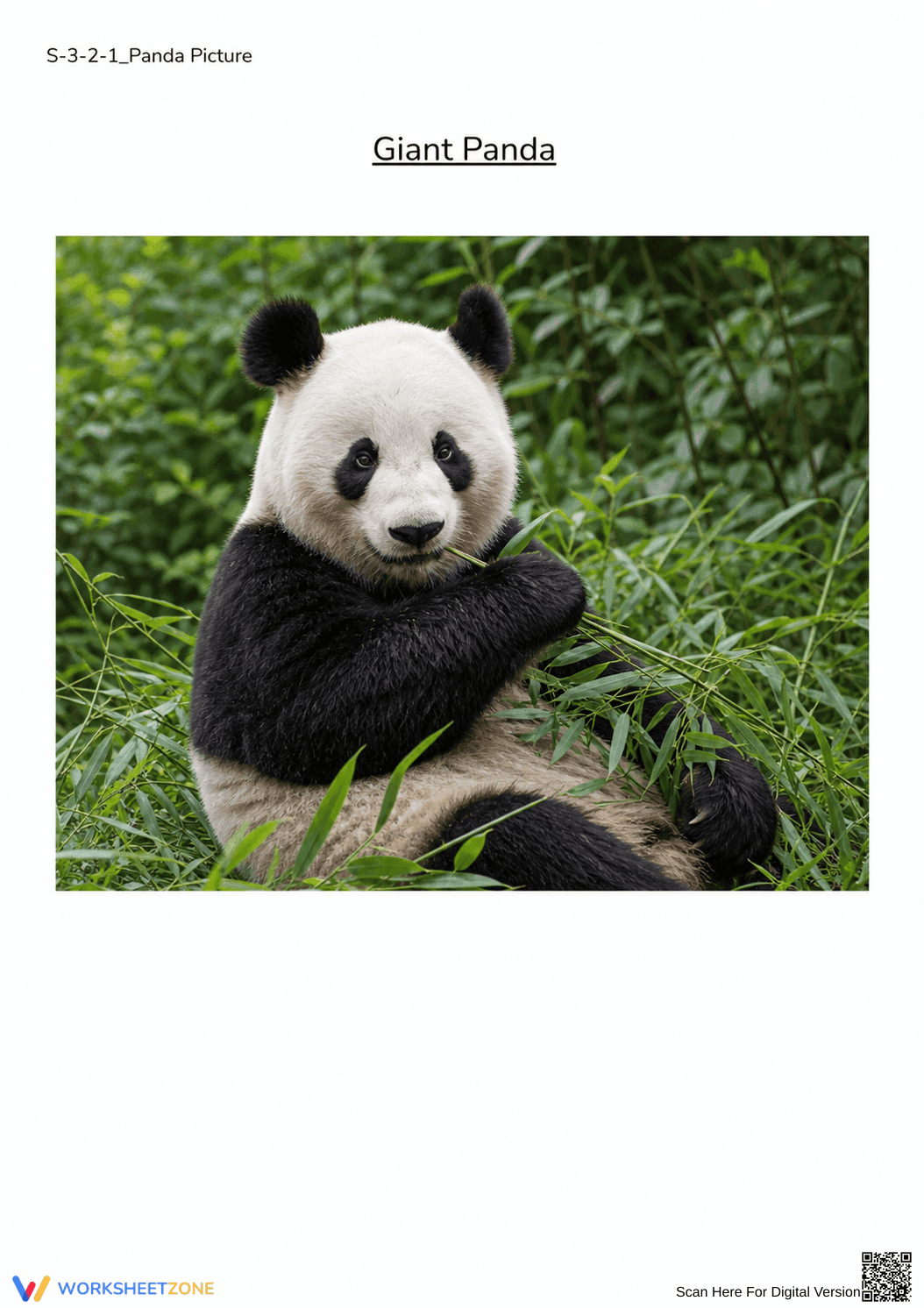
This Grade 3 science visual aid introduces students to the giant panda and its natural habitat. By observing this high-quality photograph, learners can identify specific physical traits and dietary needs, sparking meaningful classroom discussions about animal adaptations and environmental survival.
At a Glance
- Grade: 3 · Subject: Science
- Standard:
3-LS4-3— Analyze how organisms survive in specific habitats- Skill Focus: Visual observation and habitat analysis
- Format: 1 page · 0 problems · No answer key · PDF
- Best For: Lesson introduction and discussion
- Time: 5–10 minutes
This resource features a single, full-color photograph of a giant panda consuming bamboo in its natural environment. Designed as a visual anchor rather than a traditional question-and-answer worksheet, it provides a clear, engaging focal point for students to practice scientific observation. There are no written tasks, allowing educators complete flexibility in how they guide the inquiry process.
- Print (1 minute): Simply print or project the high-resolution PDF directly onto your smartboard.
- Distribute (1 minute): Hand out physical copies to small groups or display it for the whole class.
- Review (3 minutes): Prompt students with open-ended questions about the panda's diet, physical characteristics, and habitat needs.
Total teacher prep time is under 2 minutes, making this an excellent, zero-prep addition to any life science unit or emergency sub plan.
Aligned to primary standard 3-LS4-3: Construct an argument with evidence that in a particular habitat some organisms can survive well, some survive less well, and some cannot survive at all. This visual evidence helps students connect the panda's specialized diet of bamboo to its specific environmental requirements. Both standard codes can be copied directly into lesson plans, IEP goals, or district curriculum mapping tools.
Use this image before direct instruction to activate prior knowledge and generate student questions about animal adaptations. During a whole-group session, project the image and ask students to point out physical features that help the panda eat bamboo. As a formative assessment observation tip, listen to student conversations to gauge their baseline understanding of how an animal's environment dictates its survival strategies. Expect this observation activity to take 5 to 10 minutes.
This resource is ideal for third-grade general education students, visual learners, and English Language Learners who benefit from strong visual supports before tackling complex academic vocabulary. For differentiation, provide sentence frames (e.g., "I notice the panda has..." or "The bamboo helps the panda...") to support expressive language. It pairs perfectly with an anchor chart on animal adaptations or a direct instruction lesson on endangered species.
Integrating high-quality visual aids into elementary science instruction is a proven method for increasing student engagement and comprehension. When addressing standard 3-LS4-3, which requires students to analyze how organisms survive in specific habitats, visual evidence serves as a critical bridge between abstract concepts and concrete understanding. According to a ScienceDirect TpT Analysis, incorporating vivid, real-world imagery into instructional materials significantly enhances vocabulary acquisition and scientific inquiry skills among young learners. By observing the giant panda in its natural environment, students can more readily construct arguments about environmental dependencies, dietary needs, and physical adaptations. This foundational observation practice supports broader scientific literacy and prepares students for more complex ecological concepts in later grades, ensuring they develop a robust, evidence-based framework for understanding the natural world and its diverse ecosystems.


