


























Views
Downloads
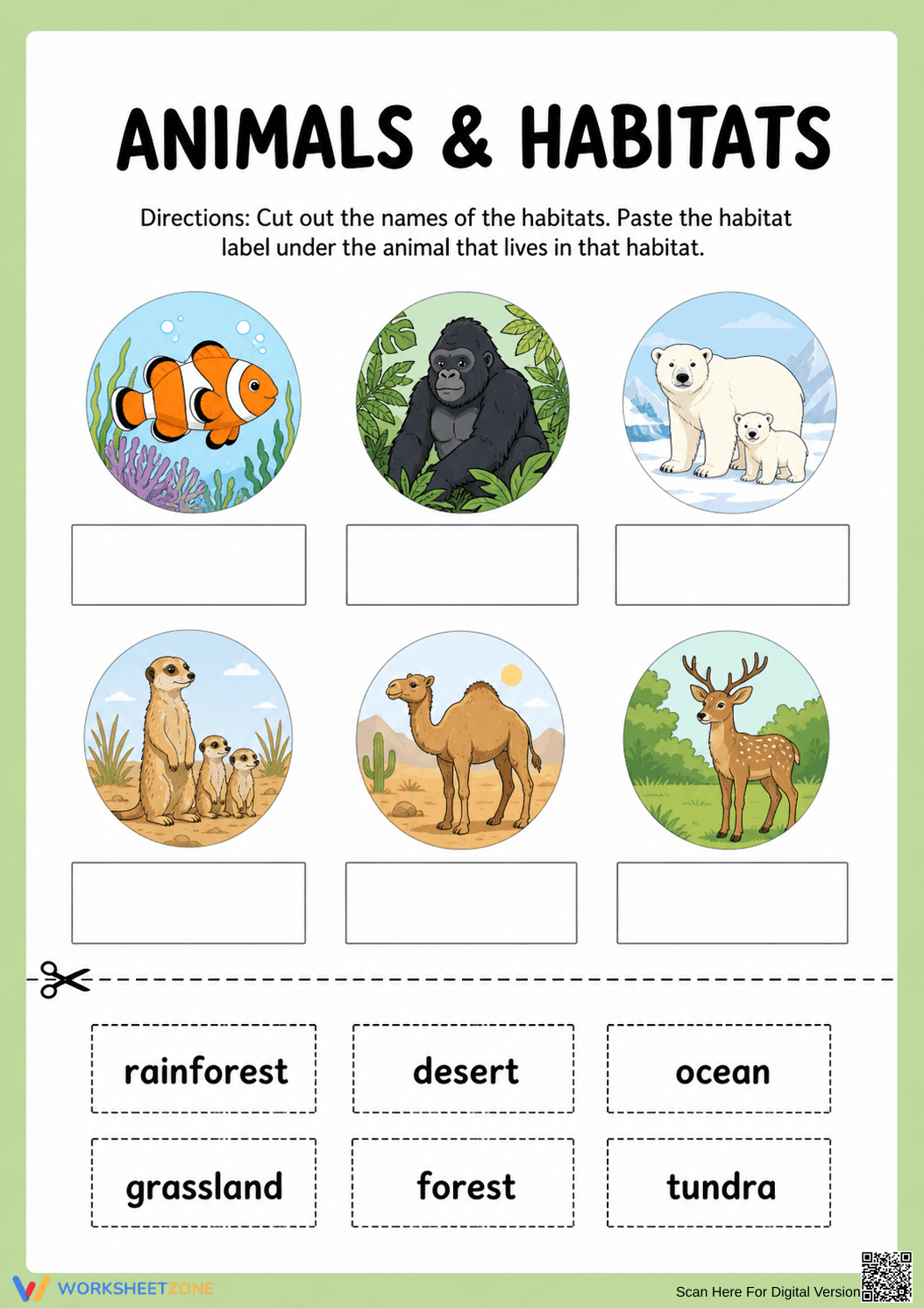

Essential Animal Habitats Cut and Paste | Grade 3
Paste this activity's link or code into your existing LMS (Google Classroom, Canvas, Teams, Schoology, Moodle, etc.).
Students can open and work on the activity right away, with no student login required.
You'll still be able to track student progress and results from your teacher account.
This Grade 3 animal habitats worksheet helps students classify organisms by their natural environments through a tactile matching exercise. By identifying where animals like polar bears and camels live, learners demonstrate an understanding of environmental suitability. This activity provides a clear visual assessment of a student's ability to link physical traits to specific ecosystems.
At a Glance
- Grade: 3 · Subject: Science
- Standard:
3-LS4-3— Identify where organisms live and how they survive in specific environments- Skill Focus: Habitat classification
- Format: 1 page · 6 problems · Answer key included · PDF
- Best For: Independent practice or science centers
- Time: 15–20 minutes
What's Inside: This single-page PDF features six high-quality animal illustrations paired with six cut-out habitat labels. Students work with diverse biomes including the rainforest, desert, ocean, grassland, forest, and tundra. The layout includes clear cutting guides and designated pasting zones, ensuring a tidy and organized final product for student portfolios.
Zero-Prep Workflow
- Print: Select the single-page PDF and print enough copies for your class (30 seconds).
- Distribute: Hand out the sheets along with scissors and glue sticks to each student (1 minute).
- Review: Use the included answer key to check for understanding as a whole group (5 minutes).
Total teacher preparation time is under two minutes, making this an ideal resource for emergency sub plans or last-minute science block additions.
Standards Alignment
This activity aligns with `3-LS4-3`, requiring students to provide evidence of why certain organisms live in specific habitats. It supports the study of biological evolution and unity by highlighting how animal traits match their surroundings. Both standard codes can be copied directly into lesson plans, IEP goals, or district curriculum mapping tools.
How to Use It
Use this as a formative assessment after a lesson on biomes to gauge student retention of habitat characteristics. Alternatively, place it in a science center for independent exploration. Teachers should observe if students recognize the visual cues, such as the cactus in the desert frame, to inform future instruction. The expected completion time is approximately 15 to 20 minutes.
Who It's For
This worksheet is designed for third-grade students but is highly effective for Grade 2 enrichment or Grade 4 review. It is particularly useful for English Language Learners (ELLs) who benefit from the strong visual-to-text association. Pair this with a classroom anchor chart showing global climate zones or a short passage about animal adaptations.
The Animals and Habitats Cut and Paste Activity is a structured tool for reinforcing 3-LS4-3 concepts regarding organism survival in specific environments. Research from Fisher & Frey (2014) emphasizes that tactile, hands-on activities like cutting and pasting significantly improve cognitive retention and engagement for elementary learners compared to passive observation. By requiring students to physically manipulate labels, the worksheet bridges the gap between abstract ecological concepts and concrete visual identification. This 1-page resource provides 6 distinct classification tasks that allow educators to quickly identify misconceptions about animal adaptations. According to the RAND AIRS 2024 report on instructional materials, high-quality visual aids are essential for supporting science literacy in diverse classrooms. This worksheet serves as a reliable evidence-based resource for building foundational biology skills while maintaining a low-barrier entry for students with varying reading levels or fine motor abilities.


