




























Views
Downloads

Essential Animal Habitat Worksheet | Grades 3-6 Ready

Paste this activity's link or code into your existing LMS (Google Classroom, Canvas, Teams, Schoology, Moodle, etc.).
Students can open and work on the activity right away, with no student login required.
You'll still be able to track student progress and results from your teacher account.
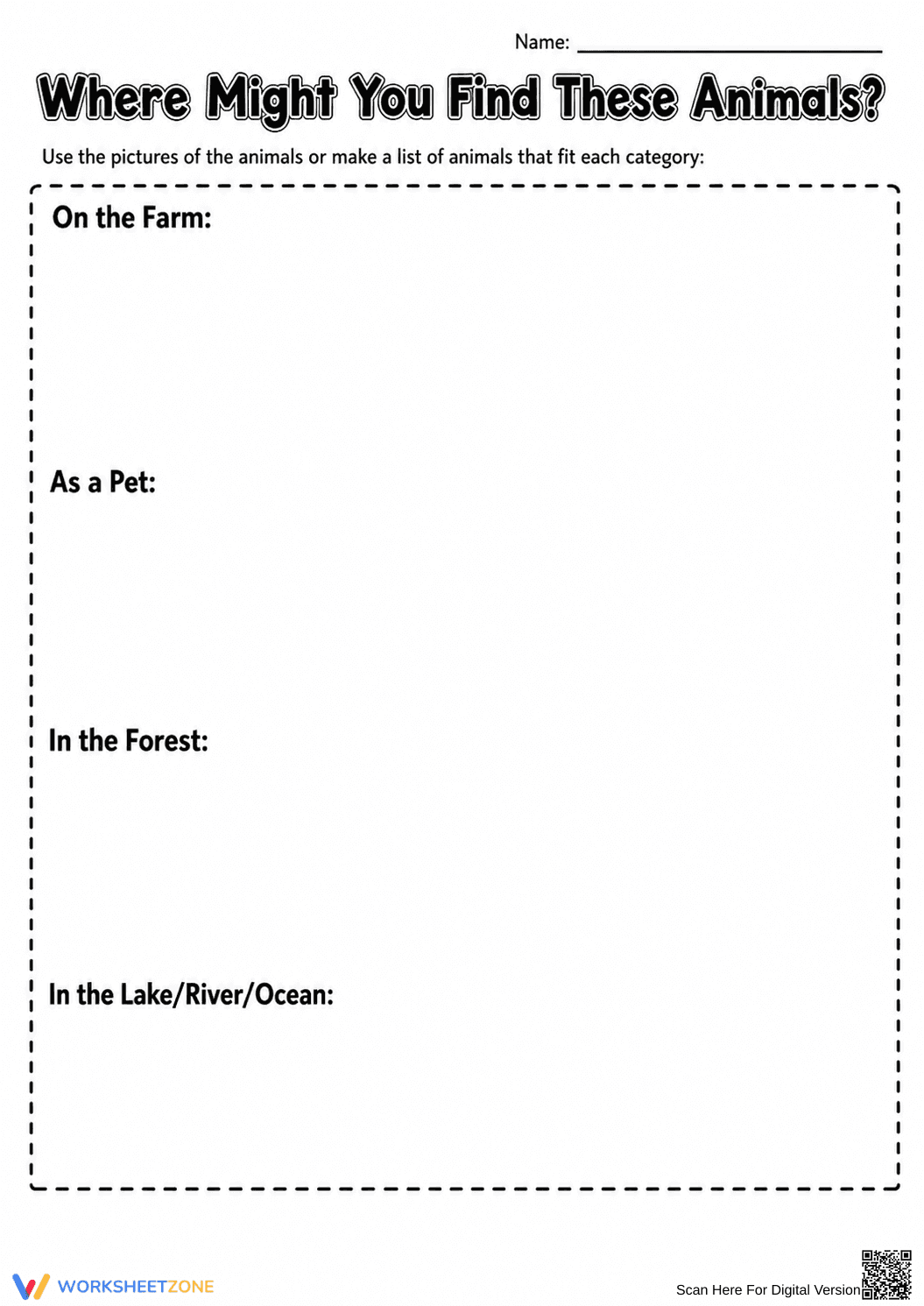
This Grade 3-6 animal classification worksheet helps students identify and categorize organisms based on their natural habitats. By listing animals found on farms, in homes, in forests, and in water bodies, learners demonstrate their understanding of how physical environments support different species. It provides a clear, structured format for assessing prior knowledge or reinforcing biology lessons.
At a Glance
- Grade: 3-6 · Subject: Science
- Standard:
3-LS4-3— Construct an argument that some animals survive well in particular habitats- Skill Focus: Habitat classification
- Format: 1 page · 4 categories · Open-ended · PDF
- Best For: Quick formative assessment or sub plans
- Time: 15–20 minutes
This single-page PDF features four distinct categorization zones: Farm, Pet, Forest, and Lake/River/Ocean. The layout is clean and distraction-free, providing ample white space for students to write or draw their answers. It includes a clear header for student names and simple instructions that allow for immediate independent work without extensive teacher explanation or setup.
Zero-Prep Workflow
- Print: Generate copies for your class in under 30 seconds.
- Distribute: Hand out the sheets for immediate individual or partner work.
- Review: Conduct a 5-minute whole-class share-out to build a master list of animals.
Total teacher preparation time is less than 2 minutes, making it an ideal choice for emergency sub folders or transition periods between science units.
Standards Alignment
This resource aligns with `3-LS4-3`: "Construct an argument with evidence that in a particular habitat some organisms can survive well, some survive less well, and some cannot survive at all." It also supports broader biological classification goals across upper elementary grades. Both standard codes can be copied directly into lesson plans, IEP goals, or district curriculum mapping tools.
How to Use It
Use this worksheet during the "Explore" phase of a 5E lesson model to see which animals students already associate with specific environments. Alternatively, assign it as a formative assessment after a lesson on adaptations to verify that students can distinguish between domestic and wild habitats. Expect completion within 15 to 20 minutes depending on the required list length.
Who It's For
This worksheet is designed for students in grades 3 through 6, including English Language Learners who benefit from the clear, simple category labels. It pairs naturally with an anchor chart of world biomes or a classroom library collection of animal reference books to help students expand their lists beyond common examples.
According to the RAND AIRS 2024 report, structured categorization tasks significantly improve long-term retention of scientific taxonomies in elementary learners. This worksheet addresses the 3-LS4-3 standard by requiring students to mentally map organisms to the specific environments where they thrive. By distinguishing between four major habitat types—agricultural, domestic, woodland, and aquatic—students build the foundational schema necessary for more complex ecological studies in middle school. Research from Fisher & Frey (2014) emphasizes that such low-stakes writing tasks allow teachers to quickly identify misconceptions about animal needs before moving into high-stakes testing. This 1-page resource provides a high-utility, evidence-based approach to biology instruction, ensuring that students can accurately classify animals by their environmental requirements while maintaining a zero-prep profile for the educator. It serves as a bridge between basic identification and complex environmental argumentation.


