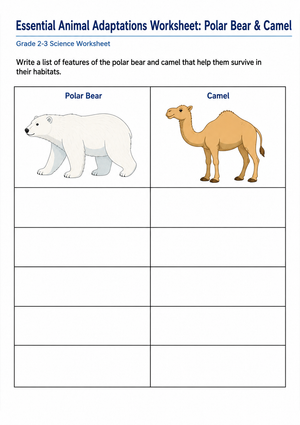
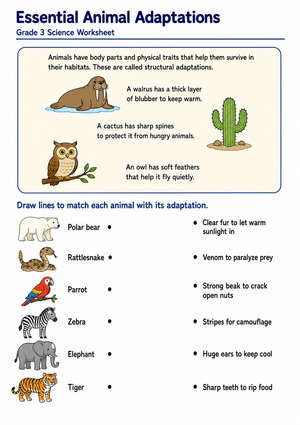
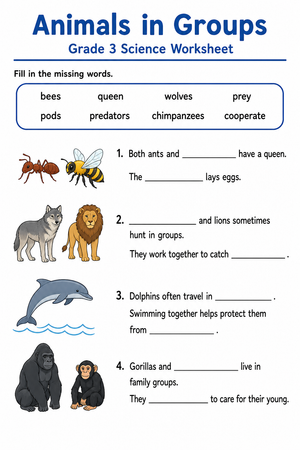
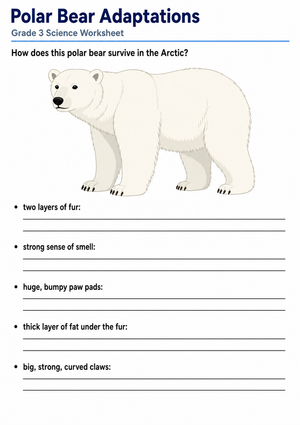
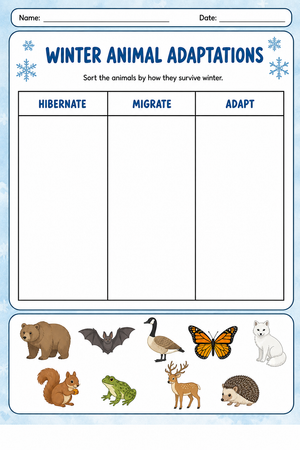
These 3rd grade animal adaptations worksheets resources give teachers a focused set of practice materials that move students past simply naming animals and toward explaining the survival logic behind each trait. The set addresses the core science reasoning skill NGSS expects by third grade: students need to articulate why a feature helps an animal survive, not just identify that it exists.
What Students Practice Across the Set
Each worksheet targets a distinct skill, so teachers can pull individual resources to match exactly where a lesson is headed. The work students do includes:
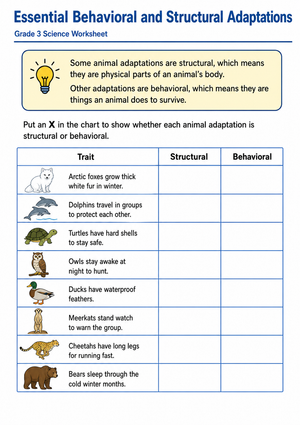
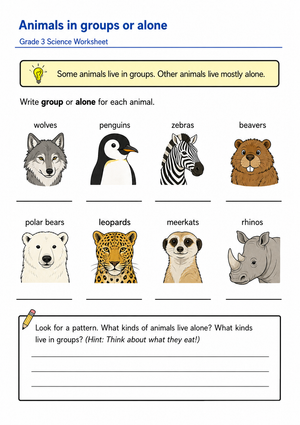
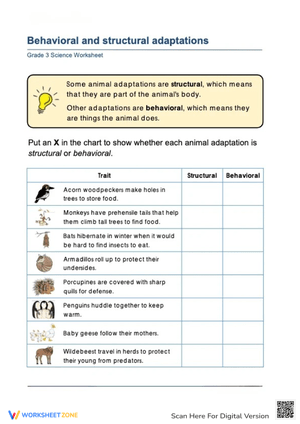
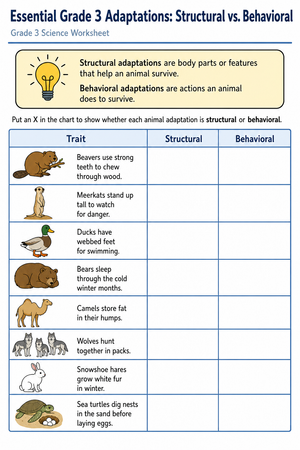
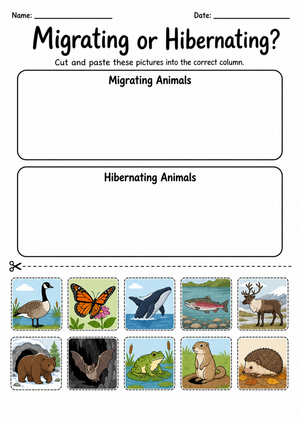
- Sorting a mixed list of traits — thick blubber, pack hunting, webbed feet, migration — into structural and behavioral columns
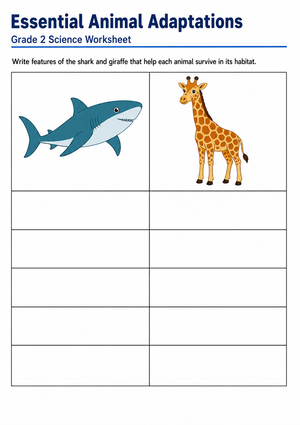
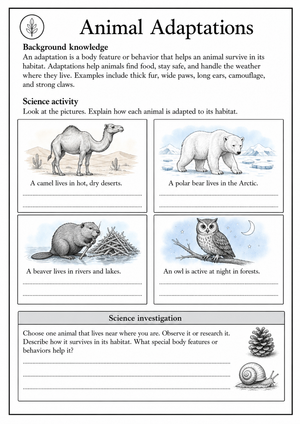
- Matching animals to their habitats based on physical features alone, then writing a sentence justifying each match
- Reading short informational passages about specific animals and underlining sentences that describe an adaptation, then labeling each as structural or behavioral
- Identifying camouflage and mimicry from descriptions and images, including the snowshoe hare's seasonal fur change and the viceroy butterfly's resemblance to the toxic monarch butterfly
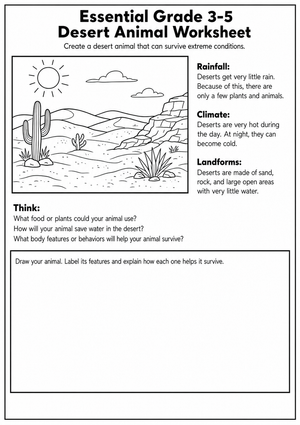
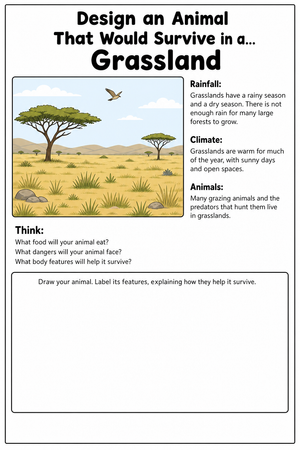
- Completing a habitat-challenge task where students draw and label three adaptations for an invented creature placed in a constrained environment — always dark, extremely cold, or completely dry
That last task consistently reveals more about student understanding than multiple-choice items. A student who can justify why their creature has reflective eyes for a lightless cave has internalized the logic of adaptation in a way a fill-in-the-blank question simply won't catch.
Student Mistakes Worth Anticipating Before You Teach This Unit
The structural-versus-behavioral sorting task is where most errors concentrate. Students routinely place hibernation in the structural column because they think of it as a body characteristic rather than a behavior. Writing "hibernation = the bear's body" on a sort card is almost a rite of passage in third grade. A brief discussion before the sort — asking students whether a robot could hibernate versus whether a robot could have blubber — tends to clear that up faster than re-explaining the definitions.
A second persistent error is treating camouflage and mimicry as the same concept. Both involve an animal "looking like something else," so students merge them. The distinction that sticks: camouflage is blending into the background; mimicry is looking like another organism. Once students write those two sentences on a sticky note and keep them visible, they sort examples accurately. Also watch for students who believe adaptations are choices — third graders frequently write that a duck "chose to grow webbed feet" because it wanted to swim, which is worth addressing directly as a misconception about how traits develop across generations.
Building These Worksheets Into Your Weekly Science Block
The sorting worksheet works well on the first day of the unit as a pre-assessment — you learn immediately which students already have a working mental model and which are starting from scratch. The habitat-matching worksheet fits naturally at the mid-unit point, after students have seen enough examples to reason from evidence rather than guess. Save the invented-creature task for the end of the unit; it asks students to apply everything at once and lands well during the last 20 minutes of a Friday science block when a formal assessment would feel forced.
The reading-passage worksheets support literacy integration without turning science time into ELA time. Students highlight the adaptation sentences, label them, and answer two or three evidence-based questions — that's still a science task, since they're reading to extract biological reasoning, not to summarize a narrative. Teachers using flexible 90-minute blocks have had success pairing one of these worksheets with a read-aloud on the same animal and then using the worksheet questions as the discussion anchor for the debrief.
Standard Alignment
NGSS 3-LS4-2 is the primary standard addressed: students use evidence to construct an explanation for how variations in characteristics among individuals of the same species provide advantages in surviving, finding mates, and reproducing. These 3rd grade animal adaptations worksheets materials place students directly inside that standard by requiring written justification — not just selection — for why each trait matters. The habitat-matching and invented-creature tasks specifically target the "construct an explanation" language in the standard, which demands more than identification.
NGSS 3-LS3-2 also applies to the structural variation worksheets, since students examine how inherited traits like beak shape or fur thickness differ across individuals and connect those differences to survival outcomes. Both standards appear in most third-grade science pacing guides during the life science unit, so this set can anchor two weeks of structured practice without reaching beyond the expected curriculum window.
Adjusting the Work for Mixed-Ability Science Classes
For students who need more support, the sorting worksheet becomes much more accessible with a visual word bank attached — photographs of each animal paired with the trait name. Without the photograph, a student who doesn't know what a "dewlap" or "spiracle" is hits a vocabulary wall before reaching the actual thinking task. Adding the visual removes that barrier while keeping the reasoning work intact.
The habitat-matching worksheet tiers naturally by adjusting the justification requirement. Students who need extra support write one word; grade-level students write a complete sentence; students ready for extension write two sentences that include a prediction about what would happen to the animal if the habitat became significantly warmer or drier. That prediction layer is where 3rd grade animal adaptations worksheets resources rarely venture, and it's exactly where stronger third graders need to be pushed — especially students who blow through identification tasks in two minutes and then spend the rest of science time drawing on their folders.
Frequently Asked Questions
Do these worksheets cover both structural and behavioral adaptations, or just physical traits?
Both types appear across the set. Several worksheets ask students to sort traits into structural and behavioral categories, and the reading-passage worksheets include animals known for strong behavioral adaptations — migration, pack hunting, nocturnal activity — alongside structural ones. Teachers who want to focus on one type can pull individual worksheets rather than working through the full set in sequence.
Are answer keys included?
Yes. Each worksheet comes with a corresponding answer key. For open-ended tasks like the justification sentences and the invented-creature activity, the answer key provides sample responses and notes on what constitutes an acceptable scientific explanation at the third-grade level, since those tasks don't have a single correct answer.
How do these worksheets connect to reading standards?
The reading-passage format directly supports RI.3.1 (asking and answering questions using key details from informational text) and RI.3.3 (describing the relationship between scientific ideas and concepts). Students underline evidence for adaptations in the text and connect those details to a broader survival explanation. The literacy work is built into the task structure itself, not added as a label after the fact.
Can I use one worksheet as a standalone lesson, or do they work only as a unit?
Each worksheet stands on its own. Teachers regularly pull individual resources for warm-ups, review sessions, or sub plans rather than working through the set from start to finish. The 3rd grade animal adaptations worksheets set is organized so that each resource addresses a specific skill, making it straightforward to match one worksheet to exactly where a lesson needs to go — no prerequisite worksheets required.












 Interactive Worksheet Maker
 Quiz Maker
 Word Search Maker
 Crossword Puzzle Maker
 Word Scramble Generator
 Sentence Scramble Generator
 Handwriting Worksheet Generator
 Name Tracing Generator
 Fill In The Blank Generator