




























Views
Downloads

Carrot Life Cycle Printable | Grade 3 Science

Paste this activity's link or code into your existing LMS (Google Classroom, Canvas, Teams, Schoology, Moodle, etc.).
Students can open and work on the activity right away, with no student login required.
You'll still be able to track student progress and results from your teacher account.
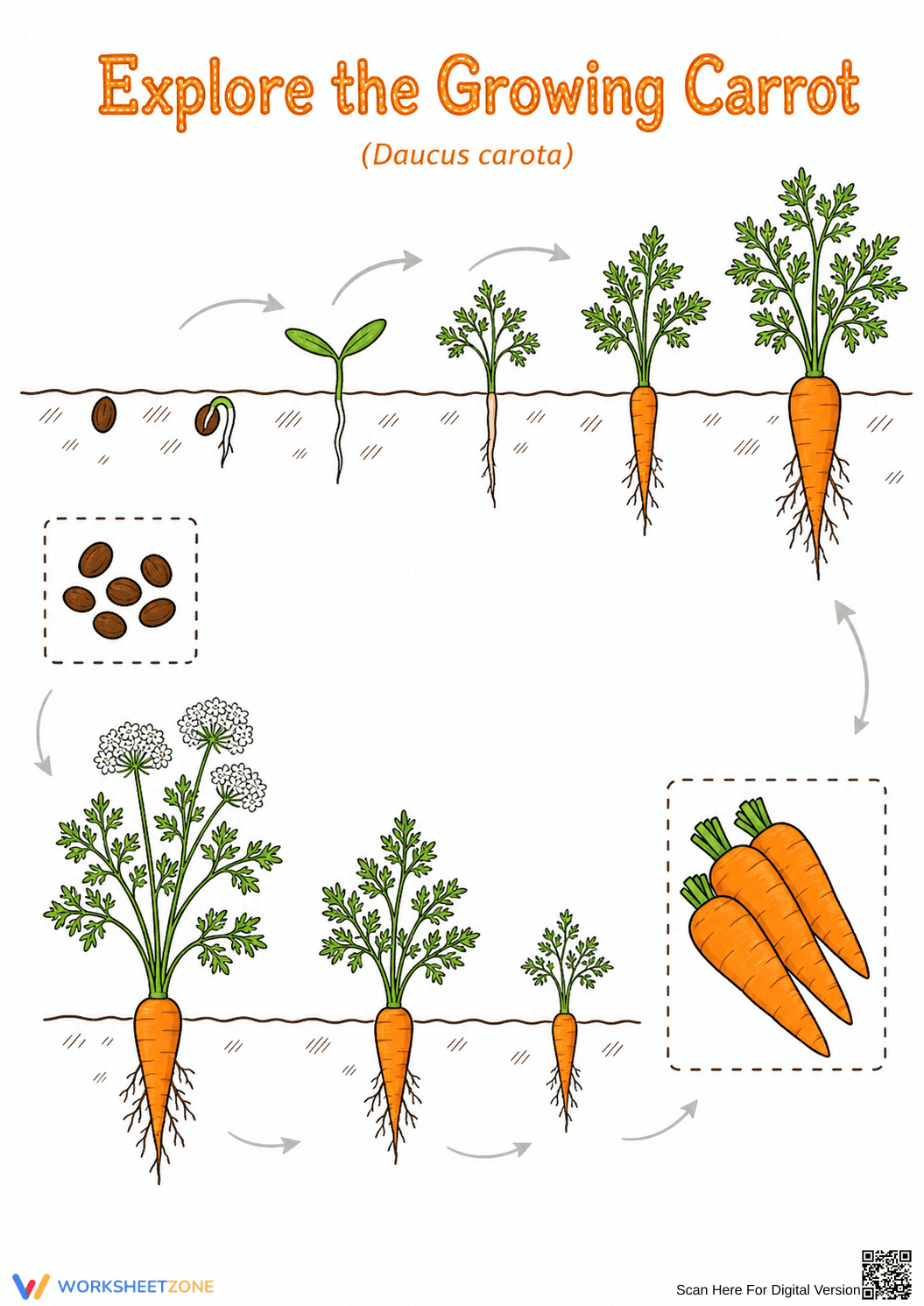
This Grade 3 science worksheet provides a clear, visual model of the carrot life cycle to help students understand how plants grow, reproduce, and die. By examining the detailed diagram from seed to mature flowering plant, young learners build foundational biology skills and grasp the continuous nature of plant development.
At a Glance
- Grade: 3 · Subject: Science
- Standard:
3-LS1-1— Develop models describing diverse organism life cycles- Skill Focus: Plant Life Cycles
- Format: 1 page · 1 visual diagram · No answer key needed · PDF
- Best For: Visual reference and science centers
- Time: 10–15 minutes
This single-page resource features a full-color diagram of a carrot plant's life cycle. The visual traces the journey of Daucus carota from tiny seeds, through the seedling phases, into a mature taproot, and finally producing flowers that drop new seeds. Directional arrows guide students through the continuous biological loop, making botanical concepts accessible.
Zero-Prep Workflow
This diagram requires no teacher preparation, making it an ideal grab-and-go resource.
- Print (1 minute): Simply print the PDF in color or grayscale. The high-contrast illustrations ensure clarity in any format.
- Distribute (1 minute): Hand out the diagram to students as a reference sheet or paste it into interactive science notebooks.
- Review (3 minutes): Walk through the arrows as a class, pointing out how the mature carrot eventually flowers to restart the cycle.
With under two minutes of total prep time, this visual aid is perfect for emergency sub plans or quick lesson supplements.
Standards Alignment
This resource is aligned to the Next Generation Science Standards, specifically 3-LS1-1: Develop models to describe that organisms have unique and diverse life cycles but all have in common birth, growth, reproduction, and death. By tracing the carrot's growth stages, students directly observe these commonalities in a specific plant species. Both standard codes can be copied directly into lesson plans, IEP goals, or district curriculum mapping tools.
How to Use It
Use this diagram during direct instruction to introduce plant life cycles. It serves as an excellent anchor chart or a reference page inside a science journal. As a formative assessment observation tip, ask students to point to the stage where the plant is harvested for food versus where it reproduces. This resource takes 10 to 15 minutes to review.
Who It's For
Designed primarily for third-grade science students, this visual worksheet is easily adaptable for second or fourth graders. The text-light format provides excellent differentiation for English Language Learners and visual learners. It pairs perfectly with a hands-on seed planting activity or a direct instruction lesson on how vegetables grow.
Integrating clear visual models into elementary science instruction significantly improves student comprehension of continuous biological processes. According to the RAND AIRS 2024 report on science literacy, students who utilize explicit diagrams to map out sequences demonstrate a much higher retention rate of core botanical concepts compared to text-only instruction. This resource directly supports standard 3-LS1-1 by helping students develop models describing diverse organism life cycles. By tracing the specific growth stages of a carrot from seed to flower, learners can anchor abstract ideas about birth, growth, reproduction, and death to a concrete, familiar example. Providing high-quality visual aids reduces cognitive load, allowing young learners to focus entirely on the scientific relationships being presented rather than struggling to decode complex text descriptions of the same phenomena. This approach ensures equitable access to rigorous science content.


