




























Views
Downloads

Carrot Life Cycle Worksheet | Essential Grade 3 Science

Paste this activity's link or code into your existing LMS (Google Classroom, Canvas, Teams, Schoology, Moodle, etc.).
Students can open and work on the activity right away, with no student login required.
You'll still be able to track student progress and results from your teacher account.
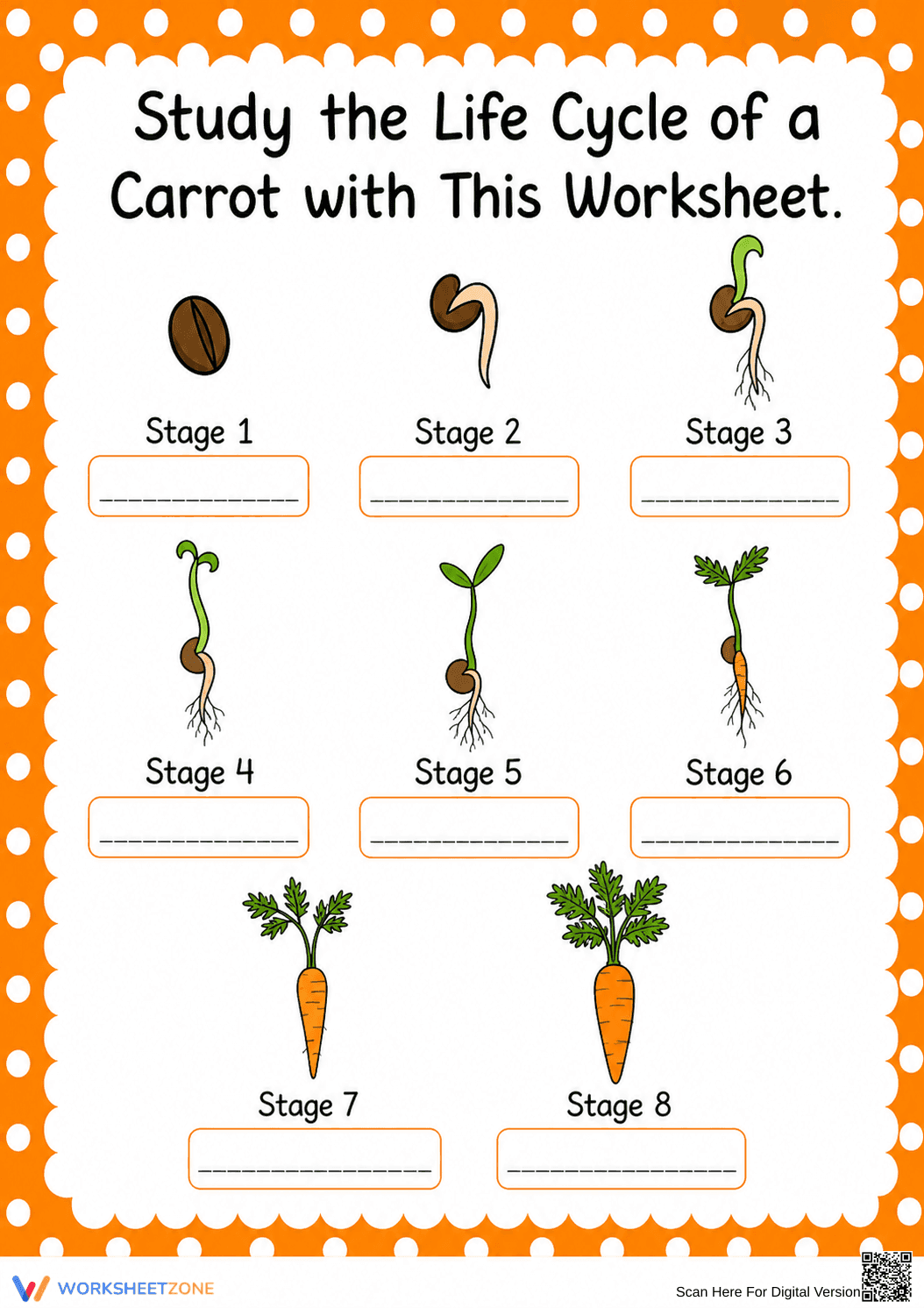
This Grade 3 carrot life cycle worksheet provides a structured visual model for students to identify and sequence the biological development of a root vegetable. By labeling 8 distinct stages, learners develop a concrete understanding of plant growth patterns and the specific anatomical changes that occur from germination to harvest.
At a Glance
- Grade: 3 · Subject: Science
- Standard:
3-LS1-1— Develop models to describe that organisms have unique and diverse life cycles- Skill Focus: Plant growth sequencing
- Format: 1 page · 8 problems · Answer key included · PDF
- Best For: Independent practice or formative assessment
- Time: 15–20 minutes
What's Inside
This single-page PDF features high-quality illustrations of a carrot's progression through eight critical phases. The sequence begins with the dormant seed and moves through the sprout, seedling, and rooting phases before concluding with the fully formed mature vegetable. Each stage includes a dedicated labeling box, encouraging students to use scientific vocabulary to describe the physical transformations they observe in the diagrams.
Zero-Prep Workflow
- Print: Select the single-page PDF and print enough copies for your class in under 2 minutes.
- Distribute: Hand out the worksheets as a transition activity following a lesson on botany or seed germination.
- Review: Use the included answer key to conduct a 5-minute whole-group check, allowing students to self-correct their sequencing of the 8 stages.
Standards Alignment
This resource is specifically designed to meet `3-LS1-1`: "Develop models to describe that organisms have unique and diverse life cycles but all have in common birth, growth, reproduction, and death." By focusing on the carrot, students see a specific example of a biennial plant's growth. Both standard codes can be copied directly into lesson plans, IEP goals, or district curriculum mapping tools.
How to Use It
Use this worksheet as a formative assessment after a direct instruction lesson on plant parts. Observe if students can distinguish between the "seedling" and "young carrot" stages to gauge their attention to detail. It also serves as an excellent quiet-work option for science centers or as a supplemental activity for students who finish their primary lab work early. Expected completion time is approximately 15 minutes.
Who It's For
This resource is ideal for third-grade general education classrooms, special education settings requiring visual supports, and homeschool environments. It pairs naturally with a hands-on seed-planting project or a classroom anchor chart detailing the needs of living things.
According to the NGSS framework and research by Fisher & Frey (2014) on the gradual release of responsibility, visual models like this carrot life cycle worksheet are essential for scaffolding complex biological concepts. By providing a clear 8-stage progression, the resource allows students to internalize the 3-LS1-1 standard through active labeling and observation. Research from the NAEP suggests that students who engage with visual representations of life cycles demonstrate higher retention of botanical vocabulary compared to those using text-only descriptions. This worksheet bridges the gap between abstract biological theory and observable reality, making it a reliable tool for elementary science instruction. The structured format ensures that learners focus on the commonalities of growth and development shared by all organisms, providing a foundational understanding of life science that supports future academic success in middle school biology.


