


























Views
Downloads

Carrot Life Cycle Worksheet | Grade 3 Essential
Paste this activity's link or code into your existing LMS (Google Classroom, Canvas, Teams, Schoology, Moodle, etc.).
Students can open and work on the activity right away, with no student login required.
You'll still be able to track student progress and results from your teacher account.
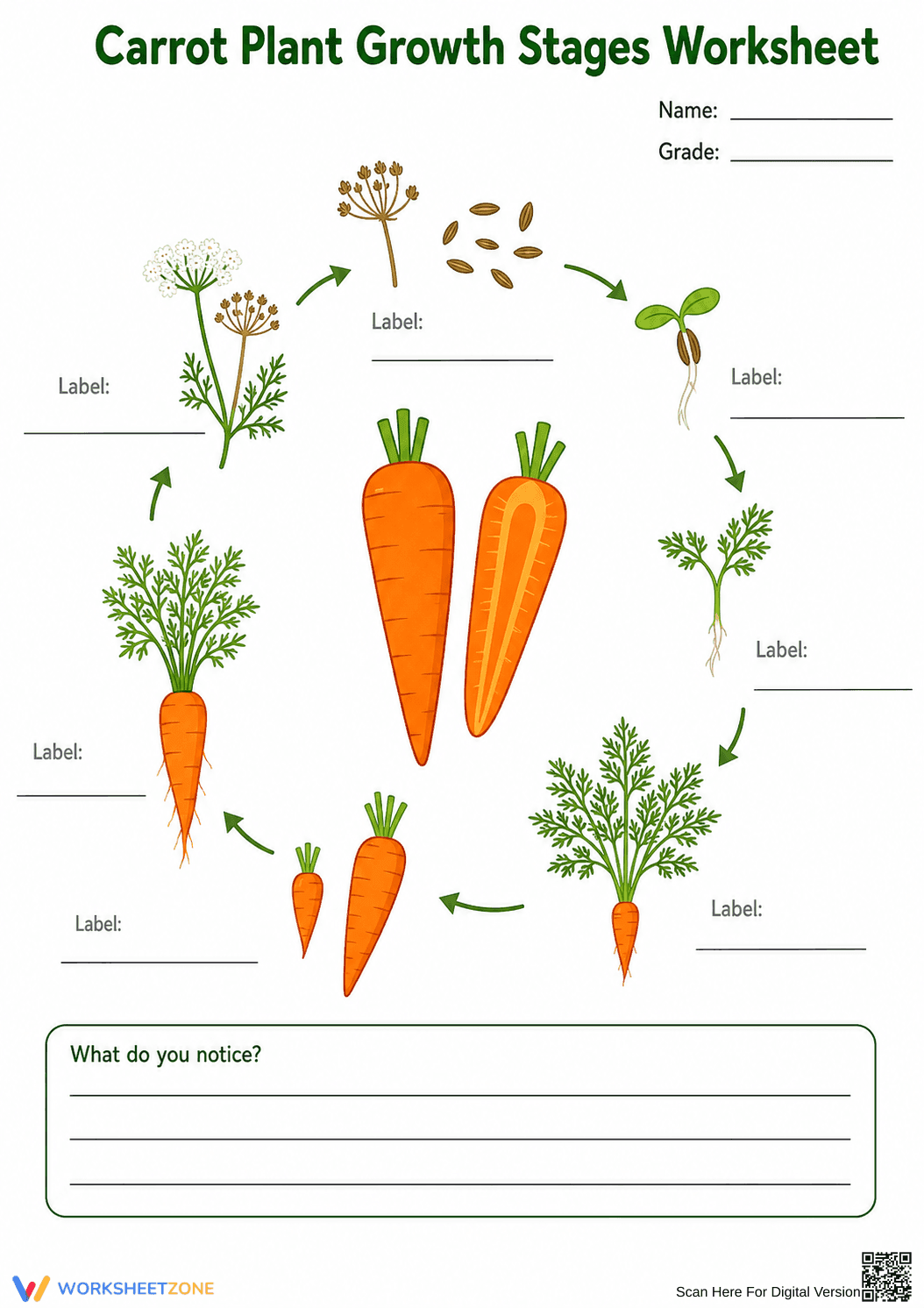
This Grade 3 carrot life cycle worksheet helps students identify and sequence the biological stages of root vegetable development. By labeling the progression from seed to flowering plant, learners build a concrete mental model of plant reproduction and growth. It transforms abstract biology into a clear, visual sequence for young scientists.
At a Glance
- Grade: 3 · Subject: Science
- Standard:
3-LS1-1— Develop models to describe unique and diverse organism life cycles- Skill Focus: Plant Growth Sequencing
- Format: 1 page · 8 problems · Answer key included · PDF
- Best For: Independent practice or science centers
- Time: 15–20 minutes
This single-page PDF features a high-quality circular diagram of the carrot's life stages. It includes 7 specific labeling lines for stages like germination, seedling, and mature root, alongside a dedicated "What do you notice?" reflection area. The visual layout uses clear arrows to indicate chronological flow, supported by a full answer key for quick grading.
The zero-prep workflow for this resource is designed for maximum efficiency. Teachers can print the master copy in under 30 seconds. Distribution takes less than 1 minute during a transition period. Finally, the structured labeling format allows for a 5-minute whole-class review or peer-check session. This makes it an ideal resource for unexpected sub plans or morning work.
This resource is primary aligned to `3-LS1-1`: "Develop models to describe that organisms have unique and diverse life cycles but all have in common birth, growth, reproduction, and death." It also supports 2-LS2-1 by illustrating the physical requirements for plant development. Both standard codes can be copied directly into lesson plans, IEP goals, or district curriculum mapping tools.
Use this worksheet during the "Explain" phase of a 5E lesson model to solidify vocabulary after a hands-on planting activity. As a formative assessment, observe if students can correctly sequence the flowering stage after the root maturation. It typically takes students 15 to 20 minutes to complete the labeling and the written observation.
This resource is tailored for elementary students in grades 2 through 5, with specific scaffolding for English Language Learners through its heavy visual support. It pairs naturally with a classroom seed-starting kit or a non-fiction text about gardening. The open-ended prompt at the bottom allows for natural differentiation for advanced writers.
According to Fisher & Frey (2014), the use of visual graphic organizers and labeling tasks is a foundational component of the gradual release of responsibility, particularly in content-area literacy like science. This worksheet leverages that research by providing a structured model for students to internalize the 3-LS1-1 standard. By requiring students to move from simple identification to synthesis via the observation prompt, the resource ensures that the 8 tasks move beyond rote memorization into conceptual understanding. Research from the NAEP indicates that students who engage with visual models of biological processes show higher retention rates of technical vocabulary. This carrot life cycle resource provides the necessary scaffolding to bridge the gap between observing nature and documenting scientific facts, making it a reliable tool for any standards-based elementary science curriculum.


