




























Views
Downloads

Carrot Life Cycle Worksheet | Printable Grade 3 Science

Paste this activity's link or code into your existing LMS (Google Classroom, Canvas, Teams, Schoology, Moodle, etc.).
Students can open and work on the activity right away, with no student login required.
You'll still be able to track student progress and results from your teacher account.
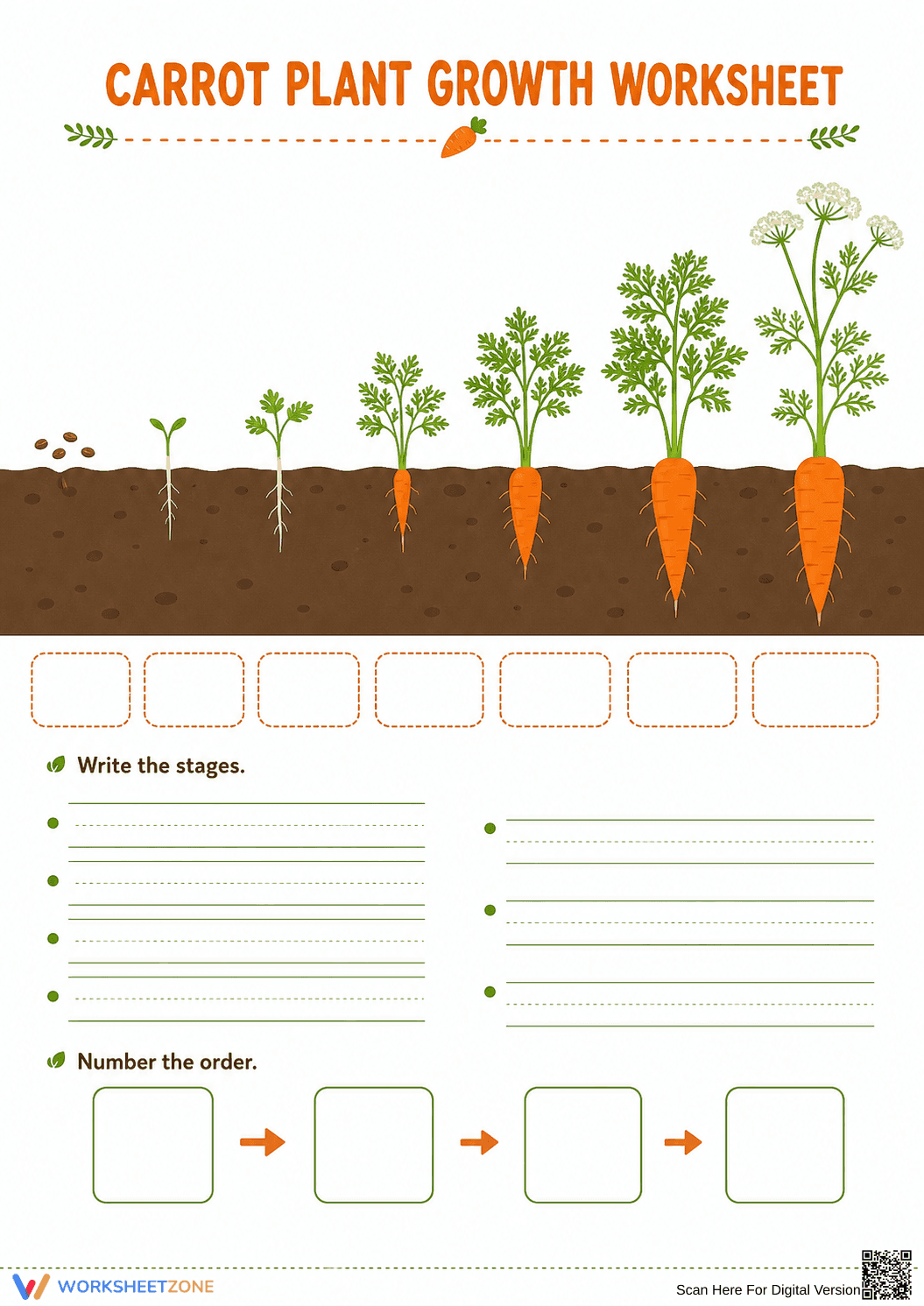
This printable carrot life cycle worksheet helps students visualize and sequence the stages of plant growth. By labeling diagrams and writing descriptive steps, learners actively process how a seed develops into a mature, flowering plant. This resource provides immediate, focused practice on biological life cycles.
At a Glance
- Grade: 3 · Subject: Science
- Standard:
3-LS1-1— Describe unique and diverse organism life cycles- Skill Focus: Sequencing plant growth stages
- Format: 1 page · 3 tasks · Answer key included · PDF
- Best For: Independent practice or review
- Time: 15–20 minutes
This single-page resource features a clear, six-stage illustration of a carrot plant developing from seed to maturity. It includes three distinct task types: empty boxes for labeling the visual diagram, lined sections for writing out the developmental stages in complete sentences, and a sequencing activity to number the correct order of growth. A complete answer key is provided for quick grading.
This resource is designed for immediate classroom implementation with zero teacher setup required.
- Print (1 minute): Simply download the PDF and print a class set. The high-contrast illustrations copy beautifully in black and white.
- Distribute (1 minute): Hand out the sheets alongside pencils. No scissors, glue, or extra materials are needed.
- Review (3 minutes): Use the included answer key to quickly check student responses or project it for self-correction.
With a total prep time of under two minutes, this worksheet makes an excellent emergency sub plan or quick transition activity.
This activity is directly aligned to 3-LS1-1: Develop models to describe that organisms have unique and diverse life cycles but all have in common birth, growth, reproduction, and death. By mapping the carrot's progression from seed to flowering plant, students create a descriptive model of a specific plant's life cycle. Both standard codes can be copied directly into lesson plans, IEP goals, or district curriculum mapping tools.
Deploy this worksheet immediately after direct instruction on plant life cycles to reinforce new vocabulary. Alternatively, use it as a morning work assignment to activate prior knowledge before a school garden visit. As students complete the writing portion, circulate and observe whether they correctly identify the transition from root growth to flowering—a key formative assessment checkpoint. Most students will complete the activities within 15 to 20 minutes.
This activity is ideal for third-grade science students mastering basic botany concepts. The clear visual scaffolds make it highly accessible for English Language Learners and students requiring visual supports for sequencing tasks. Pair this worksheet with a hands-on seed planting activity or a time-lapse video of root vegetable growth to maximize engagement and comprehension.
Understanding biological progressions is a fundamental component of elementary science education. When students describe unique and diverse organism life cycles, as outlined in standard 3-LS1-1, they build essential foundational knowledge for advanced biological studies. According to EdReports 2024, instructional materials that combine visual models with written explanations significantly improve student retention of complex scientific processes. This worksheet facilitates that dual-modality learning by requiring students to both label a visual diagram and articulate the stages in writing. By explicitly connecting the visual representation of the carrot's underground growth to the above-ground changes, learners develop a more comprehensive understanding of plant biology. Engaging with these structured sequencing tasks ensures that students can accurately track and explain the continuous cycle of birth, growth, reproduction, and death in living organisms.


