


























Views
Downloads

Carrot Life Cycle Printable Worksheet | Grade 3 Science
Paste this activity's link or code into your existing LMS (Google Classroom, Canvas, Teams, Schoology, Moodle, etc.).
Students can open and work on the activity right away, with no student login required.
You'll still be able to track student progress and results from your teacher account.
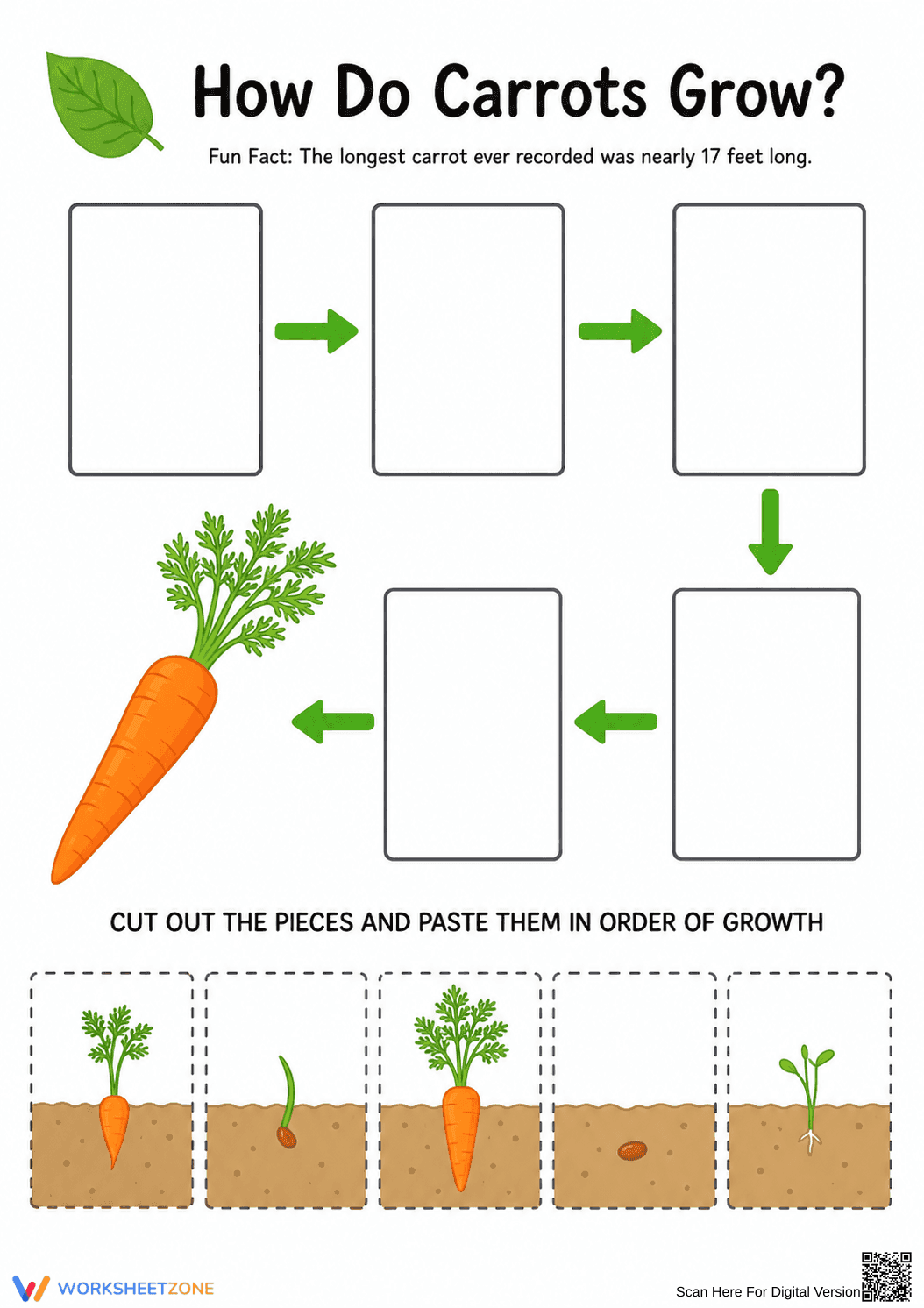
This carrot life cycle worksheet helps students visualize and sequence the biological stages of plant growth. By organizing visual data into a chronological flow chart, learners develop a concrete understanding of how seeds transform into mature vegetables. It provides a hands-on approach to biological science that reinforces observation and logical reasoning skills.
At a Glance
- Grade: 3 · Subject: Science
- Standard:
3-LS1-1— Describe the unique and diverse life cycles of organisms using models- Skill Focus: Carrot life cycle sequencing
- Format: 1 page · 5 problems · Answer key included · PDF
- Best For: Independent science centers or sub plans
- Time: 15–20 minutes
What's Inside
The worksheet features a clean, five-box flow chart with directional arrows to guide student progress. It includes five high-quality cut-out illustrations representing the seed, germination, sprout, young plant, and harvest-ready carrot. A fun fact about record-breaking carrot lengths is included at the top to engage student interest and provide a real-world connection to the biological topic.
Zero-Prep Workflow
This resource is designed for immediate classroom implementation with a total teacher prep time of under 2 minutes. Follow these three steps:
- Print (30 seconds): Select the single-page PDF and print enough copies for your entire class.
- Distribute (1 minute): Hand out the sheets along with scissors and glue sticks; no additional background reading is required.
- Review (30 seconds): Use the included answer key to check student work or display it for quick self-correction.
This streamlined process makes it an ideal choice for emergency sub plans or last-minute science block additions.
Standards Alignment
This resource is aligned with `3-LS1-1`, which requires students to develop models to describe that organisms have unique and diverse life cycles but all have in common birth, growth, reproduction, and death. It also supports 2-LS2-1 by illustrating the basic needs and growth patterns of plants. Both standard codes can be copied directly into lesson plans, IEP goals, or district curriculum mapping tools.
How to Use It
Use this activity as a formative assessment after a lesson on plant biology to check for understanding of growth stages. It also works well as a quiet-time activity during science rotations. Teachers should observe if students can distinguish between the sprout and the young plant, as this indicates a higher level of visual discrimination. Expected completion time is 15 to 20 minutes.
Who It's For
This worksheet is designed for elementary students in grades 2 through 5 who are exploring life sciences. It is particularly effective for visual learners and students who benefit from tactile, kinesthetic activities. Pair this with a real-life carrot dissection or a seed-planting experiment to create a comprehensive unit on botany and agricultural science.
According to the RAND AIRS 2024 report on elementary science instruction, hands-on sequencing activities significantly improve the retention of biological concepts compared to passive reading. This worksheet utilizes the 3-LS1-1 standard to provide a structured model of the carrot life cycle, allowing students to manipulate visual data to demonstrate mastery. By engaging in the physical act of cutting and pasting, students build stronger neural pathways associated with chronological order. Research from Fisher & Frey (2014) suggests that such scaffolded, visual tasks are essential for developing scientific literacy. This resource ensures that students can accurately identify the transition from seed to mature organism, a fundamental requirement for meeting national science frameworks. The inclusion of specific task counts and clear visual cues makes it a reliable tool for both general education and specialized instructional settings.


