


























Views
Downloads
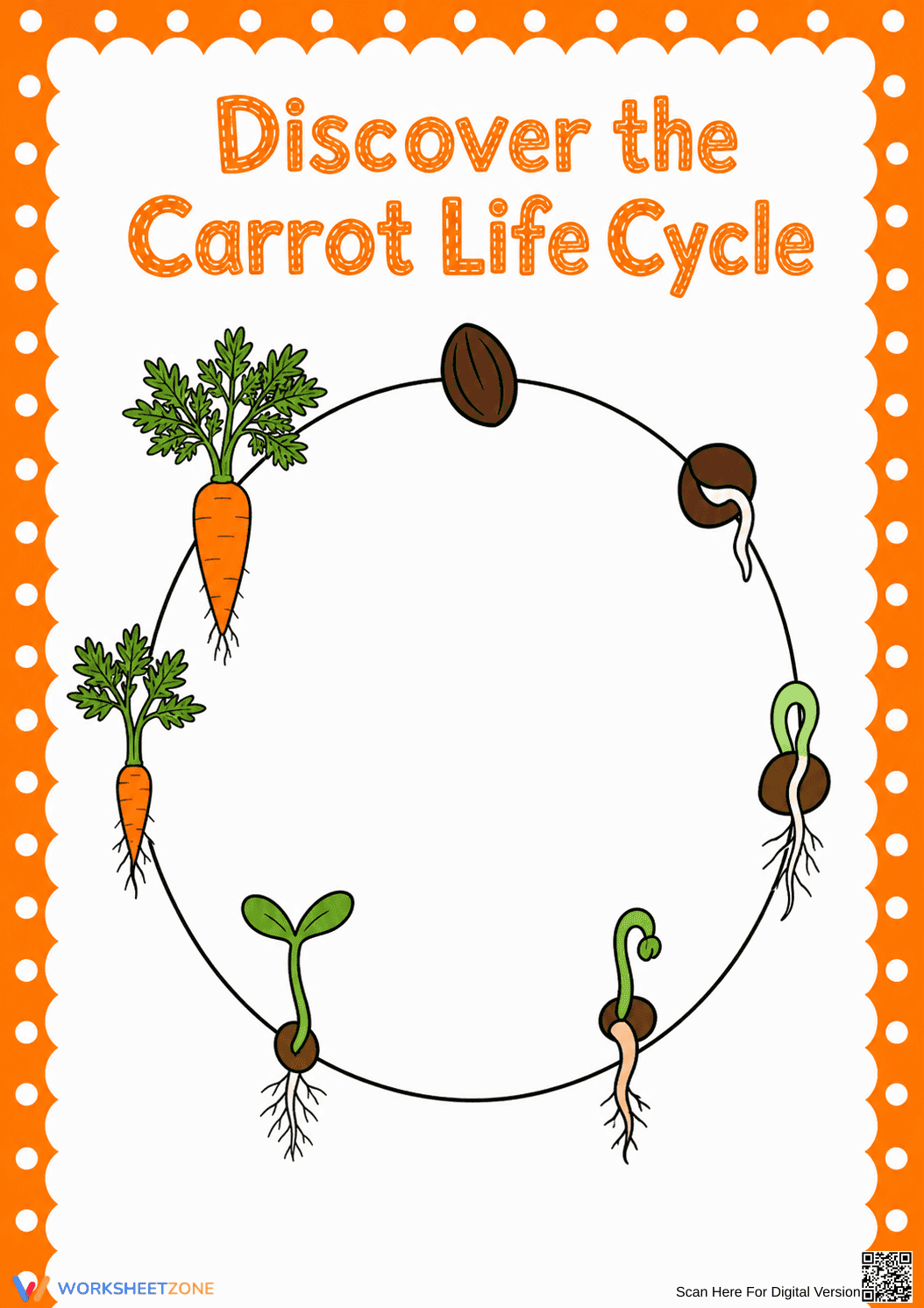

Printable Carrot Life Cycle Worksheet | Grade 3 Science
Paste this activity's link or code into your existing LMS (Google Classroom, Canvas, Teams, Schoology, Moodle, etc.).
Students can open and work on the activity right away, with no student login required.
You'll still be able to track student progress and results from your teacher account.
This Grade 3 science worksheet provides a clear, visual representation of the carrot life cycle to help students understand plant growth and development. By examining the circular diagram, learners will sequence the stages from seed to mature plant, building foundational knowledge of biological processes and life cycles.
At a Glance
- Grade: 3 · Subject: Science
- Standard:
3-LS1-1— Describe that organisms have unique and diverse life cycles- Skill Focus: Sequencing plant life cycle stages
- Format: 1 page · 1 visual diagram · No answer key · PDF
- Best For: Visual reference and discussion
- Time: 10–15 minutes
Inside this single-page PDF, educators will find a vibrant, circular diagram illustrating the six key stages of a carrot's development. The visual begins with a simple seed and progresses through sprouting, root formation, leaf development, and finally, a fully mature carrot ready for harvest. Because the diagram features illustrations without text labels, it serves as a versatile tool for direct instruction, student labeling exercises, or as a reference poster for science notebooks.
This resource is designed for immediate classroom implementation with a zero-prep workflow.
- Print (1 minute): Download the PDF and print a class set or project it on the smartboard.
- Distribute (1 minute): Hand out the diagrams as students transition into their science block.
- Review (10 minutes): Guide the class through each stage, prompting students to describe observed changes.
Total teacher preparation takes under two minutes, making this an excellent addition to emergency sub plans.
This diagram is aligned to the Next Generation Science Standards, specifically focusing on 3-LS1-1: Develop models to describe that organisms have unique and diverse life cycles but all have in common birth, growth, reproduction, and death. By tracing the carrot's growth from seed to mature plant, students interact directly with a model of a biological life cycle. Both standard codes can be copied directly into lesson plans, IEP goals, or district curriculum mapping tools.
Educators can utilize this diagram during direct instruction by projecting it onto a whiteboard and having students collaboratively label each stage. Alternatively, it works perfectly as a formative assessment tool after a lesson on plant biology; teachers can ask students to point to specific stages, such as germination or maturation, and explain what the plant needs to survive at that point. The expected completion time for a guided labeling and discussion activity ranges from 10 to 15 minutes.
This resource is ideal for third-grade science students, though its highly visual nature makes it easily adaptable for younger learners or English Language Learners who benefit from picture-based vocabulary building. The clear, cartoon-style illustrations provide excellent differentiation for students who struggle with text-heavy science materials. It pairs naturally with hands-on gardening activities, seed-planting labs, or anchor charts detailing the parts of a plant.
Understanding biological progressions through visual models is a critical component of early science education. This resource supports 3-LS1-1 by helping students describe that organisms have unique and diverse life cycles. According to a ScienceDirect TpT Analysis, incorporating clear, sequential diagrams significantly improves student retention of complex biological processes compared to text-only instruction. Visual aids like this circular life cycle chart reduce cognitive load, allowing young learners to focus entirely on the sequence of growth rather than decoding complex scientific terminology. By providing a structured, visual pathway from seed to mature plant, educators can foster a deeper, more intuitive grasp of botany. This approach meets rigorous academic standards and encourages active participation in the elementary science classroom.


